

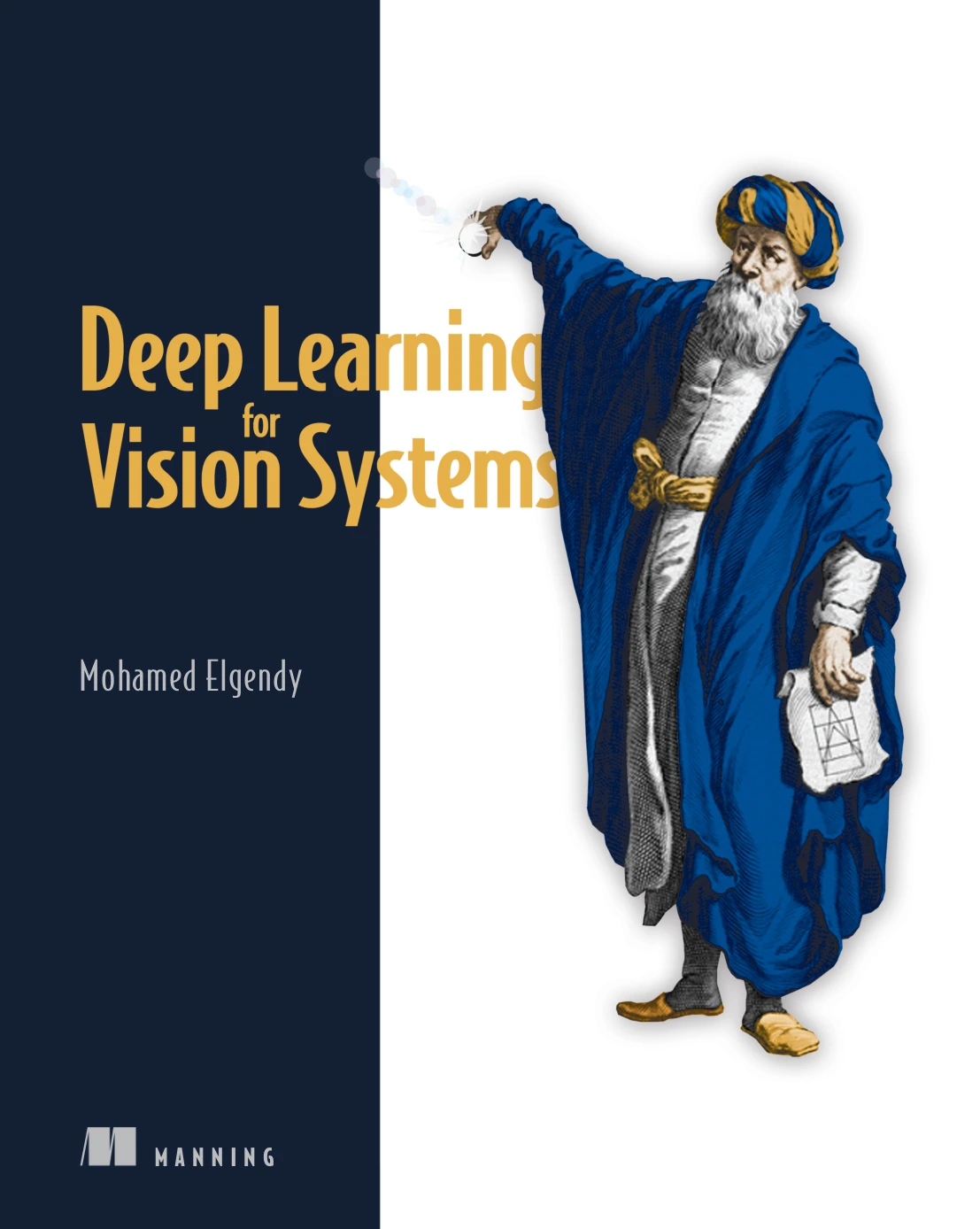
Deep Learning for Vision Systems
Original price was: $35.74.$17.87Current price is: $17.87.

Mohamed Elgendy
Product Specs:
- File Type: PDF
- File Size: 17.9 MB
- Book Language: English
- Total Page Count: 480
- Instant Download
Images may look effortless to us; teaching a computer to interpret them takes a carefully built pipeline. In Deep Learning for Vision Systems, Mohamed Elgendy follows that pipeline from image input and feature extraction to neural networks that classify images and detect objects. The result is a concept-led, implementation-oriented introduction to deep learning for computer vision.
The book starts with the groundwork—how images are represented and prepared, how neural networks learn, and how model performance is evaluated—before turning to the architectures and applications that put those ideas to work. Its contents include guided projects, giving readers a way to connect the explanations with practical model-building.
Start with the foundations, then build up
Early chapters introduce the computer-vision pipeline, perceptrons and multilayer networks, activation and error functions, optimization, and backpropagation. From there, Elgendy develops the principles of convolutional neural networks, including convolution and pooling, fully connected layers, and dropout. The progression helps readers see how each part contributes to a model’s ability to learn from images.
Explore the CNN architectures behind image recognition
Dedicated coverage of LeNet-5, AlexNet, VGGNet, GoogLeNet and ResNet gives readers a guided look at influential CNN designs. The book also addresses the decisions around training and evaluation: preparing datasets, choosing metrics, diagnosing overfitting or underfitting, tuning hyperparameters, and applying techniques such as data augmentation and batch normalization.
Put pretrained models and detection methods to work
Later sections turn to transfer learning, explaining approaches such as using a pretrained network as a classifier or feature extractor, and fine-tuning it for a target task. The contents also cover object detection frameworks including R-CNN, SSD and YOLO. Along the way, projects and Keras implementations connect the material to hands-on development.
For readers ready to work with vision models
Manning describes the intended audience as intermediate Python programmers. Readers interested in image classification, transfer learning, CNN design or object detection will find a structured path from core concepts to practical computer-vision applications.
If you want to understand both the moving parts of a vision system and how deep-learning models are assembled, this ebook offers a focused route through the subject.
User Reviews
Be the first to review “Deep Learning for Vision Systems”
You must be logged in to post a review.
Deep Learning for Vision Systems
Sold by Mohamed Elgendy Original price was: $35.74.$17.87Current price is: $17.87.






There are no reviews yet.