

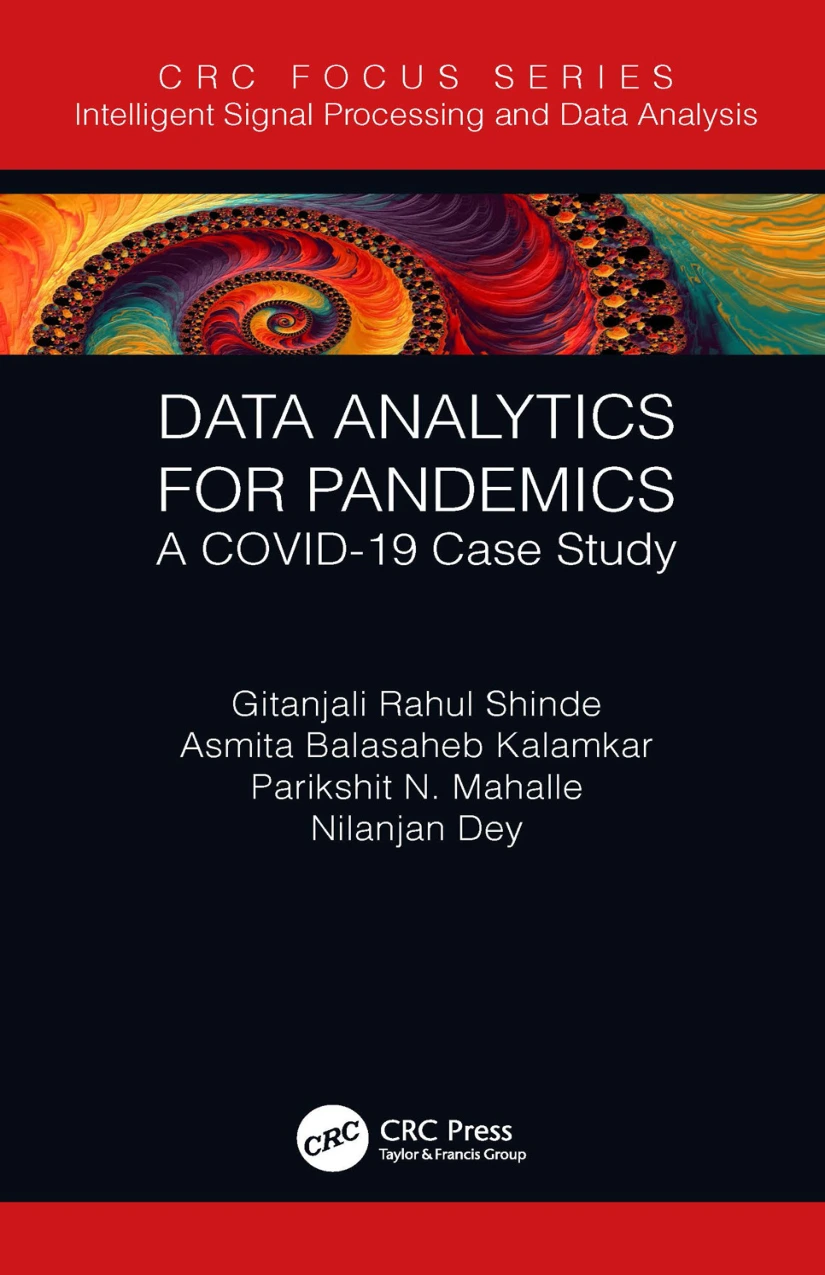
Data Analytics for Pandemics: A COVID-19 Case Study
Original price was: $23.99.$11.99Current price is: $11.99.

Gitanjali Rahul Shinde
Product Specs:
- File Type: PDF
- File Size: 3.3 MB
- Book Language: English
- Total Page Count: 85
- Instant Download
What can data reveal about the spread of a pandemic—and what must happen before those data can be trusted? Data Analytics for Pandemics: A COVID-19 Case Study connects the realities of a public-health crisis with the analytical work behind tracking trends, preparing information, and developing predictions.
Across four chapters, the authors move from the COVID-19 outbreak and pandemic concepts to data processing, big data methods, and mitigation strategies. The result is a focused introduction to pandemic analytics, with COVID-19 as its case study.
From outbreak context to data questions
The opening chapter introduces epidemics and pandemics, stages of disease, risk factors, mitigation, and situational awareness before turning to COVID-19 and disease transmission. This context helps frame the book’s central concern: analysis depends on understanding both the event being studied and the information available about it.
Preparing information for analysis
Data sources bring practical challenges. The book discusses storage platforms and services, data processing, missing-value imputation, noise treatment, and knowledge extraction. It also considers ways to work with text, image, audio, and video data—useful perspectives for readers thinking about the variety of information involved in a pandemic response.
Methods for finding patterns and making predictions
The analytics chapters cover data visualization, statistical parameters, predictive analytics, data modeling, and model performance. The authors also introduce techniques such as association-rule learning, classification trees, genetic algorithms, machine learning, regression analysis, and social-network analysis, alongside tools and technologies used in big data work.
Case studies, challenges, and mitigation
The final chapter considers COVID-19 spread in China, Italy, and the United States, then discusses mitigation strategies, challenges, recommendations, and future outlook. These sections place analytics within a wider public-health setting. Because the book was published in 2021, its pandemic-era recommendations are best understood in that historical context, rather than as current medical advice.
Who may find this book relevant?
Written for data analysts, epidemiologists, and researchers in related fields, this book will also interest readers who want a structured introduction to the data workflows and analytical techniques used to study COVID-19. It brings together disease context, data preparation, modeling, and response considerations in one concise case study.
User Reviews
Be the first to review “Data Analytics for Pandemics: A COVID-19 Case Study”
You must be logged in to post a review.
Original price was: $23.99.$11.99Current price is: $11.99.




There are no reviews yet.