

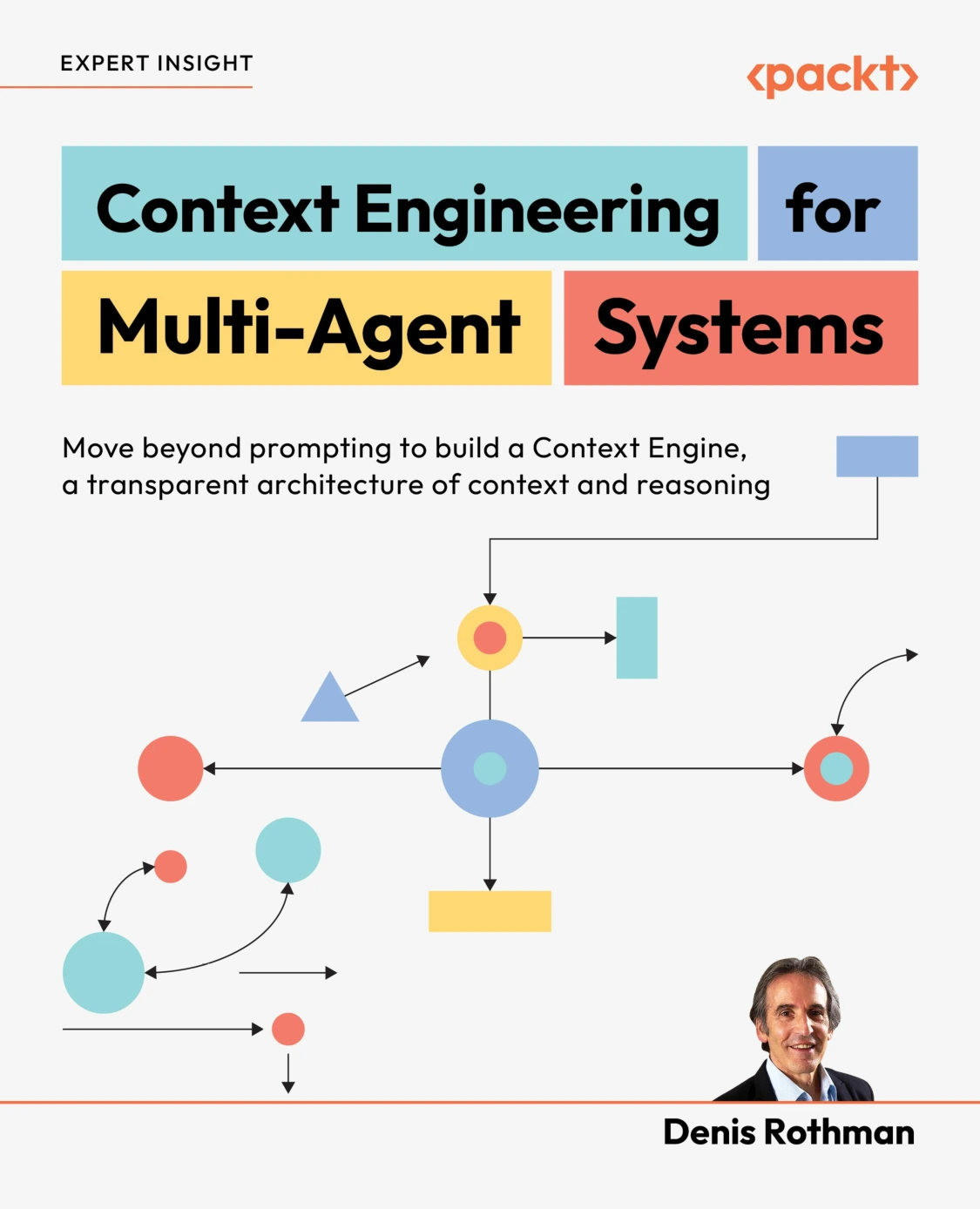
Context Engineering for Multi-Agent Systems: Move beyond prompting to build a Context Engine, a transparent architecture of context and reasoning
Original price was: $39.59.$19.80Current price is: $19.80.

Denis Rothman
Product Specs:
- File Type: PDF
- File Size: 15.7 MB
- Book Language: English
- Total Page Count: 396
- Instant Download
Reliable AI systems need more than a clever prompt. In Context Engineering for Multi-Agent Systems, Denis Rothman lays out a practical path from shaping the information given to a model to designing coordinated, context-aware agent systems. The emphasis is on making the architecture explicit: what information agents receive, how they work together, and how their execution can be examined.
Start with a blueprint, not a blank prompt
The book introduces context engineering through a progression from basic prompts to structured, goal-oriented context. Semantic role labeling provides a way to represent who does what, to whom, and under what conditions; Python examples show how those relationships can be organized and visualized. A meeting-analysis scenario then demonstrates how a complex task can be broken into a sequence of more focused steps.
Coordinate agents with purpose
Next, the focus shifts to multi-agent workflows and the Model Context Protocol (MCP). The examples build specialized agents and an orchestrator, then address message validation, error handling, and controls that help make the workflow more robust. The architectural perspective is useful for readers thinking beyond a single model call toward systems with distinct roles and responsibilities.
Separate useful context from factual knowledge
Retrieval-augmented generation (RAG) is explored as part of a context-aware system, including a dual-RAG approach that distinguishes procedural context from a factual knowledge base. The book proceeds from data preparation and ingestion to agent and orchestrator design, showing how these pieces contribute to the larger system.
Make the Context Engine inspectable
Later chapters assemble a Context Engine from specialist agents and supporting components, including a Context Librarian, planner, executor, and execution tracer. The focus on visible structure and traceable work offers a useful architectural lens for developers concerned with how an AI workflow operates—not just what it produces.
Who may find it useful?
This book is written for AI engineers, software developers, system architects, and data scientists interested in structured context and multi-agent applications. Readers with basic familiarity with large language models are best placed to follow its technical examples and architectural discussions.
For readers ready to move past ad hoc prompting, Rothman offers a hands-on route through semantic blueprints, MCP, RAG, and the design of a transparent multi-agent system.
User Reviews
Be the first to review “Context Engineering for Multi-Agent Systems: Move beyond prompting to build a Context Engine, a transparent architecture of context and reasoning”
You must be logged in to post a review.
RAG-Driven Generative AI, Second Edition | RAG-Driven Generative AI
Sold by Denis Rothman
Hands-On Explainable AI (XAI) with Python: Interpret, visualize, explain, and integrate reliable AI for fair, secure, and trustworthy AI apps
Sold by Denis Rothman Original price was: $39.59.$19.80Current price is: $19.80.
There are no reviews yet.