

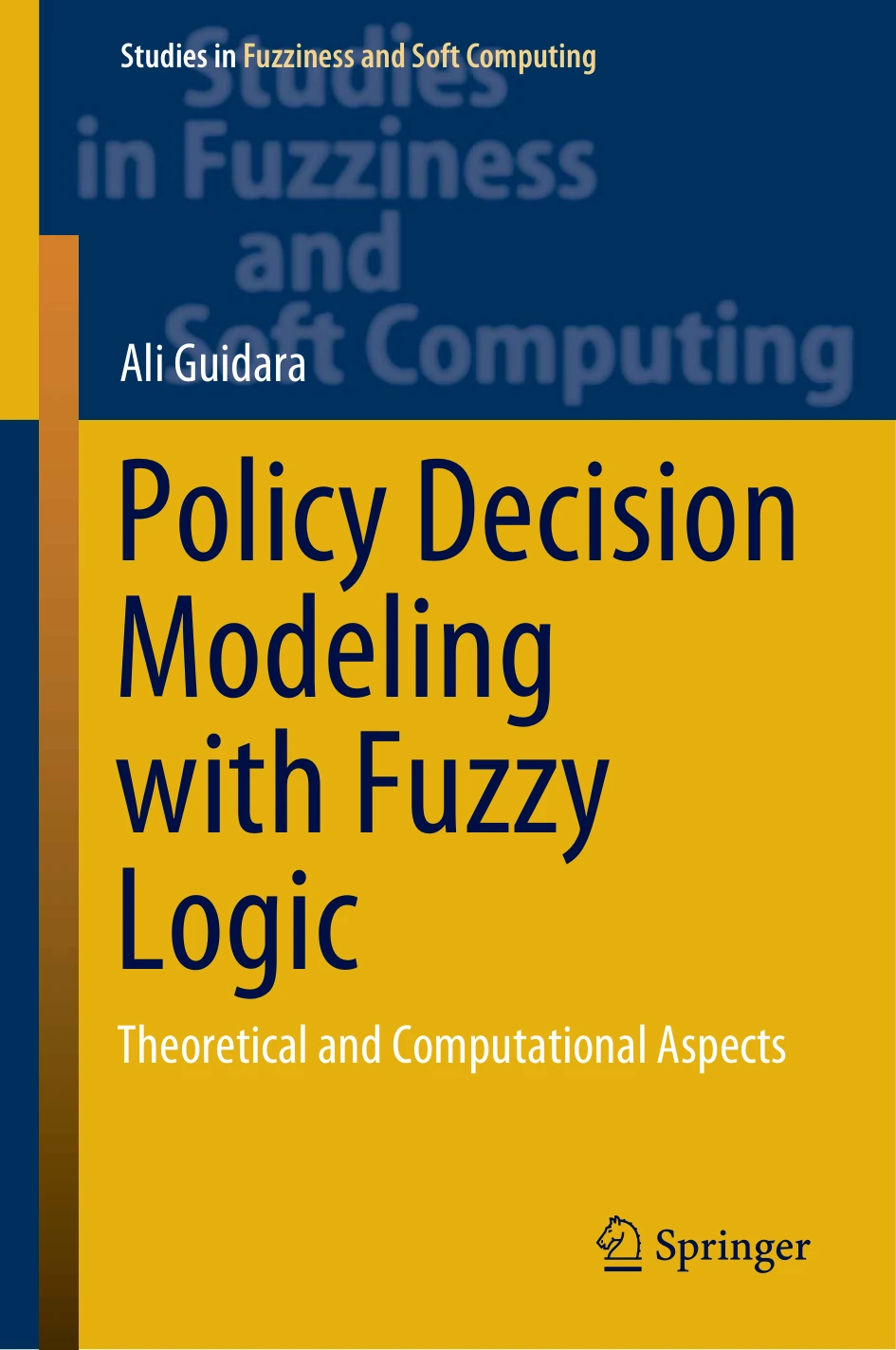
Policy Decision Modeling with Fuzzy Logic: Theoretical and Computational Aspects
Original price was: $5.00.$2.50Current price is: $2.50.

Ali Guidara
Product Specs:
- File Type: PDF
- File Size: 3.4 MB
- Book Language: English
- Total Page Count: 139
- Instant Download
A New Lens on Public Policy Decision-Making
Most analytical frameworks in public policy concentrate on the systemic level of decision-making: institutions, agendas, bargaining, and formal choice. Ali Guidara argues that this view leaves a crucial layer underexplored. Policy Decision Modeling with Fuzzy Logic turns attention to the sub-systemic environment where policy decisions actually emerge, treating that environment as a nonlinear complex system shaped by uncertainty, interaction, and human reasoning.
Published by Springer in 2021 as volume 405 of the Studies in Fuzziness and Soft Computing series, the book is both a theoretical argument and a practical modeling project. It asks how researchers can represent the messy, vague, and dynamic conditions that precede formal policy choices—and how those representations can be simulated.
Where Public Policy Meets Complexity and Fuzzy Logic
Guidara builds a bridge between several fields: policy decision analysis, complex systems, modeling and simulation, and artificial intelligence. The Stacey Matrix, adapted to public policy, helps frame complexity. Multiple streams theory provides a way to connect that complexity to the policy process. Together, these tools support a conceptual model of the sub-systemic decision environment.
Because the components of that model are described in vague and uncertain terms, the book turns to fuzzy logic. This choice is central to the project: fuzzy logic offers a computational language for variables that are not neatly true or false, but matters of degree. The result is a model designed to reflect human reasoning more closely than purely deterministic approaches can.
PODESIM: A Multi-Level Fuzzy Inference System
The computational core of the book is PODESIM, the policy decision emergence simulation model. It is presented as a multi-level fuzzy inference system that uses fuzzy data and decision heuristics to identify the sub-systemic levers of decision emergence. Rather than predicting a single inevitable outcome, PODESIM functions as an experimental diagnostic tool—a way to explore how interacting factors may shape the emergence of policy decisions.
Readers interested in computational social science will find here a detailed account of how theory, conceptual modeling, and simulation can be linked. The book does not simply propose fuzzy logic as a metaphor; it develops the approach into a working computational model.
The Cuban Missile Crisis as a Case Study
The book includes a case study of the Cuban Missile Crisis, using it to examine how the proposed framework can illuminate a high-stakes decision episode. This case anchors the theoretical and computational discussion in a specific historical context and shows how sub-systemic dynamics might be modeled in practice.
Who May Find This Book Useful
This monograph is likely to interest researchers and graduate students in public policy, political science, decision analysis, and computational social science. It will also appeal to readers working at the intersection of artificial intelligence, complex systems, and policy modeling—especially those who want to understand how fuzzy logic can be applied to real-world governance and decision problems. Policy Decision Modeling with Fuzzy Logic is a specialized, research-oriented work, best suited to readers who are comfortable with theoretical modeling and simulation concepts.
A Springer Monograph in the Studies in Fuzziness and Soft Computing Series
As part of Springer’s Studies in Fuzziness and Soft Computing series, the book contributes to a broader body of work on soft computing, fuzzy sets, and intelligent systems. Its focus on public policy decision emergence makes it a distinctive entry in that series, connecting formal computational methods with questions of governance, uncertainty, and choice.
User Reviews
Be the first to review “Policy Decision Modeling with Fuzzy Logic: Theoretical and Computational Aspects”
You must be logged in to post a review.
Original price was: $5.00.$2.50Current price is: $2.50.






There are no reviews yet.