

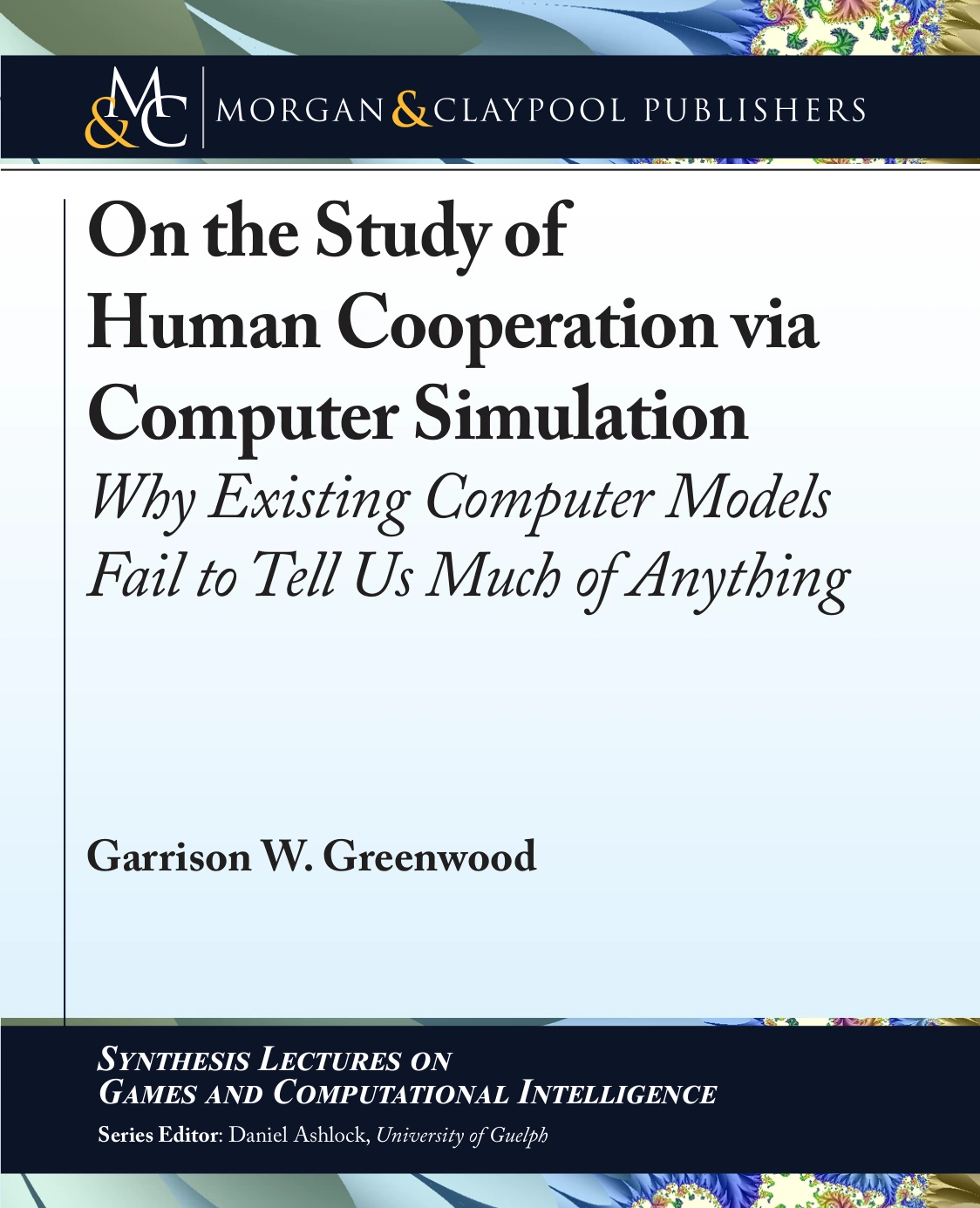
On the Study of Human Cooperation via Computer Simulation: Why Existing Computer Models Fail to Tell Us Much of Anything
Original price was: $5.00.$2.50Current price is: $2.50.

Wayne F. Wakeland
Product Specs:
- File Type: PDF
- File Size: 5.5 MB
- Book Language: English
- Total Page Count: 96
- Instant Download
Why Cooperation Is Still a Puzzle
Cooperation appears throughout nature, yet explaining why unrelated humans cooperate remains an open question. The answers matter: anything that promotes cooperation can lead to more productive workplaces and broader social benefits. This book approaches that puzzle through game theory and computer simulation, asking why decades of social dilemma research have produced so much modeling activity but comparatively little clarity.
Game theory gives researchers a precise way to study social dilemmas—situations in which people decide whether to cooperate for group benefit or defect for personal advantage. The prisoner’s dilemma is the most widely studied example. By programming these games into computer models, researchers can test theories about how cooperation emerges and what helps it persist. The book argues that many of those models contain artificial assumptions that do not match how humans actually behave, limiting what the simulations can tell us.
What the Book Covers
The opening chapters provide a basic introduction to game theory, with a focus on the prisoner’s dilemma and other social dilemma games. From there, the book turns to specific modeling traditions and their limitations. It examines spatial and network games, the case against weak selection, and the Moran process alongside replicator dynamics. Later chapters address the problems with computer models more directly and discuss model validation at length.
The result is not a general survey of cooperation research. It is a focused critique of common simulation practices and a set of recommendations for designing models that better reflect human decision-making.
A Critical Look at Familiar Modeling Tools
Weak selection, spatial games, and the Moran process are established tools in evolutionary and agent-based modeling. This book does not simply dismiss them. Instead, it explains where their assumptions diverge from realistic human behavior and why those divergences matter. For readers who use these methods, the critique offers a chance to reconsider default choices and to see how small modeling decisions can shape conclusions about cooperation.
Validation receives particular attention. A model that behaves plausibly is not necessarily a model that explains human cooperation. The book makes the case for asking better questions and for testing simulations against the phenomena they claim to illuminate.
Who This Book Is For
Researchers, graduate students, and practitioners in computational social science, game theory, agent-based modeling, and related fields will find the argument directly relevant. Economists and social scientists interested in social dilemmas will also recognize the central questions. The early game theory material makes the book accessible to readers who are new to the formal study of cooperation, while the later chapters assume a serious interest in simulation and model design.
Why the Argument Matters
If computer models are going to help explain human cooperation, they need to do more than reproduce elegant mathematical dynamics. They need to engage with the messy ways people actually make decisions. This book offers a concise, critical guide for anyone who wants social dilemma simulations to say something meaningful about cooperation—and a clear warning about the limits of models that do not.
User Reviews
Only logged in customers who have purchased this product may leave a review.
Original price was: $5.00.$2.50Current price is: $2.50.



There are no reviews yet.