

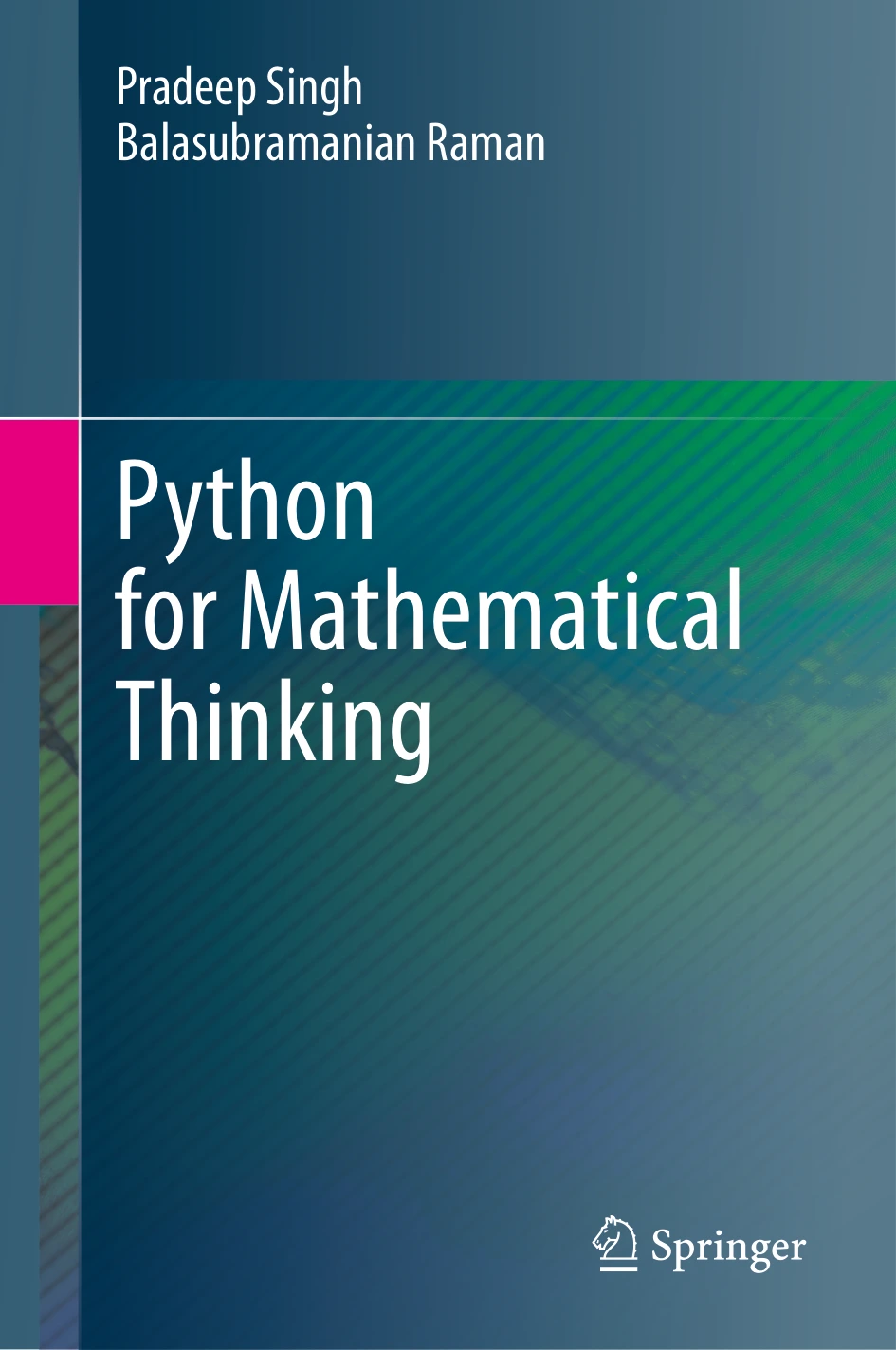
Python for Mathematical Thinking
Original price was: $5.00.$2.50Current price is: $2.50.

Pradeep Singh
Product Specs:
- File Type: PDF
- File Size: 14.4 MB
- Book Language: English
- Total Page Count: 504
- Instant Download
Where Proofs and Programs Meet
Some mathematical ideas become clearer when you can execute them. Python for Mathematical Thinking treats proofs and programs as complementary ways of exploring the same structures. Written by Pradeep Singh and Balasubramanian Raman, this Springer volume is built for readers who want to move between rigorous mathematics and working Python code without treating either side as an afterthought. 🧮
The book assumes undergraduate calculus and basic programming, then steadily deepens the conversation. Its aim is not to replace mathematical reasoning with code, but to show how computation can make abstract ideas tangible and how mathematical precision can make code more trustworthy.
From Foundational Structures to Contemporary Research
The material unfolds in layers. It begins with integers, rational fields, and Euclidean spaces before moving into vector calculus, spectral theory, and measure-theoretic probability. Later chapters explore numerical linear algebra, dynamical systems, stochastic simulation, compressed sensing, and quantum information. Each step is designed to connect classical mathematical ideas with the computational methods used to investigate them.
Mathematics First, Python Second—Then Both Together
Concepts are introduced as mathematically precise statements, motivated by examples from analysis, algebra, geometry, probability, and the theory of computation. Only then are they translated into idiomatic Python. Libraries such as NumPy, SymPy, and SciPy appear as natural extensions of the mathematics, not as shortcuts around it.
Computational complexity receives serious attention throughout. Big-O analyses accompany theorems, and efficient data structures are derived rather than quoted. That combination helps readers think about both correctness and performance—two concerns that rarely travel separately in real computational work.
What Readers Can Expect 🐍
- A bridge between chalkboard proofs and executable experiments.
- Mathematical statements paired with Python implementations and examples.
- Complexity analysis woven into the presentation of algorithms.
- Coverage that reaches from foundational structures to research-level topics.
- A tone that treats mathematics and computation as partners in inquiry.
Who This Book Is For
The preface describes the book as a companion from novice to researcher. Students can use it to connect formal proofs with hands-on experiments; mathematicians can use it as a platform for computational exploration; scientists, engineers, and economists can find principled algorithms whose correctness is tied to mathematical reasoning rather than folklore. A background in undergraduate calculus and basic programming will help readers get the most from the chapters.
Why Mathematical Thinking Still Matters 💡
Python is powerful, but fluency in a language is hollow without a rigorous grammar. This book keeps that grammar in view. It is less about arriving at an answer than about cultivating a habit of asking why a statement should hold—and then using computation to test, illustrate, and extend that understanding. For readers who want their code and their mathematics to sharpen each other, Python for Mathematical Thinking offers a substantial, carefully structured path.
Available as a digital edition from Digital Delights.
User Reviews
Be the first to review “Python for Mathematical Thinking”
You must be logged in to post a review.
Original price was: $5.00.$2.50Current price is: $2.50.
There are no reviews yet.