

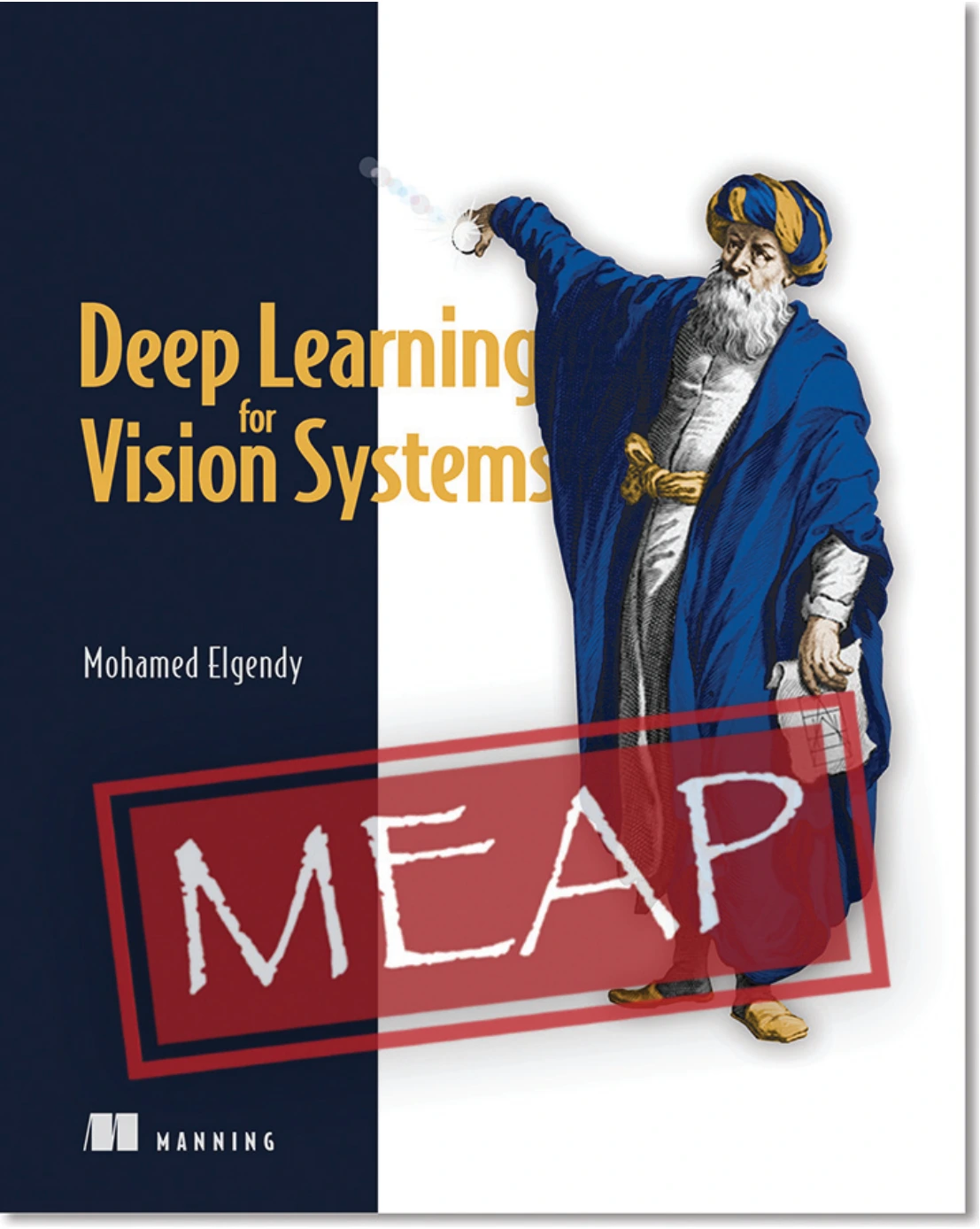
Deep Learning for Vision Systems
Original price was: $43.99.$22.00Current price is: $22.00.

Mohamed Elgendy
Product Specs:
- File Type: PDF
- File Size: 34.2 MB
- Book Language: English
- Total Page Count: 396
- Instant Download
Computer vision asks how a machine can interpret an image; deep learning supplies many of the tools that make that possible. Mohamed Elgendy’s Deep Learning for Vision Systems builds from foundational neural-network ideas toward practical vision tasks, connecting model design with the decisions involved in training and evaluating a system.
This file is the Version 6 manuscript from Manning’s Early Access Program. Its contents map out a progression from vision fundamentals to classification, detection, generative models, and AI ethics—useful context for readers who want to understand not just what these systems do, but how their underlying approaches fit together.
From pixels to learned features
The opening sections introduce computer vision concepts, neural networks, and convolutional neural networks. They explore how image features are represented and learned, and why convolutional approaches suit image classification better than a basic multilayer perceptron in many cases.
Training is more than choosing a model
Model performance depends on the work around the architecture, too. The manuscript covers data splits, evaluation metrics, error analysis, overfitting and underfitting, regularization, batch normalization, and hyperparameter tuning. These topics help frame model-building as a sequence of decisions rather than a single coding step.
Recognize objects and reuse what models know
Chapters on advanced CNN architectures and transfer learning examine ways to approach image-classification problems, including when a pretrained network may serve as a classifier or feature extractor. The object-detection section introduces R-CNN, SSD, and YOLO, bringing the discussion from classifying an image toward locating objects within it.
Generative models, style, and recognition
The contents extend beyond recognition into generative adversarial networks, style transfer, and face recognition. Together, these subjects show the range of computer-vision work addressed in the manuscript, from interpreting visual input to generating or transforming images.
For readers building a foundation
The book is aimed at readers learning deep learning through computer-vision applications. The published edition is described by its publisher as suited to intermediate Python programmers. Expect a technical introduction that moves from core concepts toward model evaluation and recognizable vision tasks, with the Version 6 MEAP status in mind when considering the manuscript’s scope.
For anyone curious about how neural networks learn to see, this is a structured route through the central ideas—and the practical questions—that shape computer-vision systems.
User Reviews
Be the first to review “Deep Learning for Vision Systems”
You must be logged in to post a review.
Deep Learning for Vision Systems
Sold by Mohamed Elgendy Original price was: $43.99.$22.00Current price is: $22.00.



There are no reviews yet.