

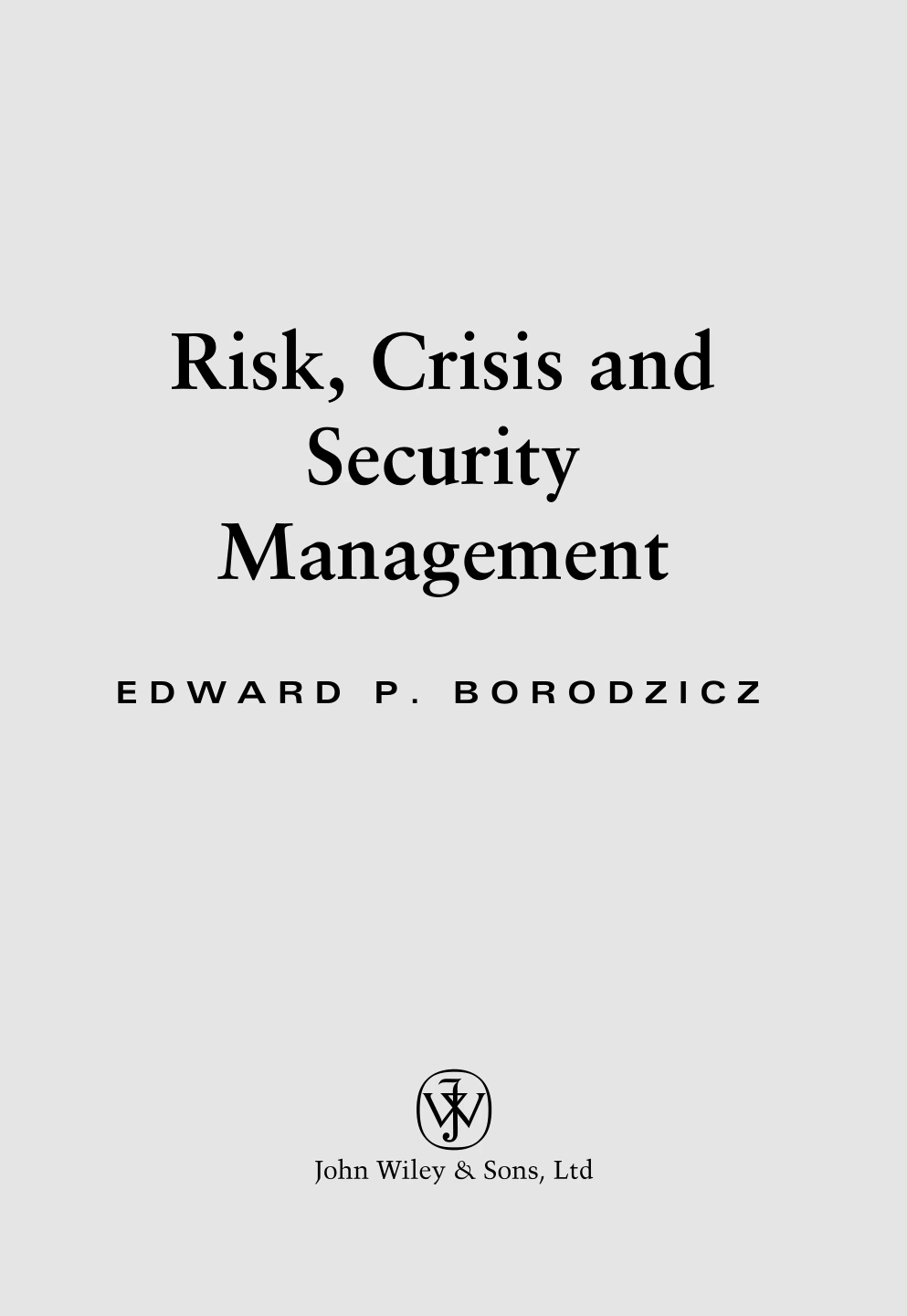
Risk, Crisis and Security Management
Original price was: $5.00.$2.50Current price is: $2.50.

Edward P. Borodzicz
Product Specs:
- File Type: PDF
- File Size: 5.2 MB
- Book Language: English
- Total Page Count: 258
- Instant Download
A Serious Look at Risk, Crisis, and Security
Few subjects test an organization more than a crisis that refuses to follow the script. Risk, Crisis and Security Management by Edward P. Borodzicz brings together three fields that are often treated separately: the analysis of risk, the management of crises, and the practice of security. Published by John Wiley & Sons, the book is built for readers who need more than a checklist; it asks how organizations actually interpret danger, why failures happen, and what it takes to prepare for events that may never be fully predictable.
Borodzicz writes for a world in which security is no longer a narrow technical concern and crisis planning cannot be left to a binder on a shelf. The result is a measured, interdisciplinary guide that connects theory with the messy realities of decision-making under pressure.
What the Book Explores
The book moves from conceptual foundations to operational practice. Early chapters examine the new totems that shape how risk is understood and the theories that explain organizational failure. From there, it turns to security as a corporate concern, the nature of crisis, and the frameworks of business continuity management.
- Risk and organizational failure: how assumptions, culture, and systems contribute to breakdowns.
- Security management: the growing place of security within corporate strategy and operations.
- Crisis: what distinguishes a crisis from an ordinary disruption and how organizations respond.
- Business continuity: planning and practices designed to keep essential functions alive during disruption.
- Simulations and games: training methods that let teams rehearse crisis decisions before real events occur.
Case Studies That Ground the Theory
A substantial appendix presents four very different case studies. They include the events of 11 September 2001, business continuity training at a bank, the King’s Cross underground fire, and City University’s recovery from fire. These cases give the book a practical anchor: rather than treating crisis management as an abstract exercise, they show how risk, security, and continuity decisions unfold in specific, high-stakes contexts.
Why Simulations Matter
One of the book’s most distinctive threads is its attention to simulations and games. For crisis managers, exercises are not role-play for its own sake. They reveal gaps between formal plans and real behavior, test communication under stress, and help teams discover where assumptions break down. Borodzicz treats this as a serious management discipline, not a training gimmick.
Who May Find It Useful
This is a book for readers who want a thoughtful grounding in risk, security, and continuity. It should appeal to students of risk management, crisis management, and security studies, as well as managers, emergency planners, consultants, and professionals responsible for organizational resilience. The material is serious and analytical, but it remains accessible to readers who are new to the field and willing to engage with its concepts.
A Book for Uncertain Times
Crises rarely announce themselves in neat categories. Risk, Crisis and Security Management helps readers see the connections between risk analysis, security practice, and crisis response—and why those connections matter when the unexpected arrives. For anyone building a more resilient organization, it offers a clear, well-structured place to start thinking harder about what could go wrong, what can be done, and how people and systems actually behave when the pressure is on.
User Reviews
Only logged in customers who have purchased this product may leave a review.
Original price was: $5.00.$2.50Current price is: $2.50.


There are no reviews yet.