

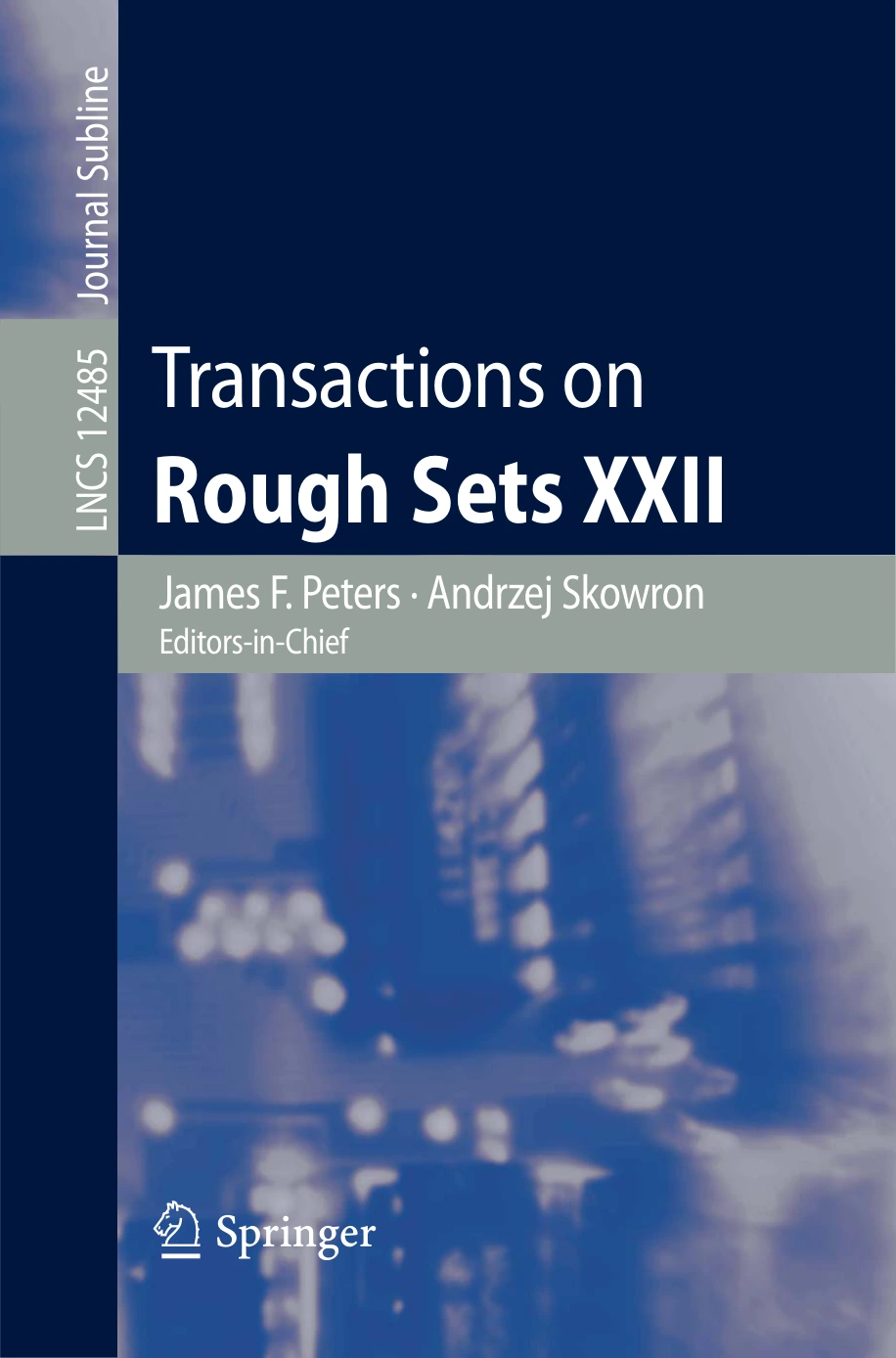
Transactions on Rough Sets XXII
Original price was: $5.00.$2.50Current price is: $2.50.

James F. Peters
Product Specs:
- File Type: PDF
- File Size: 9.5 MB
- Book Language: English
- Total Page Count: 335
- Instant Download
Inside This Volume
Transactions on Rough Sets XXII continues the series’ role as a venue for high-quality research on rough set foundations and applications. The volume presents six peer-reviewed contributions and an erratum, selected and edited by James F. Peters and Andrzej Skowron.
Rough set theory, introduced by Zdzisław Pawlak, provides tools for handling uncertainty, vagueness, and incomplete information. This volume extends those ideas into practical algorithms, algebraic structures, and hybrid intelligent systems.
Research Themes and Contributions
- Decision tree optimization: Mohammad Azad investigates bi-objective optimization of CART-like decision trees for data analysis, showing usefulness for medium-sized decision tables.
- Parallel rough set software: Nicholas Baltzer and Jan Komorowski present a multi-core execution process in ROSETTA, optimized for speed and modular extension, tested on four datasets.
- Sequences of orthopairs: Stefania Boffa and Brunella Gerla explore tolerance relations and sequences of orthopairs, linking rough sets to many-valued structures.
- Algebraic and logical foundations: Arun Kumar develops new semantics for Stone algebras, dual Stone algebras, and regular double Stone algebras, advancing generalized rough set theory.
- Similarity-based rough sets: Dávid Nagy uses correlation clustering to generate base sets, reducing complexity while preserving interpretability.
- Erratum: Correction to a reference in a previous TRS paper on rough sets in economy and finance.
Why This Volume Matters
The contributions bridge foundational theory and computational practice. They address scalability, knowledge extraction, algebraic representation, and clustering—key concerns for anyone working with uncertain or incomplete data. The editors have selected work that demonstrates how rough set paradigms continue to evolve alongside machine learning and data science.
Who Should Read This Book
Researchers, graduate students, and practitioners in rough sets, artificial intelligence, machine learning, data mining, and knowledge representation will find this volume valuable. It assumes familiarity with core rough set concepts and offers advanced insights suitable for specialists and those deepening their expertise.
User Reviews
Be the first to review “Transactions on Rough Sets XXII”
You must be logged in to post a review.
Original price was: $5.00.$2.50Current price is: $2.50.





There are no reviews yet.