

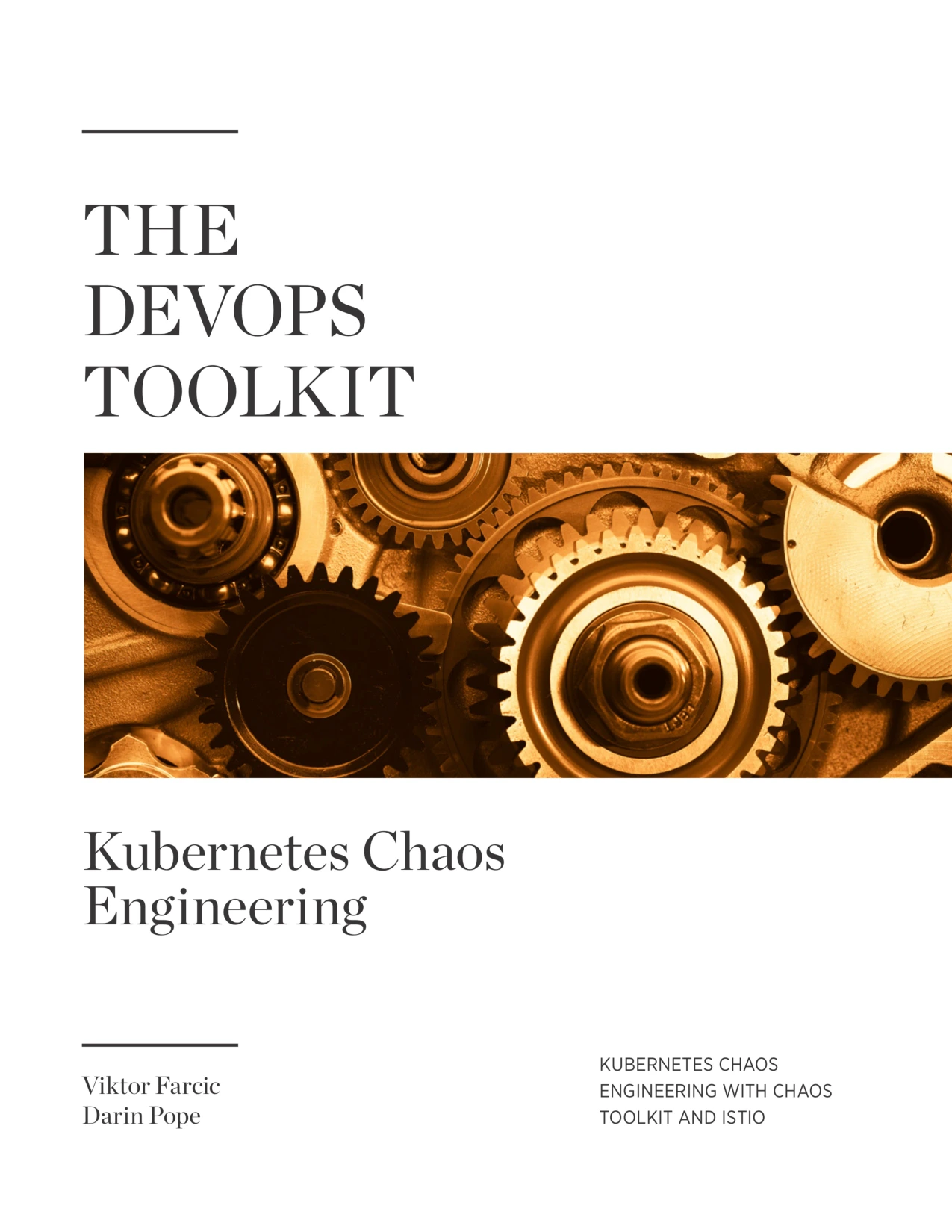
The DevOps 2.7 Toolkit: Kubernetes Chaos Engineering
Original price was: $5.00.$2.50Current price is: $2.50.

Viktor Farcic
Product Specs:
- File Type: PDF
- File Size: 2.6 MB
- Book Language: English
- Total Page Count: 196
- Instant Download
Embrace Controlled Destruction on Kubernetes ☸️
Most technology teams spend their days avoiding failure. Chaos engineering flips that instinct: it deliberately breaks things to learn how systems really behave under stress. In The DevOps 2.7 Toolkit: Kubernetes Chaos Engineering, Viktor Farcic and Darin Pope show how to apply this discipline within Kubernetes using two powerful open-source tools: Chaos Toolkit and Istio.
The book doesn’t stop at theory. It builds from the ground up, starting with the principles of a steady-state hypothesis and moving into concrete experiments you can run against your own clusters.
Design Experiments That Mirror Real Failures
Farcic and Pope stress that useful chaos experiments should replicate events that are likely to happen—application crashes, network latency, dependency outages, node failures. The guide walks through defining what “normal” looks like, then injecting disruptions to see whether that steady state holds.
- Terminate application instances and validate fault tolerance
- Obstruct and destroy network traffic with Istio fault injection
- Drain and delete Kubernetes nodes to test cluster resilience
- Generate chaos experiment reports for team review
Run Experiments In-Cluster, On Schedule
Beyond one-off tests, the book covers deploying Chaos Toolkit inside Kubernetes itself. You’ll learn how to run scheduled experiments, handle failed runs, and send notifications—turning chaos engineering from a manual exercise into a repeatable, automated practice.
Observe the Impact with Real Dashboards
Destruction is only useful when you can see the consequences. The later chapters bring in Grafana, Kiali, and Prometheus to monitor random instance and node terminations, network disruptions, and alerting conditions. This observability layer helps you connect the dots between injected failures and system behavior.
Is Your Team Ready?
The authors are refreshingly honest: chaos engineering is not for every organization. You need a mature Kubernetes environment, reliable monitoring, and the willingness to run experiments in production. If you already have that foundation—or want to build a case for investing in it—this book gives you a pragmatic path forward.
For DevOps engineers, site reliability engineers, and platform teams comfortable with containers, this hands-on Toolkit volume cuts through the hype and delivers a practical way to make Kubernetes systems more resilient.
User Reviews
Be the first to review “The DevOps 2.7 Toolkit: Kubernetes Chaos Engineering”
You must be logged in to post a review.
Original price was: $5.00.$2.50Current price is: $2.50.

There are no reviews yet.