

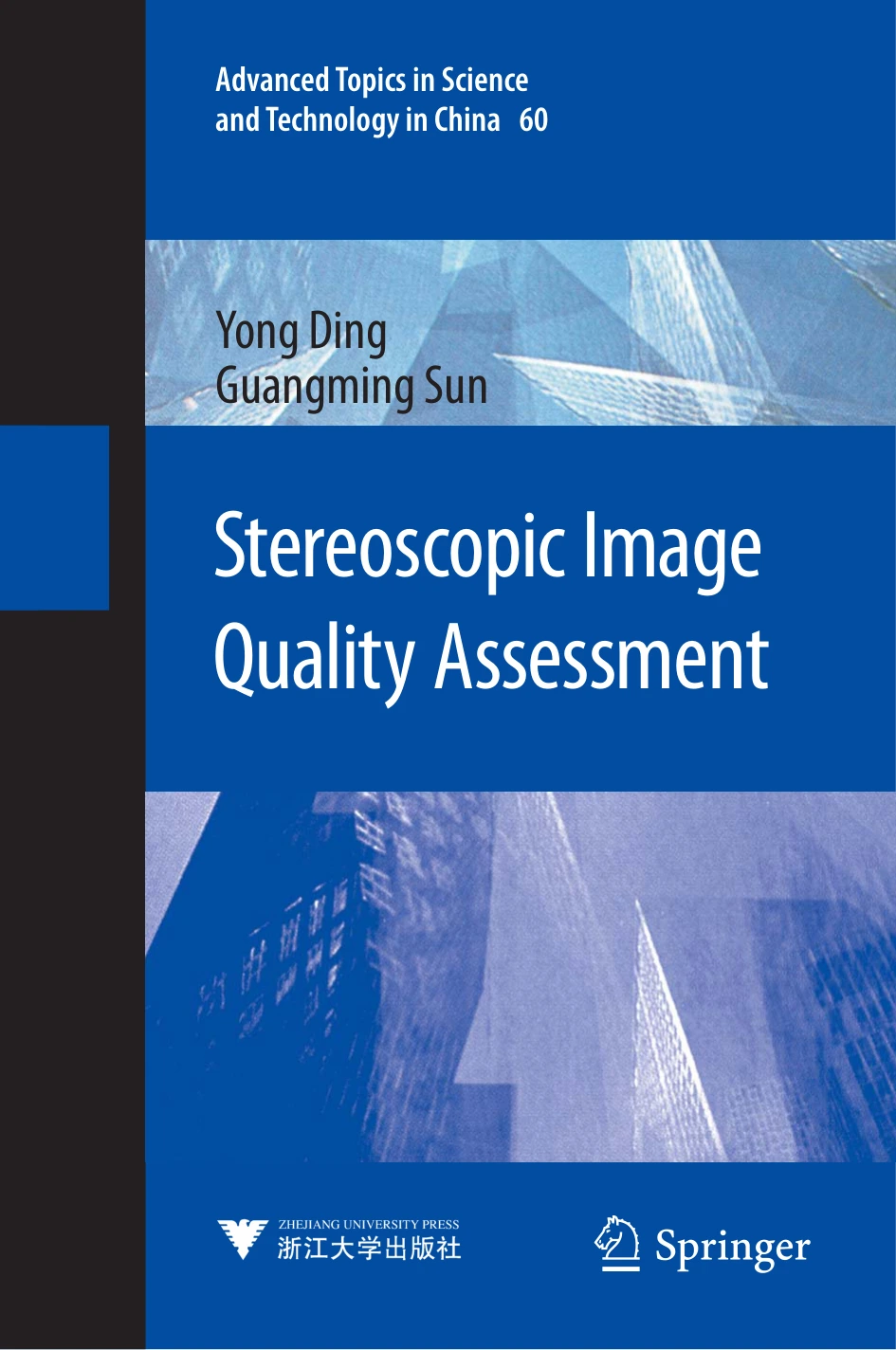
Stereoscopic Image Quality Assessment
Original price was: $5.00.$2.50Current price is: $2.50.

Yong Ding
Product Specs:
- File Type: PDF
- File Size: 4.4 MB
- Book Language: English
- Total Page Count: 174
- Instant Download
From Flat Screens to Depth Perception
Stereoscopic image quality assessment sits at the intersection of visual perception, signal processing, and machine learning. In this volume from the Advanced Topics in Science and Technology in China series, Yong Ding and Guangming Sun bring together the core ideas that help researchers and engineers evaluate how good a three-dimensional image really looks to a human observer.
The book opens with a clear grounding in two-dimensional image quality assessment before isolating what makes stereoscopic content distinct: binocular disparity, fusion, rivalry, ocular dominance, and visual discomfort. That foundation makes it easier to understand why simply applying 2D metrics to stereoscopic images falls short.
Key Approaches Covered
- Weighting strategies built on conventional 2D IQA methods
- Binocular-inspired models and cyclopean image construction
- Human visual system principles such as saliency and just noticeable difference
- Deep convolutional neural network techniques for quality regression and classification
- Patch-wise strategies, transfer learning, and dual-stream interactive networks
A Resource for Advanced Study
The chapters progress from established methods to emerging deep learning directions, making the book useful for graduate students, researchers, and developers working in image processing, computer vision, or 3D display technology. It does not shy away from open challenges, and the final chapter outlines promising areas for future investigation.
Digital Delights offers this scholarly work as a convenient ebook for readers who want a structured, technically detailed overview of stereoscopic image quality assessment.
User Reviews
Be the first to review “Stereoscopic Image Quality Assessment”
You must be logged in to post a review.
Original price was: $5.00.$2.50Current price is: $2.50.


There are no reviews yet.