

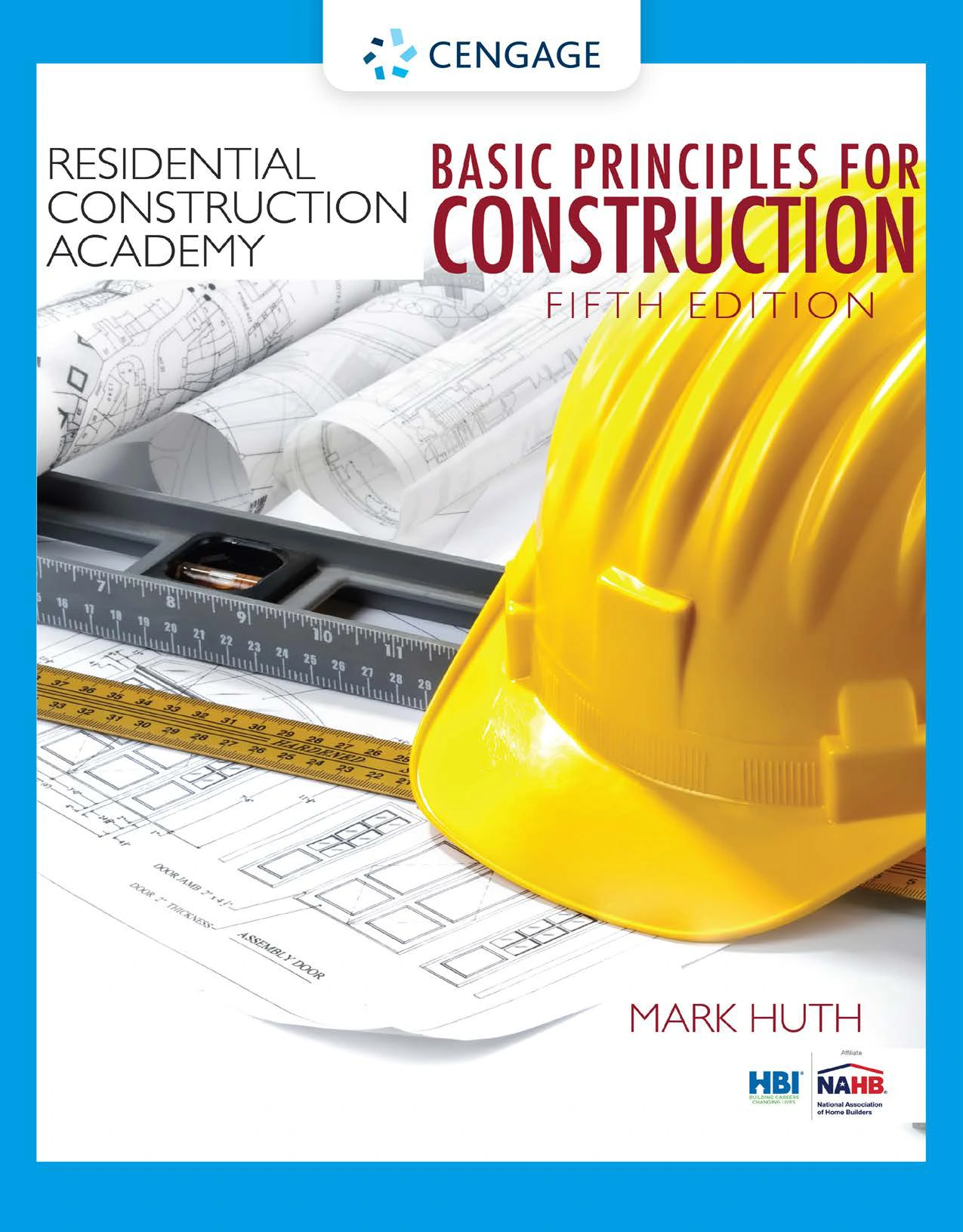
Residential Construction Academy: Basic Principles for Construction, Fifth Edition
Original price was: $5.00.$2.50Current price is: $2.50.

Mark W. Huth
Product Specs:
- File Type: PDF
- File Size: 37.3 MB
- Book Language: English
- Total Page Count: 338
- Instant Download
A Practical Foundation for Residential Construction
Residential Construction Academy: Basic Principles for Construction, Fifth Edition is a foundational textbook for anyone beginning a career in residential building. Written by Mark W. Huth and published by Cengage Learning, it gathers the core knowledge that new construction workers need into one organized volume. The fifth edition continues the series’ focus on clear instruction, real-world safety, and the basic math and tool skills that support competent work on a jobsite.
Rather than treating construction as a single trade, the book introduces the industry as a coordinated field. It explains who does what, how projects are organized, why building codes and safety rules exist, and how communication and customer service affect the work. Later sections move into the practical language of construction: measurements, drawings, materials, and fasteners.
What the Fifth Edition Covers
The material is arranged into five major sections that build on one another:
- The Construction Industry — industry organization, construction personnel, business ownership, building codes, unions and contractors’ associations, communication, and an introduction to green building.
- Safety — jobsite safety, OSHA standards, personal protective equipment, hazard communication, fire safety, trenching, electrical hazards, scaffolds, ladders, and machine safety.
- Construction Math — whole numbers, decimals, fractions, linear measure, percent, area, volume, right angles, and combined operations.
- Tools and Fasteners — hand tools, power tools, fasteners, adhesives, sealants, rigging, slings, and crane operations.
- Print Reading — views, isometric drawings, oblique drawings, and orthographic projection.
Each chapter is structured for learning. Glossaries define key terms, summaries reinforce main ideas, and review questions and activities give readers a way to check their understanding and apply what they have read.
Safety, Math, and Tools in Context
Three areas stand out for new residential construction workers. Safety is presented not as a list of rules but as a set of responsibilities shared by employees and employers. The book covers OSHA standards, personal protective equipment, electrical safety, and safe work practices around scaffolds, ladders, and machines.
Construction math receives its own full section because accurate measurement is inseparable from quality work. Readers work through fractions, decimals, percentages, area, volume, and right-angle calculations. These chapters connect arithmetic to tasks such as reading a tape measure, checking square, and estimating materials.
The tools and fasteners section explains how common hand tools and power tools are selected, used, and inspected. It also covers nails, screws, bolts, anchors, adhesives, and sealants, with attention to matching the fastener to the job. A chapter on rigging introduces slings, hardware, and crane operations for readers who need a basic understanding of lifting equipment.
Green Building and Modern Practice
The fifth edition includes an introduction to green building. Topics include site selection, lot planning, energy efficiency, water conservation, indoor air quality, material use, waste management, and green certification programs. For readers entering the field, this section shows how residential construction is increasingly shaped by environmental and health considerations alongside traditional building requirements.
Who This Textbook Serves
This book is written for students in residential construction programs, apprentices, and instructors who need a structured introduction to the trade. It also suits career changers and self-learners who want a reliable overview before seeking hands-on training. No advanced construction background is assumed; the text begins with fundamental concepts and builds from there.
Because it covers such a wide range of foundational topics, it can serve as a course text, a reference for early-career workers, or a study aid for anyone preparing for further technical instruction. The fifth edition reflects the 2020 copyright and includes updated coverage of safety and green building practice.
Build a Stronger Starting Point
Good construction work begins with understanding why things are done the way they are. Basic Principles for Construction gives readers that starting point: a clear view of the industry, a serious approach to safety, the math to measure and plan, and the tool knowledge to work with confidence under supervision. This digital edition from Digital Delights is ready for study on your preferred device.
User Reviews
Be the first to review “Residential Construction Academy: Basic Principles for Construction, Fifth Edition”
You must be logged in to post a review.
Original price was: $5.00.$2.50Current price is: $2.50.




There are no reviews yet.