

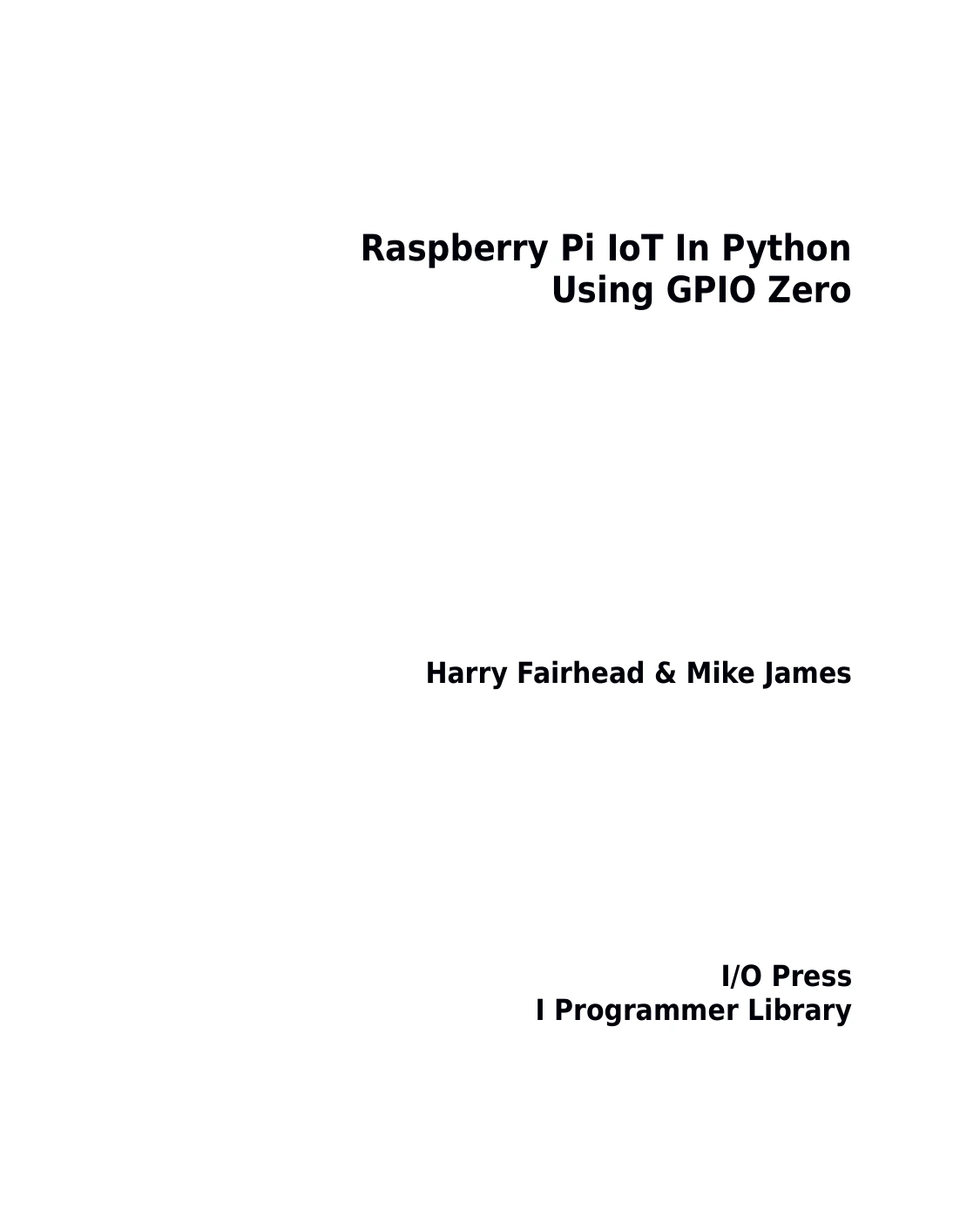
Raspberry Pi IoT In Python Using GPIO Zero
Original price was: $5.00.$2.50Current price is: $2.50.

Harry Fairhead
Product Specs:
- File Type: PDF
- File Size: 20.2 MB
- Book Language: English
- Total Page Count: 240
- Instant Download
Why Use a Raspberry Pi for IoT?
The Raspberry Pi brings something unusual to the Internet of Things: full Linux, a familiar programming environment, and enough processing power to handle serious work. In Raspberry Pi IoT In Python Using GPIO Zero, Harry Fairhead and Mike James explain how to use that platform with Python and GPIO Zero to connect software to real-world devices. The result is a book for readers who want to understand the mechanics behind the library, not just copy working code.
Published by IO Press as part of the I Programmer Library, this first edition focuses on the ideas, classes, and hardware knowledge that make GPIO Zero useful. It is especially suited to Python users who are ready to explore GPIO lines, electronics, sensors, motors, and bus protocols.
From Simple Pins to Custom Devices 💡
The book begins with the case for the Pi in IoT work and then moves through the practical foundations: setting up Python, using SSH, remote development with Visual Studio Code, and the object-oriented Python concepts that make GPIO Zero easier to follow. From there, it examines GPIO access, pin factories, and the basic electronics needed to connect hardware safely.
What the Chapters Cover
- Why the Pi is a different kind of IoT computer compared with microcontrollers
- Python and GPIO Zero setup, including remote development workflows
- GPIO fundamentals, classes, objects, attributes, and properties
- Simple on/off devices, pins, pin factories, and basic input circuits
- Simple and complex input devices, asynchronous buttons, sensors, and source/values
- Pulse width modulation, motors, servos, H-bridges, stepper motors, and compound devices
- The SPI bus, supported SPI devices, and custom SPI implementations
Understanding the Library, Not Just Using It ⚙️
GPIO Zero hides a great deal of complexity, but this book keeps looking underneath. It shows how devices are built, how classes and inheritance fit together, and how custom devices can be created to behave the way a particular project needs. The source/values model receives careful attention, and later chapters build from simple components toward more advanced motor control and SPI hardware.
That approach makes the material useful beyond the examples. A reader who follows the explanations can adapt the patterns to new sensors, new output devices, and new combinations of hardware.
Who Will Get the Most From It
This is not a beginner’s introduction to Python, and it is not a project cookbook. It will suit makers, hobbyists, students, and developers who already have some Python experience and want a deeper technical guide to Raspberry Pi IoT programming. Readers working with GPIO Zero, physical computing, or embedded Linux will find a clear path from basic GPIO lines to custom SPI devices and motor control.
A Practical Path Into Physical Computing 🧠
If you want to move beyond following tutorials and start building devices that work the way you intend, Raspberry Pi IoT In Python Using GPIO Zero offers a structured route through the hardware and software. It treats the Pi as a capable IoT computer and GPIO Zero as a system worth understanding from the inside out.
User Reviews
Be the first to review “Raspberry Pi IoT In Python Using GPIO Zero”
You must be logged in to post a review.
Original price was: $5.00.$2.50Current price is: $2.50.






There are no reviews yet.