

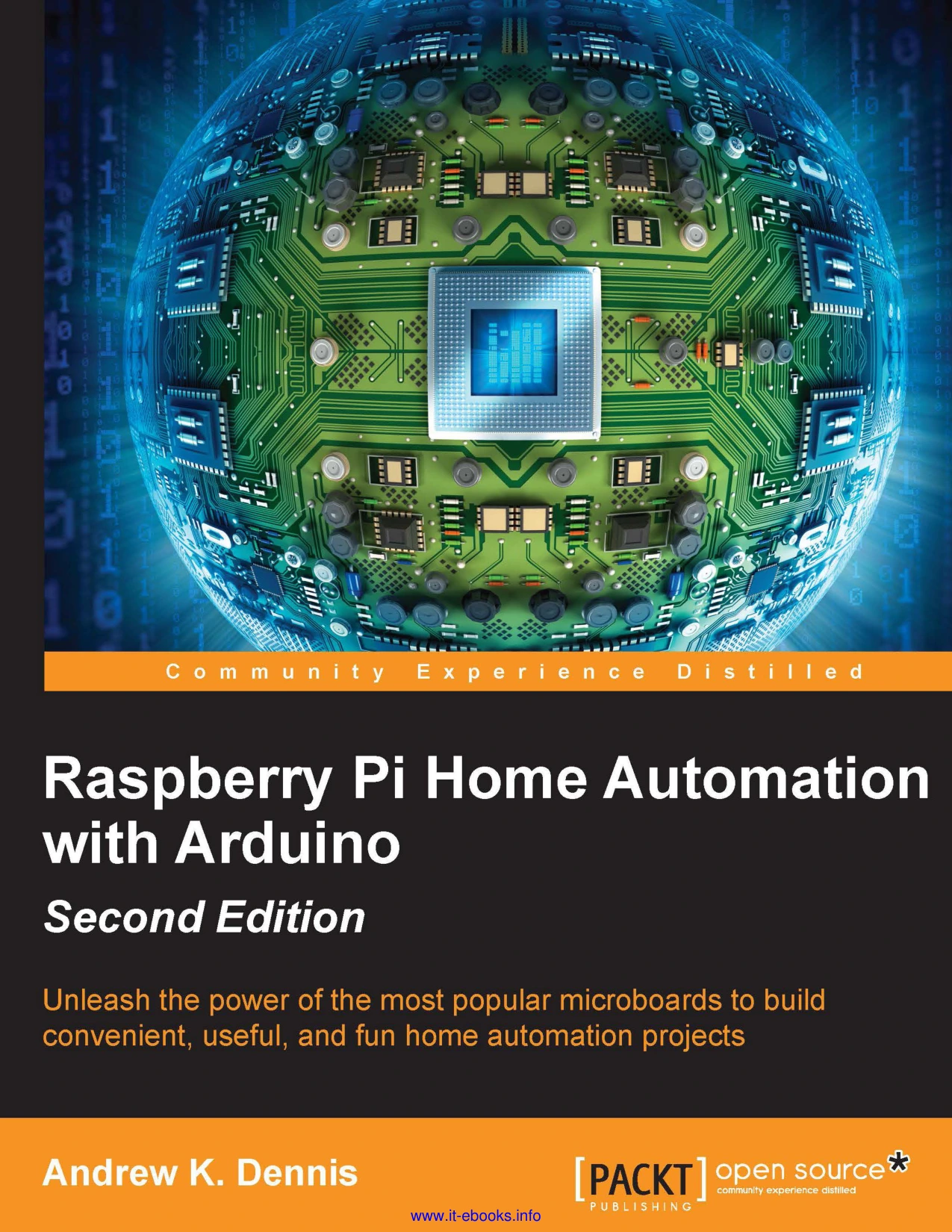
Raspberry Pi Home Automation with Arduino, Second Edition
Original price was: $5.00.$2.50Current price is: $2.50.

Andrew K. Dennis
Product Specs:
- File Type: PDF
- File Size: 6.2 MB
- Book Language: English
- Total Page Count: 148
- Instant Download
Two Microboards, One Automated House 🏠
Plenty of home automation books stop at theory. This one hands you a soldering iron and a shopping list. Raspberry Pi Home Automation with Arduino, Second Edition treats the Raspberry Pi and the Arduino as a working partnership: the Pi handles Linux, networking, databases, and web services, while the Arduino side handles the sensors, relays, and motors that touch the physical world.
Andrew K. Dennis writes for readers who have already written a little code and wired up a thing or two. That assumption is a strength — it means the book can spend its pages on circuits, scripts, and the debugging that happens when hardware refuses to cooperate.
Setting the Foundation ⚙️
Before any project begins, there is groundwork. The opening chapters cover the history and purpose of both boards, then move into the practical setup work: choosing and preparing an SD card, installing Raspbian, configuring SSH access, installing the Arduino IDE on the Pi, and bringing the Arduino-to-Raspberry Pi connection bridge into play. Soldering and the basics of writing Arduino sketches get attention here too, so readers who are comfortable with software but new to a breadboard are not left behind.
The book also places home automation in context, tracing the field from the X10 standard through the open-source era to the commercial smart-home products on shelves today — useful background for anyone deciding what to build versus what to buy.
Four Projects That Actually Run
The heart of the book is a sequence of builds that grow in ambition and complexity:
- Central air and heating thermostat — relays, a thermistor, an Ethernet shield, JSON responses, and a fan, extended with a potentiometer and an LCD screen.
- Temperature storage — a SQLite database with tables for readings and rooms, a Python application that writes to it, a cron job to keep it fed, and HTSQL for querying the results.
- Parcel delivery detector — a force-sensing resistor and a 10K ohm resistor wired to the Arduino, with a Python web application and SMTP setup to fire off an email when a package lands.
- Curtain automation — a photoresistor, a motor shield, pulse width modulation, and threaded Python code that opens and closes curtains based on ambient light.
What You’ll Be Working With 💻
The technical vocabulary here is concrete: force-sensing resistors, thermistors, photoresistors, makefiles, arduPi, Ethernet and motor shields, stepper motors, JSON, SQLite, SMTP, and Python threads. Each chapter ends with a summary and, in several cases, suggested next steps — mounting the photoresistor outdoors, replacing a pressure sensor with a camera and image recognition, or upgrading from wired Ethernet to a wireless system. Those forward-looking notes are useful signposts for readers who want to keep extending a build after the chapter closes.
Who Gets the Most From This Book
This is a good fit for makers, hobbyist developers, and electronics enthusiasts who already know their way around a command line and want a structured path into home automation. Students working on embedded systems projects will find the database and web-service chapters particularly applicable. Readers looking for a purely conceptual overview of smart homes would be better served elsewhere — the value here is in the building.
If you have a Raspberry Pi and an Arduino in a drawer and you have been meaning to put them to work on something that switches real things on and off, this second edition is a clear, project-led route from unboxing to a house that does a few chores on its own. 💡
User Reviews
Be the first to review “Raspberry Pi Home Automation with Arduino, Second Edition”
You must be logged in to post a review.
Original price was: $5.00.$2.50Current price is: $2.50.






There are no reviews yet.