

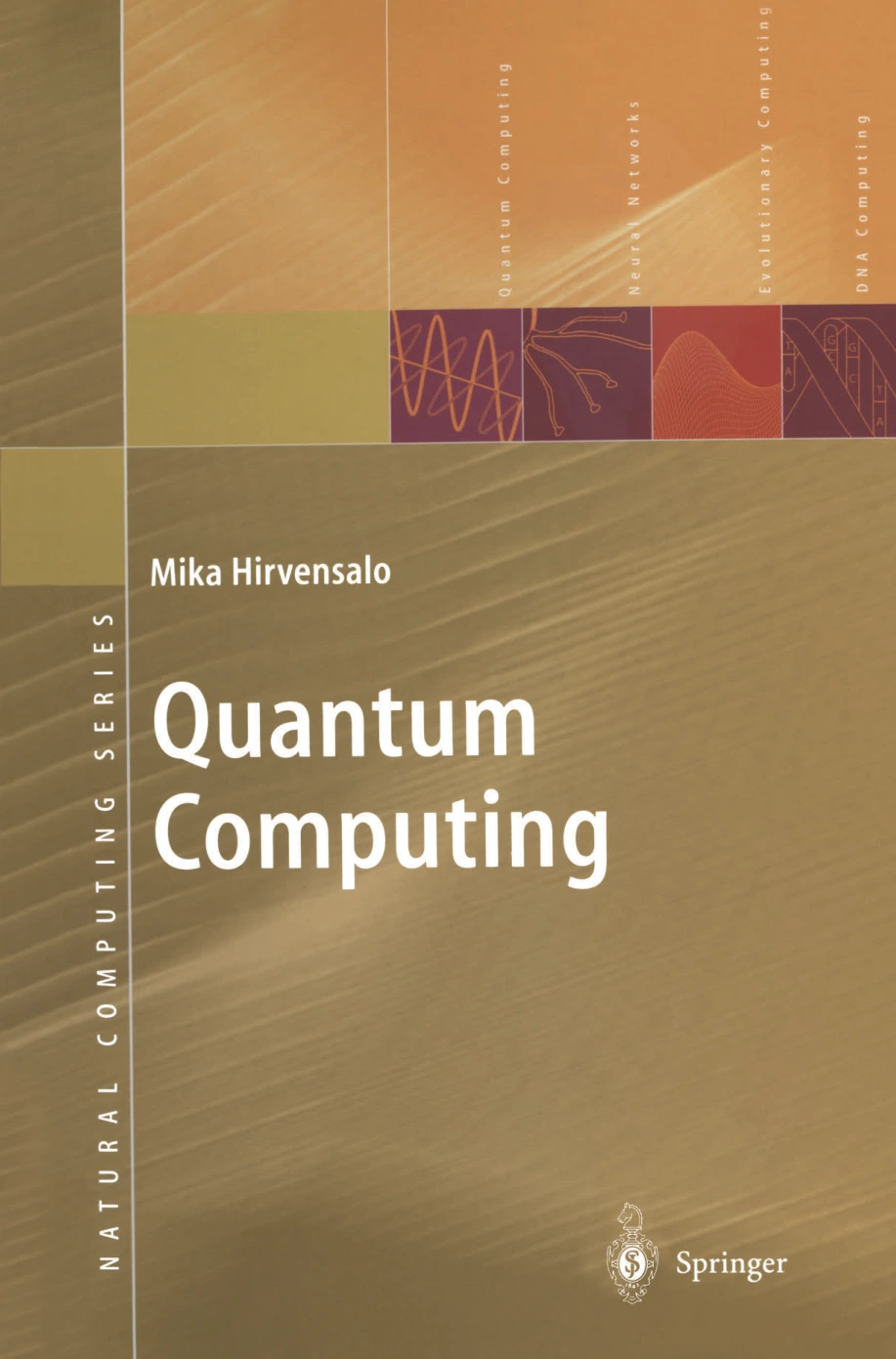
Quantum Computing
Original price was: $5.00.$2.50Current price is: $2.50.

Mika Hirvensalo
Product Specs:
- File Type: PDF
- File Size: 15.3 MB
- Book Language: English
- Total Page Count: 199
- Instant Download
A Rigorous Bridge Between Quantum Mechanics and Computation ⚛️
Mika Hirvensalo’s Quantum Computing was written for readers who suspect that the most interesting questions in computer science now require a detour through physics. Published by Springer in 2001 as part of the Natural Computing Series, the book does not treat quantum computing as a collection of futuristic slogans. It builds the subject from the ground up: first the physical language of quantum systems, then the computational models needed to describe what a quantum machine actually does.
From Turing Machines to Quantum Circuits 💻
The early chapters set the stage with classical computational models, including Turing machines, probabilistic Turing machines, and multitape machines. From there, Hirvensalo introduces quantum bits, quantum registers, quantum Turing machines, and the circuit model that runs through the rest of the book. Boolean and reversible circuits are explained before quantum circuits, which makes the transition feel like a natural extension of familiar ideas rather than an abrupt leap into abstraction.
Algorithms That Give Quantum Computing Its Reputation
A major portion of the book is devoted to the algorithms that made quantum computation impossible to ignore. Shor’s factorization algorithm is presented in full detail, with the quantum Fourier transform, period-finding, and the correctness probability developed step by step. Grover’s method for quadratic speedup follows in a deliberately basic form, and a later chapter examines lower bounds in a restricted quantum circuit model. The result is a focused account of what quantum computers might do better, rather than a broad survey of every adjacent topic.
What the Book Does Not Try to Cover
Hirvensalo is explicit about the book’s boundaries. Quantum information theory, quantum communication, quantum error correction, and quantum cryptography are not covered. That concentration gives the work a clear identity: it is primarily a mathematically oriented introduction to quantum algorithms and the models that support them. Readers looking for a wide-ranging tour of quantum technologies will want to supplement it, but those who want to understand the computational core will find the focus useful.
How the Material Is Organized 📐
The main chapters are followed by two appendices. One is written with beginners in mind, while the other gathers mathematical topics that recur throughout quantum computation. The author notes that readers with different backgrounds can follow different paths: some sections assume a solid grounding in quantum mechanics, while others are intended for readers who already know classical computation theory. That flexibility makes the book adaptable, though it does ask readers to pay attention to the guidance provided in the preface and chapter introductions.
Who Will Benefit from This Book
This is a strong choice for mathematically mature readers who want a serious introduction to quantum algorithms. It should appeal to advanced undergraduates, graduate students, and researchers in computer science, mathematics, and physics who need a bridge between the language of quantum mechanics and the theory of computation. Beginners with less background can still use the appendices and the more accessible sections, but the book does not pretend that the subject requires no preparation. For anyone studying the foundations of quantum computation, Hirvensalo’s treatment remains a clear and focused reference.
Original price was: $5.00.$2.50Current price is: $2.50.
There are no reviews yet.