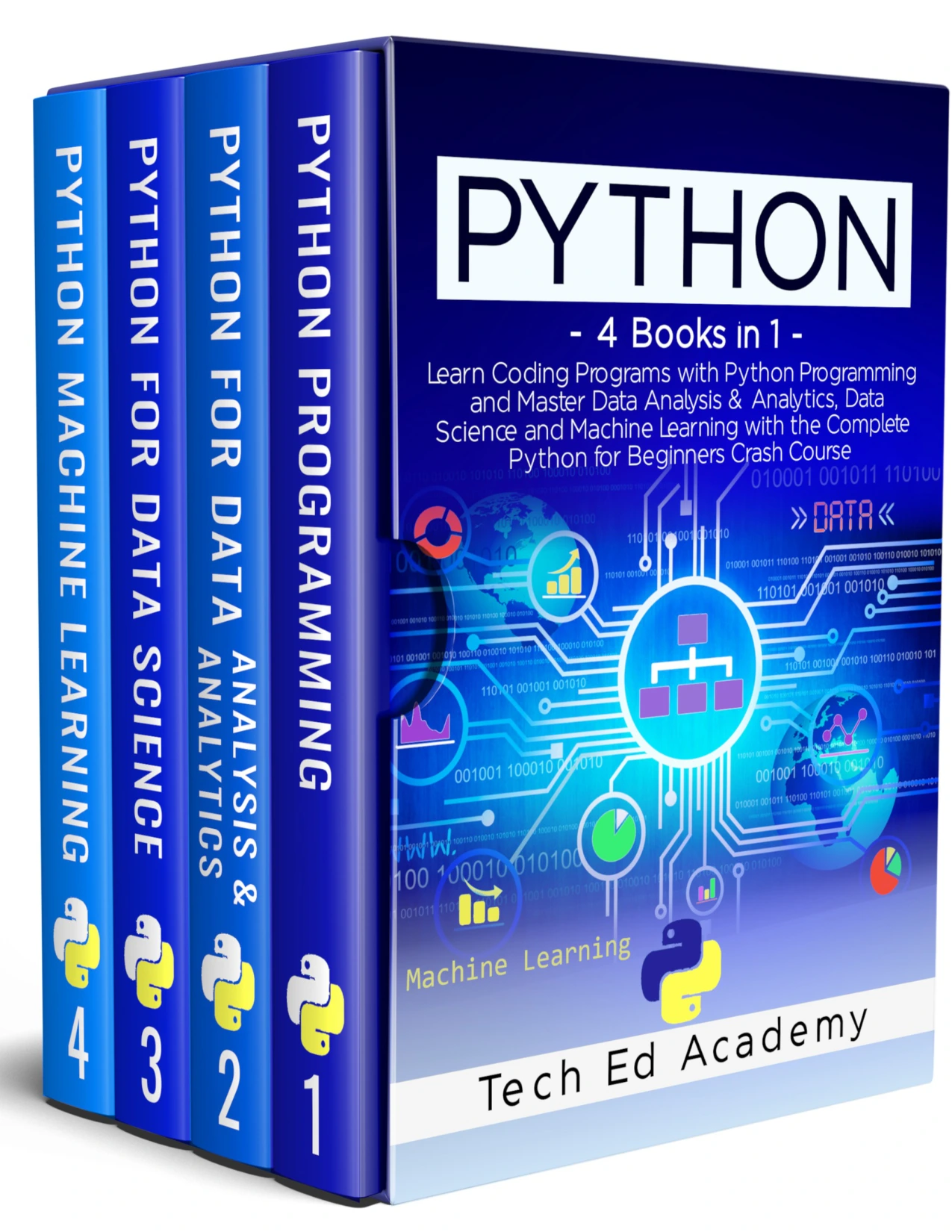
PYTHON: Learn Coding Programs with Python Programming and Master Data Analysis & Analytics, Data Science and Machine Learning with the Complete Python for Beginners Crash Course – 4 Books in 1
Original price was: $5.00.$2.50Current price is: $2.50.

Tech Ed Academy
Product Specs:
- File Type: PDF
- File Size: 9.5 MB
- Book Language: English
- Total Page Count: 463
- Instant Download
A Four-Book Python Starter Collection 🐍
This collection gathers four beginner-oriented Python titles into one volume. Instead of treating programming and data work as separate subjects, it moves from the language itself into the tools and ideas behind data analysis and analytics, with the title also signalling a reach into data science and machine learning. The result is a broad on-ramp for readers who want to understand how Python is used across coding and data projects.
Start with the Language Itself 💻
The first book walks through the essential mechanics of Python. Early chapters cover what Python is, why it has become a popular first language, how to choose a version, and how to install it on Windows, Linux, or macOS. From there, the material introduces IDLE, the Python shell, interactive mode, script mode, and the workflow of writing and running a first program.
Core Concepts, One Step at a Time
Once the environment is ready, the book turns to the building blocks that appear in everyday Python code:
- Strings, numbers, booleans, lists, and variables
- Arithmetic, comparison, and logical operators
- String methods and user input
- If, elif, and nested conditional statements
- For and while loops, including break and continue
Later sections move into lists, tuples, sets, dictionaries, functions, modules, file handling, exception handling, classes, objects, inheritance, and polymorphism. This is a traditional path through beginner Python, and it gives readers a vocabulary for reading and writing small programs.
From Code to Data Analysis 📊
The second major portion shifts toward data analysis and analytics. It explains what data analysis is, why it matters, and how different techniques fit together — descriptive, diagnostic, predictive, and prescriptive approaches are all introduced. Real-world applications appear throughout, including ecommerce, healthcare, marketing, security, transportation, logistics, customer segmentation, recommendation engines, and fraud detection.
Readers then set up their environment and revisit Python data structures from a data-centric angle before meeting Jupyter Notebook. The notebook chapter covers creating notebooks, useful commands, running first code, and practical tips for interactive work.
Libraries for Numerical Work and Visualization
NumPy enters as a foundation for scientific computing and numerical data processing, with coverage of arrays, installation, array creation, broadcasting, slicing, and indexing. Matplotlib follows for visualization, including simple graphs, more complex charts, and scatter plots. The collection also names other visualization libraries such as Seaborn, ggplot, Bokeh, pygal, Plotly, geoplotlib, Glimmer, and missingno, giving readers a sense of the wider Python data ecosystem.
Who Will Get the Most from This Collection?
This is best suited to beginners, students, career changers, and self-taught learners who want a single package that starts with Python syntax and continues into data analysis topics. The material is introductory in tone and breadth. Readers already comfortable with Python, advanced statistics, or production machine-learning workflows may prefer more specialised resources, but newcomers can use this collection as a structured first pass across coding, analytics, and the data science landscape.
A Practical Starting Point
For anyone who has been meaning to learn Python but is unsure where to begin, this four-book collection offers a guided route: install the language, practise the fundamentals, then explore the tools that turn data into insight. It is a substantial starting library for the curious beginner.
User Reviews
Be the first to review “PYTHON: Learn Coding Programs with Python Programming and Master Data Analysis & Analytics, Data Science and Machine Learning with the Complete Python for Beginners Crash Course – 4 Books in 1”
You must be logged in to post a review.
Original price was: $5.00.$2.50Current price is: $2.50.


There are no reviews yet.