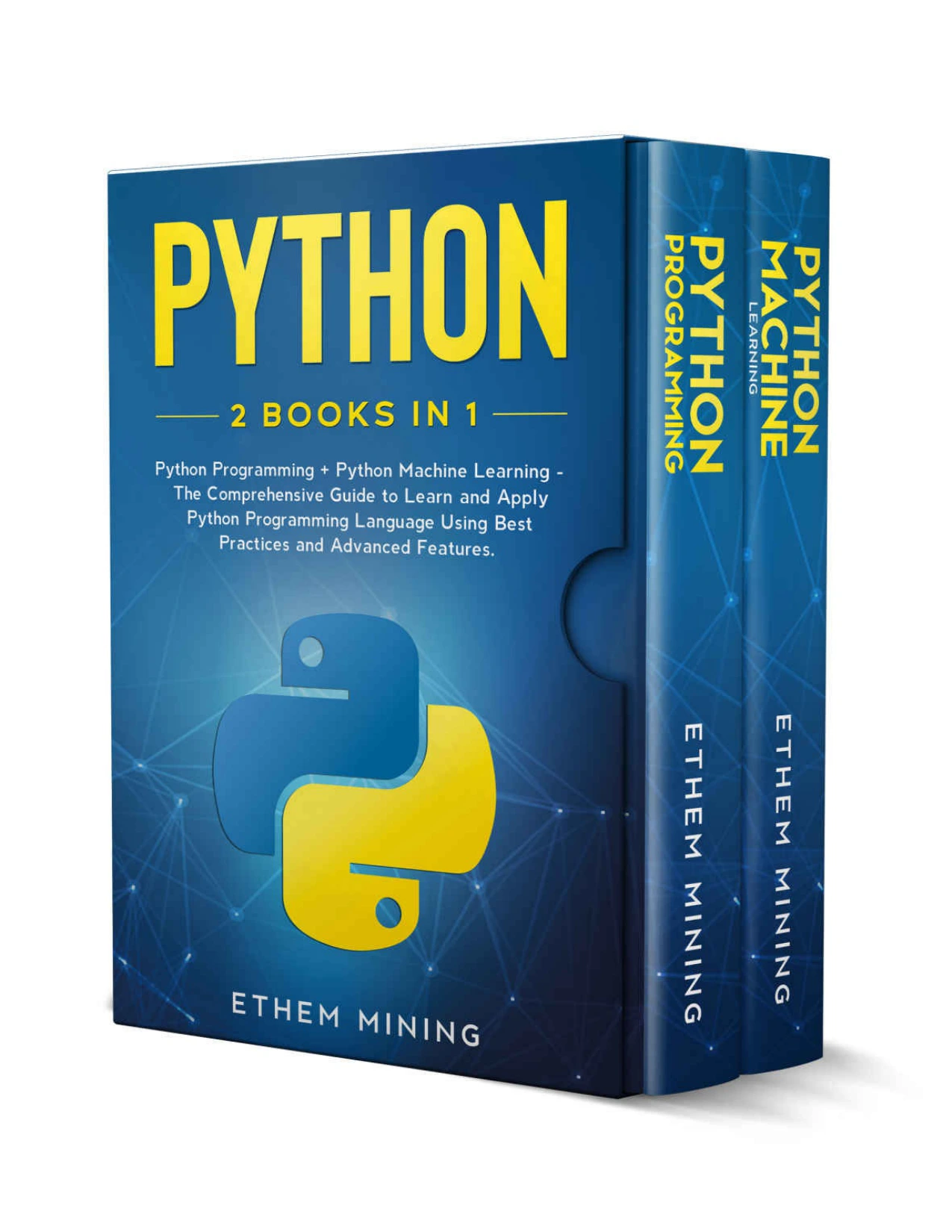
Python: 2 Books in 1: Python Programming + Python Machine Learning — The Comprehensive Guide to Learn and Apply Python Programming Language Using Best Practices and Advanced Features
Original price was: $5.00.$2.50Current price is: $2.50.

Ethem Mining
Product Specs:
- File Type: PDF
- File Size: 4.6 MB
- Book Language: English
- Total Page Count: 293
- Instant Download
Two Python Books, One Continuous Route 🐍
Many learners end up with a beginner’s syntax book on one side of the desk and an intimidating machine-learning text on the other, with a gap in between that neither one closes. This two-in-one volume by Ethem Mining is designed to remove that gap. It pairs a complete introductory Python course with a complete introduction to machine learning in Python, so the language skills and the modelling skills arrive in the order most readers actually need them.
The collection is aimed at total beginners, but it does not stop at the beginner’s shoreline. The first half teaches the language. The second half puts that language to work on data.
Book One: Python Programming from the Ground Up
The opening book takes a deliberately methodical route through Python fundamentals, in the sequence a new programmer tends to encounter real problems. It begins with orientation rather than code: what Python actually is, the kinds of software you can develop with it, and how to install it correctly on your operating system so the tooling does not become the first obstacle.
From there the material moves through the building blocks in a logical order:
- Variables — declaring, re-declaring, and deleting them, plus the distinction between local and global scope, which causes a surprising amount of early confusion.
- Data objects — numbers, strings, lists, dictionaries, and tuples, treated one at a time rather than in a single overwhelming sweep.
- Operators and statement syntax — how Python reads your code, and the rules that govern it.
- Control flow — if tests and their variations, while and for loops, and the continue, break, and pass statements that steer them.
- Exceptions — what happens when something goes wrong and how Python signals it.
- Functions — declaration, calling, arguments, expressions, and returned output.
- Modules — how to import them, and how to write and use one of your own.
- Debugging — what debugging really involves and the standard Python debugger commands.
- Files — reading, writing, and a worked example of file processing.
That final chapter matters more than it might first appear. Reading and writing files is usually the moment a learner stops writing exercises and starts writing programs that do something with real data.
Book Two: Python Machine Learning in Practice 💻
The second book assumes you can now write and debug Python, and asks a different question: how do you get a machine to find patterns you did not explicitly program? It starts with context rather than code — the development of machine learning, its relationship with big data, its goals and applications, and the benefits it offers — then lays out a seven-step working method that runs from defining the problem, gathering and preparing data, choosing a style of learning, selecting an algorithm, training and testing, improving, and finally deploying.
A substantial chapter on real-world application grounds the theory with concrete examples, from fraud detection and real-time pricing to product recommendations, self-driving cars, virtual assistants, drug discovery, and facial recognition. It also draws the practical distinction between structured and unstructured data, a split that shapes which techniques are even available to you.
The technical chapters then move through the main learning paradigms and the libraries that implement them:
- Supervised learning — feature vectors, choosing an algorithm, linear and logistic regression, decision trees, Naïve Bayes, support vector machines, K-nearest neighbour, neural networks, and the bias-variance tradeoff.
- Unsupervised and semi-supervised learning — clustering with K-means, mean shift, DBSCAN and hierarchical methods, anomaly detection, visualization, dimensionality reduction, and reinforcement learning compared directly with supervised approaches.
- Regression and classification methods — threshold functions, binary and multinomial logistic regression, data transformation, partitioning, grid methods, random forests.
- TensorFlow and Keras — how TensorFlow relates to neural networks, how the API sits as a front end, the ways computing power can be accessed, and how to install Keras, build a sequential deep learning model, train it, test it, and make predictions.
- Scikit-learn and NumPy — the data mining process and datasets in Scikit-learn, splitting data into training and testing sets, running linear regression, ndarrays and column vectors, array sizes and high-level operations, dot products, eigenvalues and eigenvectors, and matrix inversion.
Why the Library Chapters Are Worth Your Time
Machine learning is rarely written from scratch in practice. Almost every working project sits on top of a small set of established libraries, and this book introduces the four that appear most often in Python work: TensorFlow, Keras, Scikit-learn, and NumPy. Rather than presenting them as abstract tools, the chapters place each one inside a task — building a model, training it, testing it, and producing a prediction — which makes the API calls easier to remember and easier to reuse.
Who Will Get the Most From It
This collection suits readers starting from zero who intend to keep going. Absolute beginners will find the first book’s sequence manageable and the second book’s context chapters readable before the mathematics deepens. Self-taught programmers who already write Python but have never trained a model can work primarily through the second half, using the first as reference. Students, career changers, and hobbyists who want a single continuous escalation from first script to first trained model are the natural audience, and the material is written for personal study rather than classroom use.
Start With Python. Then Let Python Learn.
The appeal of a two-in-one edition like this is momentum. You finish the syntax book already knowing where it leads, and you begin the machine learning book already fluent in the language its examples are written in. If you have been meaning to learn Python properly and then take the next step into machine learning, this volume lets you do both without changing books in the middle.
User Reviews
Be the first to review “Python: 2 Books in 1: Python Programming + Python Machine Learning — The Comprehensive Guide to Learn and Apply Python Programming Language Using Best Practices and Advanced Features”
You must be logged in to post a review.
Original price was: $5.00.$2.50Current price is: $2.50.
There are no reviews yet.