

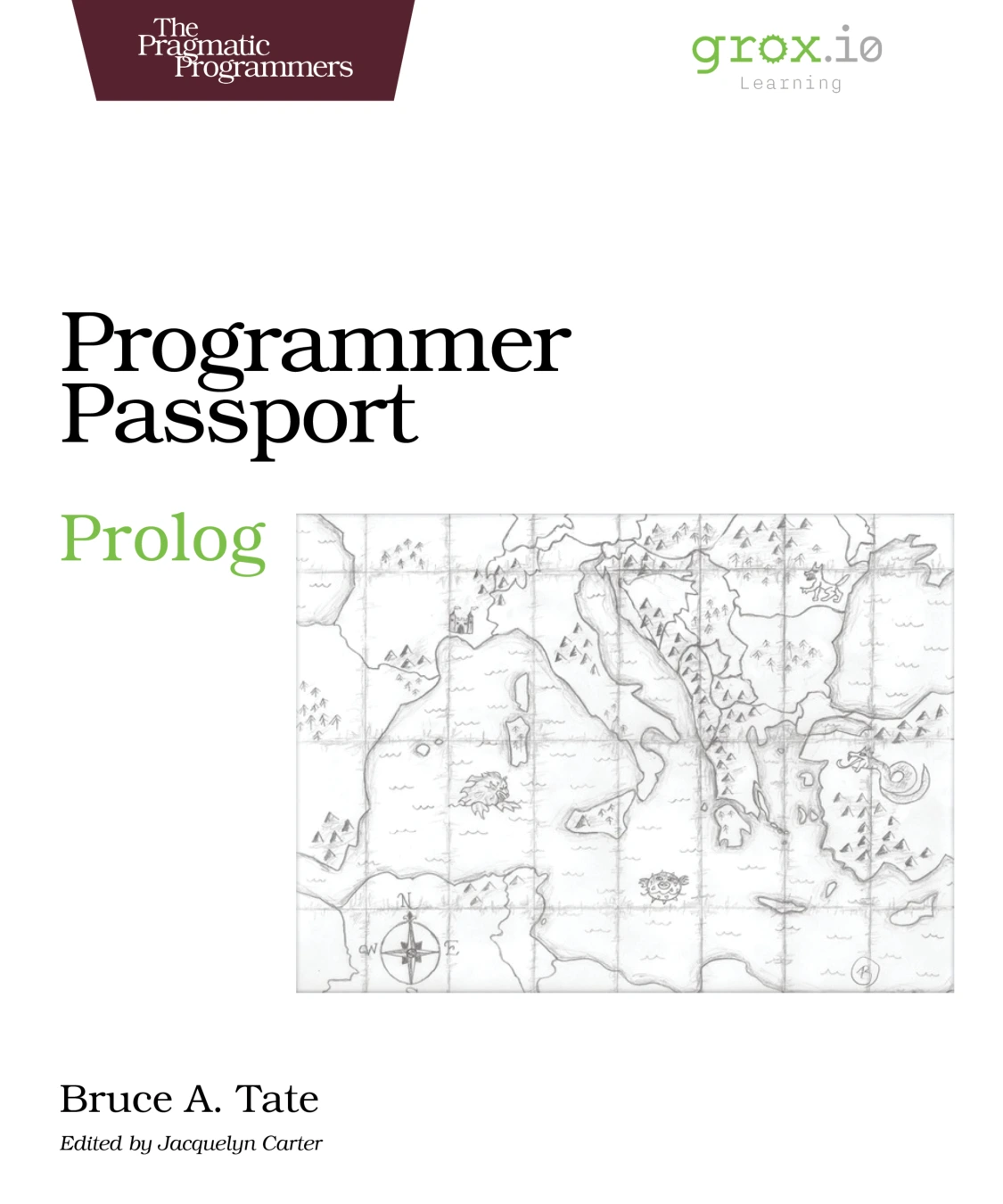
Programmer Passport: Prolog
Original price was: $5.00.$2.50Current price is: $2.50.

Bruce A. Tate
Product Specs:
- File Type: PDF
- File Size: 7.7 MB
- Book Language: English
- Total Page Count: 74
- Instant Download
A Different Way to Think About Code 🧠
Most programming languages ask you to describe how to solve a problem step by step. Prolog asks a different question: what do you know, and what can be inferred from it? Bruce A. Tate’s Programmer Passport: Prolog is a compact, hands-on introduction to that shift in perspective. Across four focused chapters, Tate works with facts, rules, and queries in SWI-Prolog, showing how a small database of statements can answer questions that would take much more code in a conventional language.
From Facts and Rules to Working Queries 💻
The book begins with logic programming basics: predicates, atoms, variables, and the SWI-Prolog console. You’ll see how simple facts and rules combine, then move into inferences and layered reasoning. The emphasis stays practical. Each chapter ends with Try It Yourself material, so you can test ideas in the console rather than just read about them.
Solve Classic Logic Problems 🧩
Chapter 2 turns to problems that have long served as logic-programming teaching tools: map coloring, unification, lists, pattern matching, and the Eight Queens puzzle. These examples show Prolog’s backtracking in action. Instead of forcing a single path, the language can explore possibilities, reject dead ends, and return all valid solutions. That makes the chapter useful for readers who want to understand why Prolog feels so different from mainstream languages.
Graphs, Paths, and Weighted Choices
Graphs get their own chapter. Tate starts with directed graphs represented as facts and edges, then moves to bidirectional graphs and path optimization, including weighted paths. If you have used graph algorithms in other languages, this section shows how declarative rules can express relationships and let the engine search for answers. The material is concise but gives enough structure to try similar modeling in your own projects.
Scheduling with Constraints
The final chapter applies Prolog to scheduling and code organization. You’ll work through scheduling teams on a field, generating possibilities, establishing constraints, and shaping a readable solution. It is a practical demonstration of how facts and rules can describe a problem space, then let Prolog find arrangements that satisfy multiple requirements.
Who This Prolog Book Is For
This is a focused guide for developers who want a fast, thoughtful introduction to logic programming. It suits programmers curious about AI-related techniques, SWI-Prolog users, and anyone who wants to add a declarative problem-solving approach to their toolkit. Because the examples are short and the explanations stay direct, it can work as a first Prolog book or as a compact refresher for experienced developers. Expect to spend time at the console; the book’s value comes from trying queries, changing rules, and watching Prolog search.
Start Your Prolog Moment
Bruce A. Tate writes from experience with multiple languages, and the preface explains his own Prolog moment — the point where a few lines of facts and rules produced a surprising set of correct answers. Programmer Passport: Prolog is an invitation to find that moment yourself, one query at a time. 📚
User Reviews
Be the first to review “Programmer Passport: Prolog”
You must be logged in to post a review.
Original price was: $5.00.$2.50Current price is: $2.50.



There are no reviews yet.