

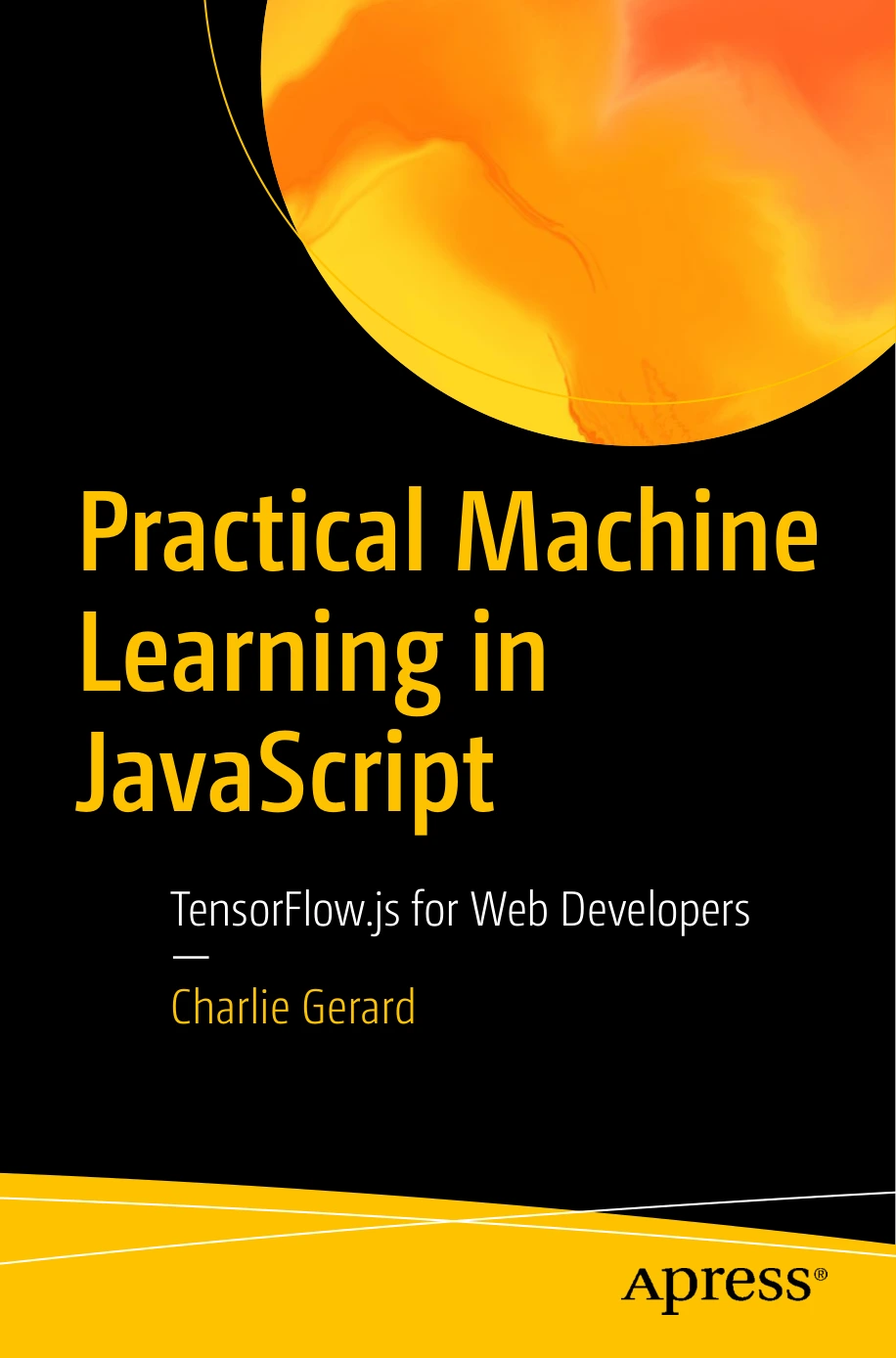
Practical Machine Learning in JavaScript: TensorFlow.js for Web Developers
Original price was: $5.00.$2.50Current price is: $2.50.

Charlie Gerard
Product Specs:
- File Type: PDF
- File Size: 9.0 MB
- Book Language: English
- Total Page Count: 334
- Instant Download
A Practical Path to Machine Learning for JavaScript Developers
Machine learning often feels like a Python-only discipline. Practical Machine Learning in JavaScript challenges that assumption. Published by Apress in 2021, this guide by Charlie Gerard shows how web developers can build and run machine learning models directly with, using JavaScript and the browser to create interactive, intelligent experiences. The focus stays on practical implementation: tensors, models, training, prediction, and the kinds of projects that make the concepts stick.
Start with the Foundations 🧠
The book opens with the basics of machine learning, covering what it is and how the main learning types differ: supervised, unsupervised, reinforcement, and semi-supervised. It also introduces algorithms such as K-nearest neighbors and convolutional neural networks, giving readers the vocabulary and mental models they need before working with code.
Move into 💻
Next comes itself. Readers learn how to work with tensors, access and manipulate data, use pre-trained models, and create, train, and predict with their own models. This section forms the technical bridge between machine learning theory and browser-based JavaScript projects.
Build Projects That Use Real Inputs ⚙️
The middle of the book is project-driven. An image classifier demonstrates how to use a pre-trained model in a web application. Text classification and sentiment analysis introduce natural language processing, including concepts like positive, negative, and neutral sentiment, toxicity classification, named entity recognition, text summarization, and question answering with. Later experiments explore audio data, visualization, training classifiers, transfer learning, body and movement tracking, sensor data, and web sockets.
Take Models into Production
Moving from prototype to production raises its own questions. The book covers machine learning in production, including high availability, the machine learning life cycle, machine learning systems, pre-trained models, and serving platforms. These chapters help developers think beyond the notebook or demo and consider how models behave in real applications.
Consider Bias in Machine Learning
A later chapter examines bias in machine learning, with examples of how bias can appear and potential solutions such as framing the problem carefully and collecting data thoughtfully. For developers building systems that affect people, this is a necessary part of the conversation.
Who This Book Is For
If you are a web developer curious about machine learning but not ready to leave JavaScript behind, this book meets you where you are. It is also useful for front-end engineers, full-stack developers, and technically minded makers who want to understand through working code. Charlie Gerard, a senior front-end developer at Netlify, Google Developer Expert in Web Technologies, and Mozilla Tech Speaker, brings a practitioner’s perspective to the subject. The result is a guide for developers who want to experiment, build, and ship machine learning features in the browser.
User Reviews
Be the first to review “Practical Machine Learning in JavaScript: TensorFlow.js for Web Developers”
You must be logged in to post a review.
Original price was: $5.00.$2.50Current price is: $2.50.

There are no reviews yet.