

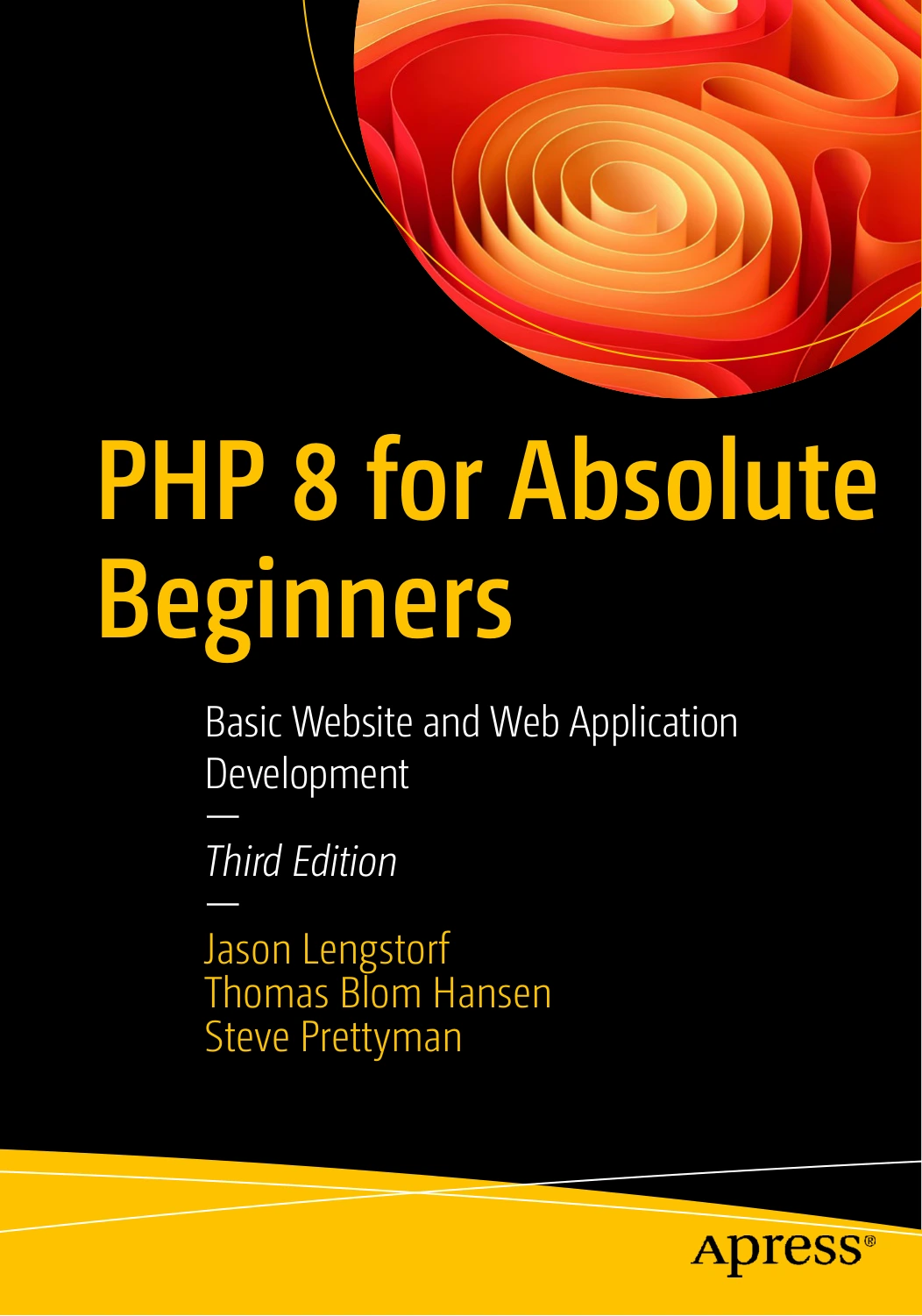
PHP 8 for Absolute Beginners: Basic Website and Web Application Development, Third Edition
Original price was: $5.00.$2.50Current price is: $2.50.

Jason Lengstorf
Product Specs:
- File Type: PDF
- File Size: 10.1 MB
- Book Language: English
- Total Page Count: 439
- Instant Download
Start Building With PHP 8 — From First Script to Working Application
Plenty of PHP material assumes you already think like a developer. This book does not. PHP 8 for Absolute Beginners begins with the small practical questions — what PHP actually does on a server, how Apache and MySQL/MariaDB fit together, what happens when a browser requests a page that ends — and then builds outward chapter by chapter until you are assembling a functioning blog.
Across its pages the third edition stays deliberately concrete. Ideas arrive attached to something you can run, break, fix, and run again.
Set Up a Real Development Environment First 💻
Before the first line of code, the book walks through installing PHP, Apache, and MySQL/MariaDB, opening the XAMPP control panel, and confirming that each service is actually running. It is the least glamorous part of learning to program and the part that trips up the most beginners — so the material treats it as a proper task rather than a footnote. You write a first script, execute it, and see output in a browser, which is the moment the abstractions stop feeling abstract.
Language Basics That Hold Up Under Pressure
From there, the chapters move through variables, control structures, includes, and page templates. A running exercise builds a small dynamic site: a page template that gets reused, a navigation bar that changes depending on where the visitor is, information passed between pages, and isset() used to test whether a variable is actually set before relying on it. The result is a site that behaves differently instead of a static collection of files.
Forms, Functions, and the Shape of an Application
Form management gets its own treatment — the <input> element and its common types, the meaning of the method attribute, and how submitted data travels from a page into PHP logic. Named functions are introduced with attention to arguments and flexibility, then extended into object-oriented territory with constructors, getters, and setters. Rather than presenting objects as an advanced topic shelved for later, the book lets them emerge as a sensible answer to growing complexity.
Build a Dynamic Image Gallery 📷
One of the most satisfying stretches of the book builds a gallery that reads a folder of images and displays them. Along the way you meet glob for finding files, a form for uploading new images, the planning of an uploader class, and the single responsibility principle as a design habit rather than a slogan. It is a compact project, but it touches file handling, user input, class design, and page rendering in a way that mirrors real work.
Databases, MVC, and the Blog System
The later chapters shift toward architecture. After a review chapter consolidating PHP 8 syntax, the book introduces MySQL/MariaDB data storage, builds a database with CREATE statements, and drives a database-backed site poll. From there, the model-view-controller pattern is explained by using it: separating concerns, wiring a poll view to a poll model, connecting to the database from PHP, sharing that connection, retrieving records through a PDOStatement, and updating a table from form input.
The final project — a basic blog system — brings those pieces together. You create the blog_entry table, build an admin view with entry manager navigation and module controllers, design the entry input form, connect to the database, write an Entry_Table class, process and save submitted entries, and then display them on the user-facing side using SQL clauses such as SUBSTRING.
Who This Book Suits
- Complete beginners who want a structured, project-based route into server-side programming
- Self-taught developers filling gaps in PHP, database, and MVC fundamentals
- Students and instructors looking for an incremental, exercise-driven text
- Anyone moving from static HTML toward genuinely dynamic sites
If you learn best by building something small, understanding why it works, and then making it slightly bigger, this edition was written with you in mind. 📚
User Reviews
Be the first to review “PHP 8 for Absolute Beginners: Basic Website and Web Application Development, Third Edition”
You must be logged in to post a review.
Original price was: $5.00.$2.50Current price is: $2.50.
There are no reviews yet.