

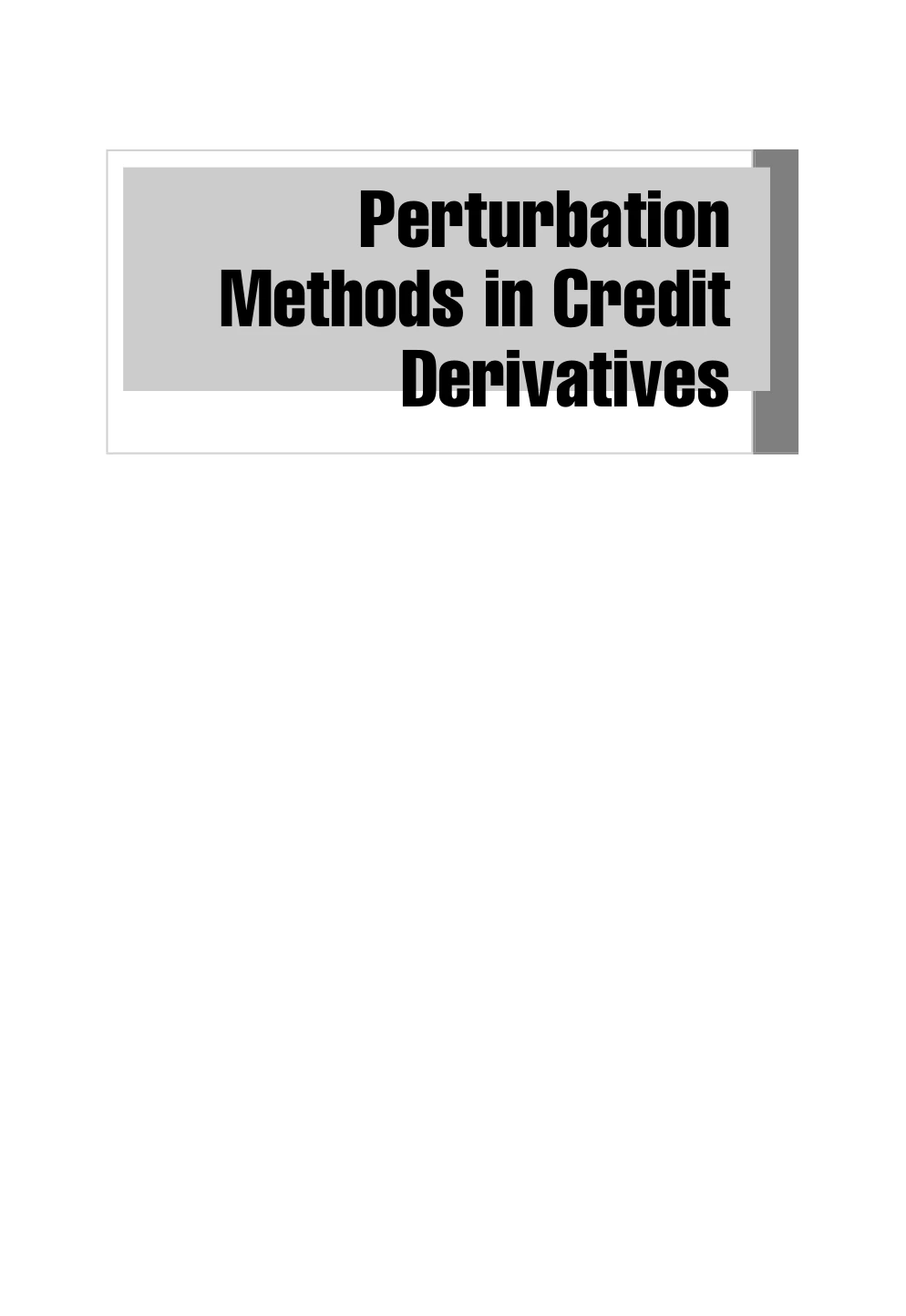
Perturbation Methods in Credit Derivatives: Strategies for Efficient Risk Management
Original price was: $5.00.$2.50Current price is: $2.50.

Colin Turfus
Product Specs:
- File Type: PDF
- File Size: 2.9 MB
- Book Language: English
- Total Page Count: 246
- Instant Download
Analytic Pricing for Credit and Hybrid Derivatives
Colin Turfus’s Perturbation Methods in Credit Derivatives is a technical guide for quants who need to price semi-exotic credit and hybrid products without relying solely on brute-force simulation. The book develops a systematic approach for deriving exact or approximate analytic expressions, using operator formalism and perturbation expansions to construct pricing kernels. Those kernels then become the building blocks: once obtained, a product price follows from a convolution of the payoff with the kernel.
Published in 2021 by John Wiley & Sons in the Wiley Finance series, the book assumes a working knowledge of risk-neutral pricing and the stochastic calculus used to define standard derivatives models. From there, it builds a framework that reaches across rates, credit, equity, and FX hybrids.
What the Book Sets Out to Do
Rather than solving individual payoff problems one at a time, Turfus seeks general solutions to pricing equations. This shift in emphasis is central to the book’s method. The result is a reusable mathematical toolkit for analysts who want analytic insight into products where closed-form solutions are not readily available.
- Derive pricing kernels for short-rate and credit-intensity models.
- Apply perturbation expansion techniques to obtain tractable approximations.
- Use convolution to price specific products from those kernels.
- Extend the framework to hybrid and multi-factor settings.
From Pricing Kernels to Product Prices
The book treats the pricing equation as a linear partial differential equation, often a second-order diffusion equation. Using the Feynman–Kac theorem, it re-expresses models in this PDE form and then applies operator methods to find solutions. The approach is demonstrated on Hull–White and Black–Karasinski short-rate models, with applications to zero-coupon bonds, LIBOR, caplets, and European swaptions.
Later chapters extend the same logic to multi-factor modelling and to hybrids involving rates and credit, credit and equity, credit and FX, and multiple currencies. The book also revisits quanto CDS pricing, contingent CDS, and cross-currency swaps within the perturbation framework.
Models and Hybrids Covered
The material moves from foundations to increasingly complex settings. Readers encounter:
- Pricing kernels and evolution operators.
- Hull–White and Black–Karasinski short-rate models.
- Multi-factor and multi-curve frameworks.
- Rates–credit, credit–equity, credit–FX, and rates–credit–FX hybrids.
- Risk-free rates, compounded rates, and average rate options.
- Scenario generation, model risk management, and machine learning synergies.
Chapter 17 discusses the relationship between perturbation methods and machine learning, including asymptotics as control variates and data representation. Chapter 16 addresses model risk methodology and calibration to the CDS market.
Who Will Find It Useful
This is not an introductory derivatives text. It speaks to quantitative analysts, financial engineers, risk managers, and graduate students who already understand risk-neutral pricing and stochastic calculus. Practitioners working on credit derivatives, hybrid products, or model risk will find a coherent analytic alternative to purely numerical pricing workflows.
Why This Approach Matters
Analytic approximations can provide fast intuition and serve as benchmarks for more computationally intensive methods. By focusing on pricing kernels rather than isolated payoffs, the book offers a way to see common mathematical structure across products that might otherwise appear unrelated. For quants who want to understand the mechanics behind efficient risk management, this is a focused and methodical addition to the Wiley Finance series.
User Reviews
Be the first to review “Perturbation Methods in Credit Derivatives: Strategies for Efficient Risk Management”
You must be logged in to post a review.
Original price was: $5.00.$2.50Current price is: $2.50.




There are no reviews yet.