

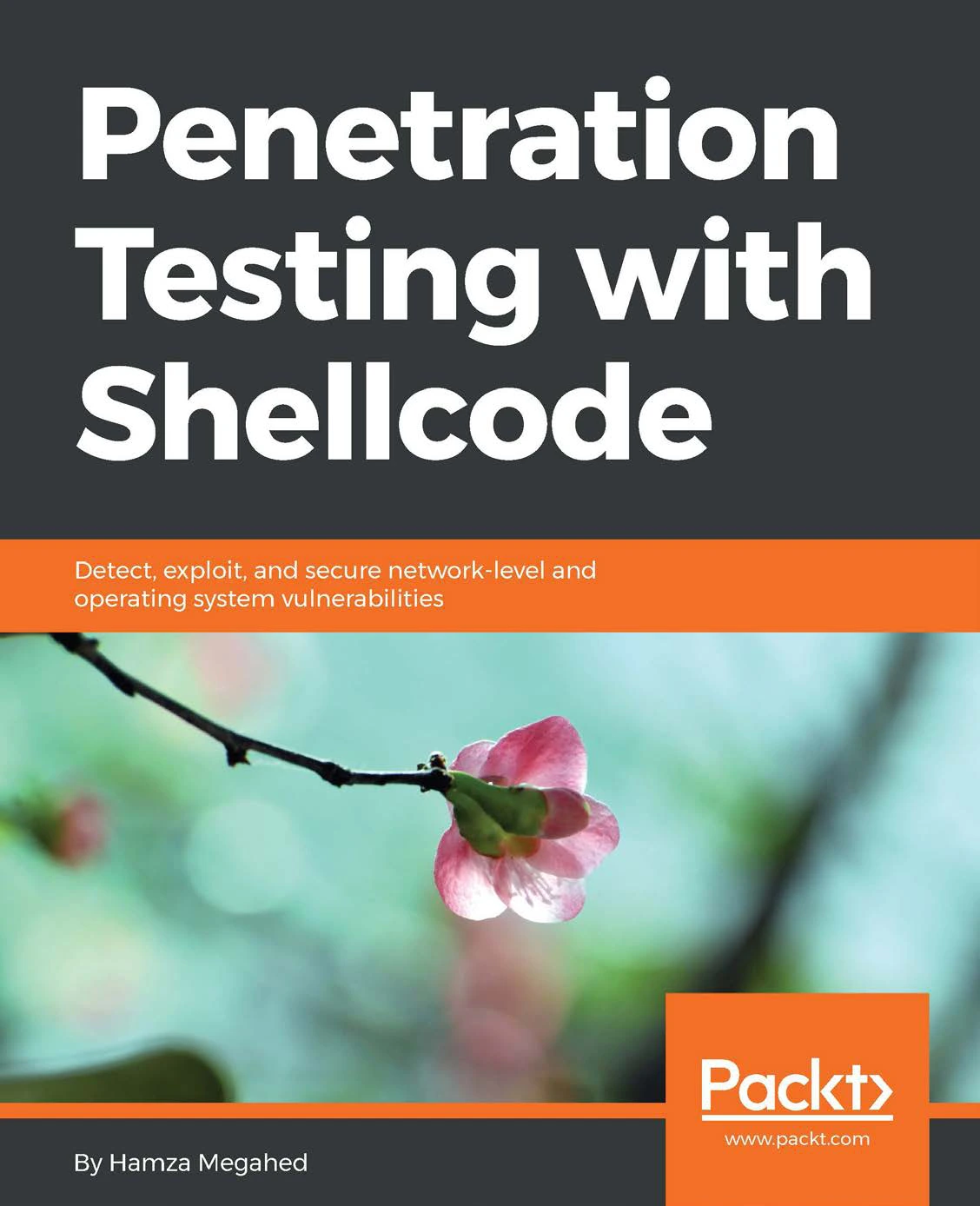
Penetration Testing with Shellcode: Detect, exploit, and secure network-level and operating system vulnerabilities
Original price was: $5.00.$2.50Current price is: $2.50.

Hamza Megahed
Product Specs:
- File Type: PDF
- File Size: 23.7 MB
- Book Language: English
- Total Page Count: 336
- Instant Download
Shellcode, Exploits, and the Low-Level Work Behind Penetration Testing
Penetration Testing with Shellcode is a hands-on Packt guide for readers who want to understand what happens beneath the surface of a software vulnerability. Hamza Megahed starts with the building blocks—stack and heap behavior, memory layout, registers, endianness, system calls—then moves into setting up controlled lab environments and writing assembly on Linux.
The book’s central thread is practical: how shellcode is created, tested, and used inside exploit development. It examines bad characters, relative addressing, the jmp-call technique, stack-based methods, and classic shellcode payloads such as execve, TCP bind shells, and reverse TCP shells. Metasploit appears as a tool for generating shellcode, but the earlier chapters establish the underlying mechanics so the payloads are not treated as magic. 🔐
From Assembly to Buffer Overflow Attacks
After the assembly and reverse-engineering foundations, the book turns to buffer overflow attacks on both Linux and Windows. Readers work through stack overflows, fuzzing, controlling the instruction pointer, injecting shellcode, and building complete examples. Later chapters introduce return-oriented programming, structured exception handling, and real-world scenarios involving Freefloat FTP Server, Sync Breeze Enterprise, and Easy File Sharing Web Server.
The final chapter shifts to detection and prevention, looking at system, compiler, and developer approaches to reducing the impact of the vulnerabilities discussed throughout the book. That balance matters: the material is offensive in orientation, but it also asks how defenders and developers can make exploitation harder. ⚙️
What You’ll Work Through 💻
- Core concepts: stack, buffer, stack overflow, heap corruption, memory layout, and shellcode
- Computer architecture foundations: general-purpose registers, instruction pointer, segment registers, endianness, and syscalls
- Lab setup for attacker machines, Linux and Windows victims, Ubuntu assembly, and networking
- Linux assembly language, including data types, stack operations, arithmetic, loops, procedures, and logical and bitwise operations
- Debugging and reverse engineering on Linux and Windows
- Shellcode creation techniques, bad characters, execve, bind shells, reverse TCP shells, and Metasploit generation
- Buffer overflow exploitation on Linux and Windows
- Exploit development with fuzzing, EIP control, shellcode injection, ROP, and SEH
- Real-world practice against Freefloat FTP Server, Sync Breeze Enterprise, and Easy File Sharing Web Server
Who This Book Is For
The preface names penetration testers, malware analysts, security researchers, forensic practitioners, exploit developers, C language programmers, software testers, and security students as the intended readers. That list reflects the book’s range: it is not a surface-level introduction to security tools. It assumes readers are willing to work close to memory, assembly, debuggers, and exploit code. The lab setup chapter helps create a safer testing space, but the content still demands focus and curiosity about low-level systems. 🧠
Why Shellcode Still Matters
Shellcode sits at the intersection of operating system internals, networking, and exploit development. Understanding how it is written and why certain bytes fail can change how a penetration tester approaches a target and how a defender thinks about memory corruption. This book connects those layers rather than treating each one as an isolated topic. It is a technical path through the mechanics of exploitation, written for readers who want to build the skills from the ground up. 🛠️
If your work involves offensive security, exploit analysis, or low-level programming, Penetration Testing with Shellcode offers a structured route through the techniques and thinking behind shellcode-based attacks.
User Reviews
Be the first to review “Penetration Testing with Shellcode: Detect, exploit, and secure network-level and operating system vulnerabilities”
You must be logged in to post a review.
Original price was: $5.00.$2.50Current price is: $2.50.





There are no reviews yet.