

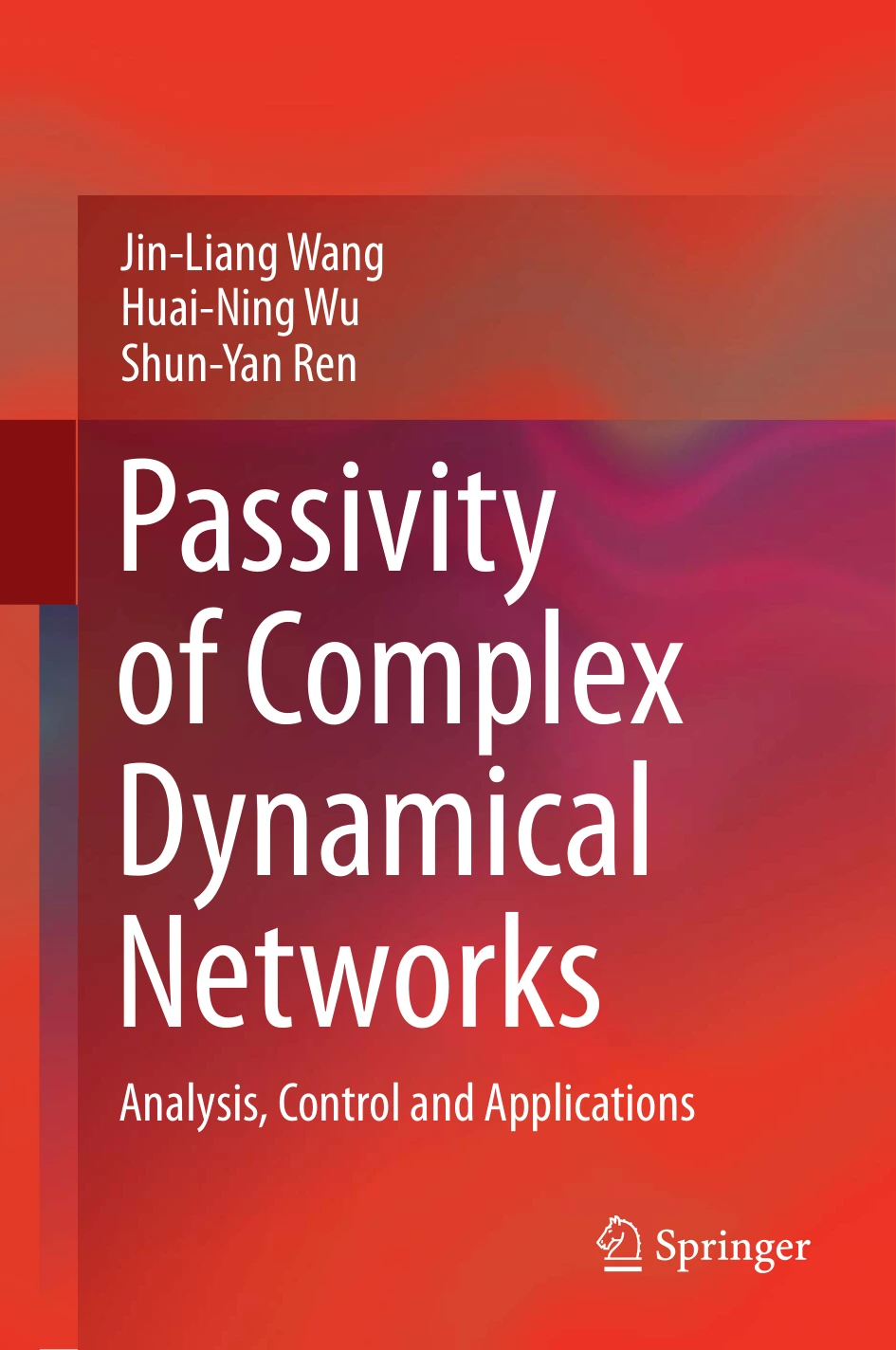
Passivity of Complex Dynamical Networks: Analysis, Control and Applications
Original price was: $5.00.$2.50Current price is: $2.50.

Jin-Liang Wang
Product Specs:
- File Type: PDF
- File Size: 9.7 MB
- Book Language: English
- Total Page Count: 251
- Instant Download
A Focused Treatment of Passivity in Complex Dynamical Networks
Passivity has become a central concept in the analysis and control of complex dynamical networks, linking system energy, stability, and synchronization. This monograph by Jin-Liang Wang, Huai-Ning Wu, and Shun-Yan Ren brings together recent theoretical advances in passivity for network models that go beyond the standard same-dimension input-output setting. It is aimed at readers who want a rigorous, methodical account of how passivity conditions are derived and then used to design control and synchronization schemes.
From Ordinary to Partial Differential Network Models
The book moves from ordinary differential complex dynamical networks to partial differential models where states depend on both time and space. Early chapters examine networks with nonlinear, time-varying, non-symmetric, and delayed coupling, and networks with multiple weights. Later chapters turn to coupled neural networks, reaction-diffusion neural networks, and delayed reaction-diffusion networks. The progression gives readers a broad view of how passivity theory adapts as network structure and dynamics become more complex.
Passivity, Synchronization, and Finite-Time Control
A recurring theme is the link between passivity and synchronization. The authors derive input strict passivity, output strict passivity, and finite-time passivity criteria, then show how those criteria support synchronization results. Control strategies include state feedback, adaptive state feedback, pinning adaptive control applied to selected nodes or edges, and adaptive control for uncertain networks. Several chapters focus specifically on finite-time passivity and finite-time synchronization, a direction that matters when convergence within a prescribed time is required.
Methods and Analytical Framework
Lyapunov functionals and inequality techniques form the technical backbone of the book. The authors use these tools to establish sufficient conditions for passivity, robust passivity, global exponential stability, and asymptotic stability. Numerical examples appear throughout to illustrate the derived criteria and to demonstrate their effectiveness. The treatment is mathematically detailed, so readers should be comfortable with dynamical systems, matrix analysis, and control theory at the graduate or advanced undergraduate level.
A Notable Application: Food Web Dynamics
One chapter applies passivity-based analysis to a food web model with time delay and reaction-diffusion terms. This application shows how the theoretical framework can be used to study stability and control in a biological network context, extending the book’s relevance beyond purely engineering examples. It also illustrates the practical motivation behind the more abstract passivity results developed earlier.
Who Will Find It Useful
This monograph is intended for researchers, graduate students, and practitioners working on complex networks, nonlinear control, synchronization, neural networks, and reaction-diffusion systems. It will be most valuable to readers who already have a foundation in control theory and applied mathematics and who want a concentrated, research-level treatment of passivity methods. The combination of theoretical derivations, control design strategies, and numerical validation makes it a useful reference for advanced study and for researchers entering this specialized area.
User Reviews
Be the first to review “Passivity of Complex Dynamical Networks: Analysis, Control and Applications”
You must be logged in to post a review.
Original price was: $5.00.$2.50Current price is: $2.50.






There are no reviews yet.