

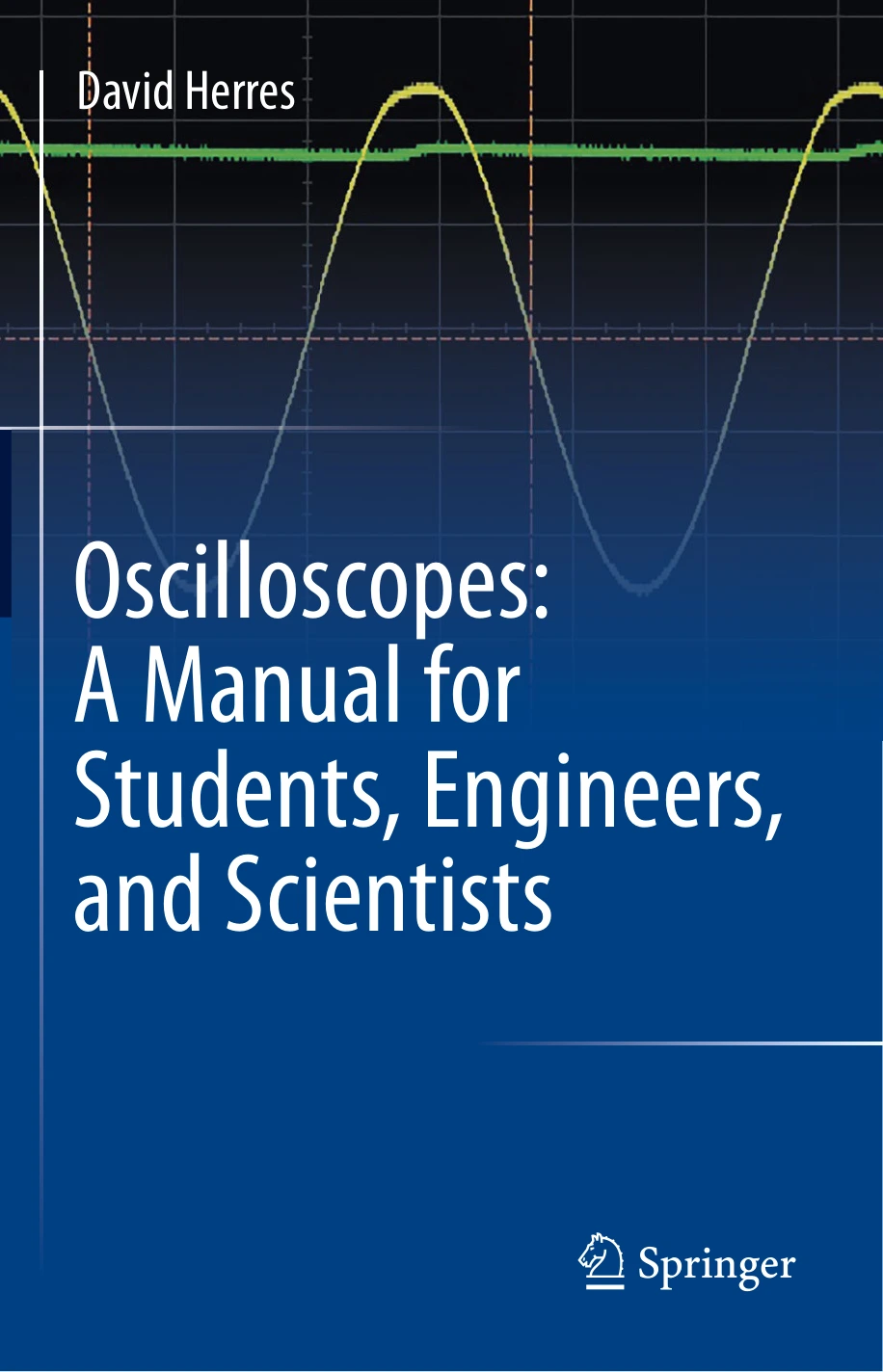
Oscilloscopes: A Manual for Students, Engineers, and Scientists
Original price was: $5.00.$2.50Current price is: $2.50.

David Herres
Product Specs:
- File Type: PDF
- File Size: 16.0 MB
- Book Language: English
- Total Page Count: 276
- Instant Download
Oscilloscopes: A Manual for Students, Engineers, and Scientists ⚡
David Herres writes for readers who already have some grounding in electronics and want to understand the oscilloscope more deeply—not just how to turn it on, but how it captures, displays, measures, and helps analyze waveforms. The book moves from waveform fundamentals and instrumentation overview into the inner workings of the instrument, then outward to practical measurement, debugging, and communication tasks.
What the Book Covers
Early chapters introduce waveform fundamentals, the Fourier transform, and spectrum analyzer basics. From there, Herres examines the semiconductors inside an oscilloscope, the signal path, triggered-sweep digital storage architecture, front-end design, preamplifiers, bandwidth enhancement, and memory depth. A Tektronix MDO3104 is used for many demonstrations, with the author noting that the techniques transfer to other makes despite differences in menus and terminology.
From Theory to Bench Practice
The middle sections treat the oscilloscope as a diagnostic tool. Readers encounter noise mitigation, noise floor considerations, math mode, measure functions, frequency-trace addition and subtraction, waveform histograms, and cursor-based manual measurements. Sampling, sample rate, waveform update rate, and record length are also discussed in detail, because these factors shape what a digital scope can show.
Digital Signals and Serial Buses
Later chapters shift to acquiring, displaying, and measuring digital signals. Topics include point-to-point digital communication, I2C, SPI, and LIN buses, plus debugging and troubleshooting digital circuits. The book also addresses hardware problems and debugging strategies, signal tracing in radio or TV equipment, and digital bus debugging notes.
Networking, PC-Based Scopes, and Safety
Near the end, Herres looks at oscilloscope networking and device communications: editing files, directories, reference waveforms, and instrument setups; connecting a scope to a computer via LAN and VISA drivers; National Instruments; displaying external video; and connecting printers and keyboards. There is coverage of electrocardiography and wireless oscilloscope technology, followed by PC-based scopes, handheld models, and major manufacturers. Safety guidance is present throughout, including grounding and floating-ground hazards.
Who This Manual Is For
The introduction states that the book will be most useful for readers with some theoretical and practical knowledge of electronics. Complete mastery is not expected. Algebra, right-triangle trigonometry, and some calculus are helpful, but calculus is not essential. Students, technicians, and experienced engineers who want to look deeper into oscilloscope properties, functionality, and practical applications are the intended audience.
Why It Matters
An oscilloscope is a window into signals that meters alone cannot reveal. Herres balances instrument theory with bench-level technique, making the material relevant to anyone who needs to see, measure, and troubleshoot electronic behavior with confidence. The result is a focused manual that treats the oscilloscope as both a measuring tool and an analytical instrument. 🛠️
User Reviews
Be the first to review “Oscilloscopes: A Manual for Students, Engineers, and Scientists”
You must be logged in to post a review.
Original price was: $5.00.$2.50Current price is: $2.50.



There are no reviews yet.