

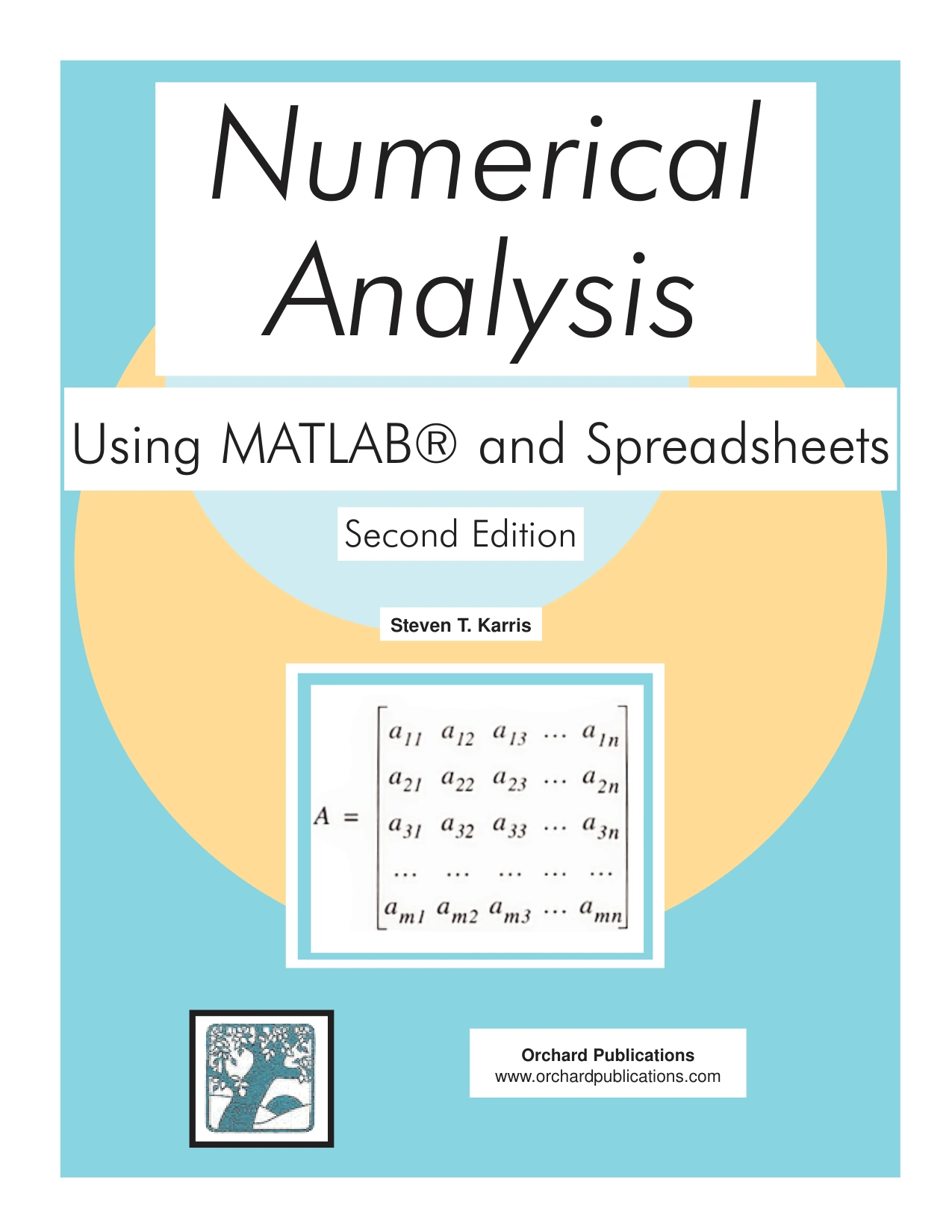
Numerical Analysis Using MATLAB and Spreadsheets, Second Edition
Original price was: $5.00.$2.50Current price is: $2.50.

Steven T. Karris
Product Specs:
- File Type: PDF
- File Size: 4.6 MB
- Book Language: English
- Total Page Count: 570
- Instant Download
A Practical Bridge Between Numerical Methods and Computational Tools
Some numerical-analysis books never leave the chalkboard. Numerical Analysis Using MATLAB and Spreadsheets keeps one foot in the theory and one on the keyboard, showing how established methods behave when they are implemented in MATLAB or set up in a spreadsheet. This second edition by Steven T. Karris is built as a working textbook: concepts are introduced, then demonstrated with examples, command-window conventions, and detailed procedures.
The opening chapter sets up the MATLAB environment, covering command-window practice, m-files, comments, complex numbers, and polynomial operations. From there, the book widens into the methods that make numerical analysis useful in engineering and applied mathematics.
What the Book Covers
Across sixteen chapters, the material moves from foundational computation to more specialized techniques. Readers encounter:
- Root approximation with Newton’s method, the bisection method, and spreadsheet approximations
- Sinusoids, phasors, and trigonometric representations
- Matrices, determinants, Gaussian elimination, and simultaneous equations
- Differential equations, state variables, and state-transition matrices
- Fourier, Taylor, and Maclaurin series
- Finite differences, interpolation, and regression
- Numerical solution of differential equations and numerical integration
- Difference equations, partial fraction expansion, gamma and beta functions
- Orthogonal functions, matrix factorizations, Bessel, Legendre, and Chebyshev functions
- Optimization methods
That range gives the book a useful arc. Early chapters build confidence with MATLAB syntax and basic numerical tasks, while later chapters apply those tools to equations, series, transforms, and optimization problems that appear throughout science and engineering.
MATLAB as a Computational Companion 💻
MATLAB is treated as a working environment rather than a side note. The text explains how to enter commands, organize scripts, use built-in functions, and interpret results. Examples such as polynomial root finding and matrix operations show how MATLAB can turn a theoretical procedure into a repeatable calculation. The book’s conventions for screen output, user input, functions, and file names help readers move from reading code to writing their own.
Spreadsheets as an Accessible Alternative 📊
Not every reader reaches for a programming language first. The spreadsheet sections offer a second route into numerical methods, especially for approximation and iterative procedures. By presenting both approaches, the book helps readers compare tools and choose the one that fits the problem at hand. This dual focus is one of the title’s defining features.
Who Will Find It Useful
The content is likely most valuable to engineering, mathematics, and technology students who need to connect numerical methods with software they can actually run. It can also serve as a refresher for practitioners who want a structured reference to MATLAB commands, spreadsheet techniques, and the mathematics behind common computational routines. A reader who is comfortable with algebra, calculus, and basic engineering concepts will get the most from the more advanced chapters.
Because the book combines theory, worked examples, and tool-based practice, it works both as a course companion and as a self-study resource. The second edition keeps the focus on practical implementation, making it a solid digital addition to a technical reference shelf.
User Reviews
Be the first to review “Numerical Analysis Using MATLAB and Spreadsheets, Second Edition”
You must be logged in to post a review.
Original price was: $5.00.$2.50Current price is: $2.50.
There are no reviews yet.