

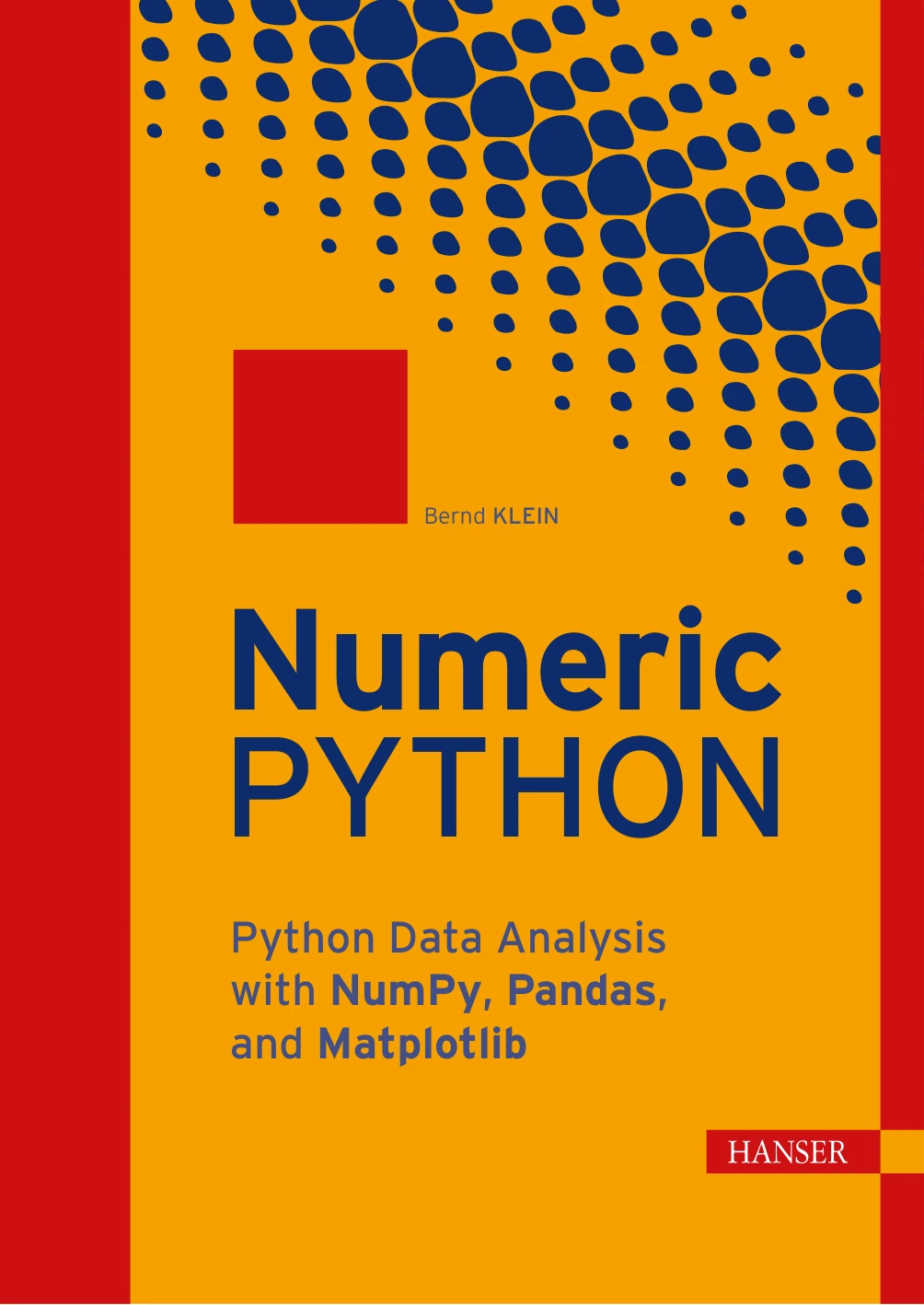
Numeric Python: Python Data Analysis with NumPy, Pandas, and Matplotlib
Original price was: $5.00.$2.50Current price is: $2.50.

Bernd Klein
Product Specs:
- File Type: PDF
- File Size: 19.2 MB
- Book Language: English
- Total Page Count: 576
- Instant Download
Numeric Python: A Practical Path Through Python’s Data Stack
Bernd Klein’s Numeric Python treats NumPy, Pandas, and Matplotlib as parts of one working system. Rather than presenting isolated tricks, it builds a coherent route from numerical programming fundamentals to the array operations, statistical tools, and visual outputs that make Python useful for analysis.
The book opens by defining numerical programming and explaining how Python relates to NumPy, Matplotlib, SciPy, and Pandas. That framing matters: it gives readers a map before they start working with individual libraries.
Build Fluency with NumPy Arrays
The early chapters move from simple arrays to the details that shape performance and behavior. Readers encounter zero-, one-, two-, and multi-dimensional arrays; indexing and slicing; memory requirements; timing comparisons between lists and arrays; creation functions such as zeros, ones, identity, and eye; copying and contiguous arrays; data type objects; structured arrays; and Unicode strings in arrays.
Later sections cover reshaping, ravel and flatten, adding dimensions, concatenation, stacking, tiling, scalar and array operations, matrix multiplication and dot products, comparison operators, broadcasting in row-wise and column-wise forms, and universal functions with output parameters.
Statistics, Randomness, and Synthetic Data
A substantial section turns to statistics and probability. It works through Python’s random module and NumPy’s random submodule, including true random numbers, random integers, samples and selections, intervals, seeds, weighted selection, sampling, Cartesian choice and product, Gaussian normal distributions, and a binary transmitter exercise. The material culminates in synthetic sales figures, showing how random data can be generated and shaped for analysis.
Installation, Tools, and Reproducible Work
The book also covers the environment around the code. Installation guidance includes conda and Miniconda, pip, and starting JupyterLab. These sections help readers set up a workable numerical Python stack before moving into the more detailed library material.
Who This Book Is For
This is a good fit for Python users who want a structured introduction to numerical computing and data analysis. Students, analysts, engineers, scientists, and self-taught programmers can use it to strengthen their understanding of arrays, broadcasting, statistical operations, and the relationships among NumPy, Pandas, and Matplotlib. Readers already comfortable with basic Python will get the most from the progression.
Why It Stands Out
Numeric Python pays attention to the details that often trip up newcomers: why NumPy arrays behave differently from lists, how memory and timing affect choices, how broadcasting changes array operations, and how dtypes and structured arrays organize data. The result is a guide that explains not just what to type, but what the code is doing.
For readers building a foundation in Python data analysis, this book offers a clear, example-driven route through the core numerical libraries. 📊🐍
User Reviews
Be the first to review “Numeric Python: Python Data Analysis with NumPy, Pandas, and Matplotlib”
You must be logged in to post a review.
Original price was: $5.00.$2.50Current price is: $2.50.
There are no reviews yet.