

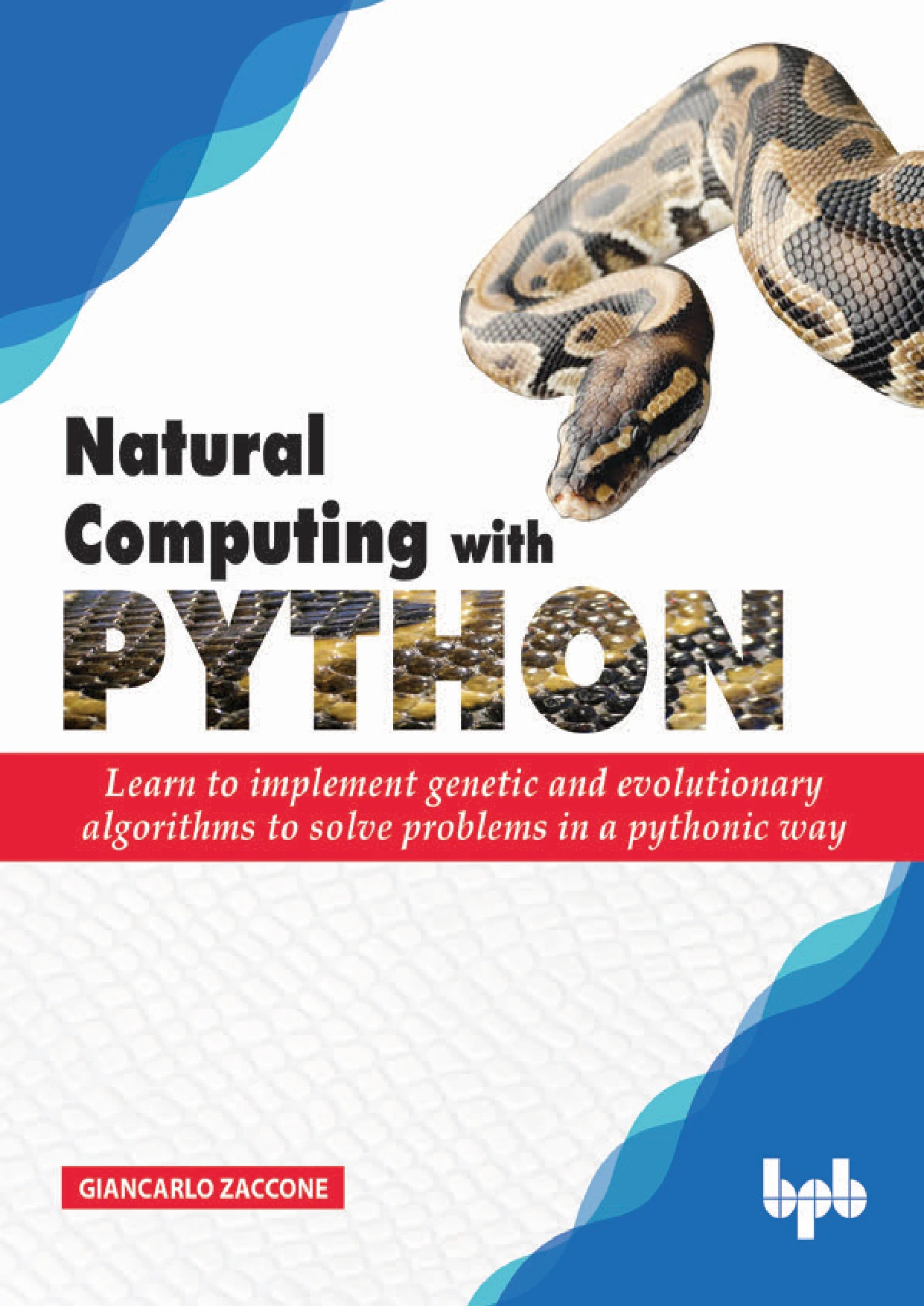
Natural Computing with Python: Learn to Implement Genetic and Evolutionary Algorithms to Solve Problems in a Pythonic Way
Original price was: $5.00.$2.50Current price is: $2.50.

Giancarlo Zaccone
Product Specs:
- File Type: PDF
- File Size: 4.5 MB
- Book Language: English
- Total Page Count: 178
- Instant Download
Natural Computing with Python is a first-edition guide that treats nature-inspired computation as a practical programming discipline rather than a purely theoretical subject. Giancarlo Zaccone builds the book around working Python examples, moving from neural networks and deep learning through genetic algorithms, swarm intelligence, cellular automata, fractals, quantum computing, and DNA computing. Published by BPB Publications in 2019, it is designed for readers who want to understand both the ideas and the code behind biologically and physically inspired algorithms.
What the Book Covers
The chapters form a broad survey of natural computing, with each topic introduced through concepts and then demonstrated in Python. The opening chapters establish neural networks and deep learning foundations, including perceptrons, activation functions, gradient descent, backpropagation, TensorFlow, Keras, convolutional and recurrent networks, autoencoders, and reinforcement learning. Later chapters shift to evolutionary and collective systems: genetic algorithms, genetic programming, ant colony optimization, particle swarm optimization, and the Artificial Bee Algorithm.
The final portion turns to computational models inspired by physics, mathematics, and biology. Readers encounter cellular automata such as the Game of Life, Langton’s ant, and Wolfram automata; fractal geometry with the Cantor set and Mandelbrot set; quantum programming with Qiskit and IBM Q; and a Python simulation of Adleman’s DNA computing experiment.
Hands-On Python, Chapter by Chapter
- Neural networks and deep learning: build MLPs, use TensorFlow, and explore CNNs, RNNs, LSTMs, autoencoders, and Q-learning.
- Genetic algorithms and programming: solve the traveling salesman problem and symbolic regression with gplearn.
- Swarm intelligence: implement ant colony and particle swarm optimization, then work with SwarmPackagePy and the Artificial Bee Algorithm.
- Cellular automata and fractals: code the Game of Life, Langton’s ant, Wolfram automata, recursion, and Mandelbrot set examples.
- Quantum and DNA computing: create quantum circuits with Qiskit, run models on IBM Q devices, and simulate molecular computation.
Who This Book Is For
This is a resource for programmers, students, and researchers who already have some Python experience and want to explore algorithms that borrow from biology, evolution, physics, and chemistry. The book’s example-driven approach suits readers who learn best by building small systems and observing how they behave. It also offers a useful overview for developers who need to connect machine learning, optimization, and unconventional computing concepts in one place.
Why Natural Computing Matters
Nature has already solved many hard problems through evolution, collective behavior, self-similarity, and molecular processes. Translating those strategies into code can lead to flexible optimization methods and new ways of thinking about computation. This book shows how those ideas connect to familiar Python tools, giving readers a practical entry point into a field that spans artificial intelligence, optimization, simulation, and quantum programming. 💻🧬🧠
Companion Resources
The publisher provides a companion code bundle and colored images for the book, which can help readers follow along with the examples and inspect visual results more clearly. ✨
If you want a single-volume tour of natural computing that keeps the Python code close to the theory, Natural Computing with Python offers a broad, hands-on starting point from Digital Delights.
User Reviews
Be the first to review “Natural Computing with Python: Learn to Implement Genetic and Evolutionary Algorithms to Solve Problems in a Pythonic Way”
You must be logged in to post a review.
Original price was: $5.00.$2.50Current price is: $2.50.





There are no reviews yet.