

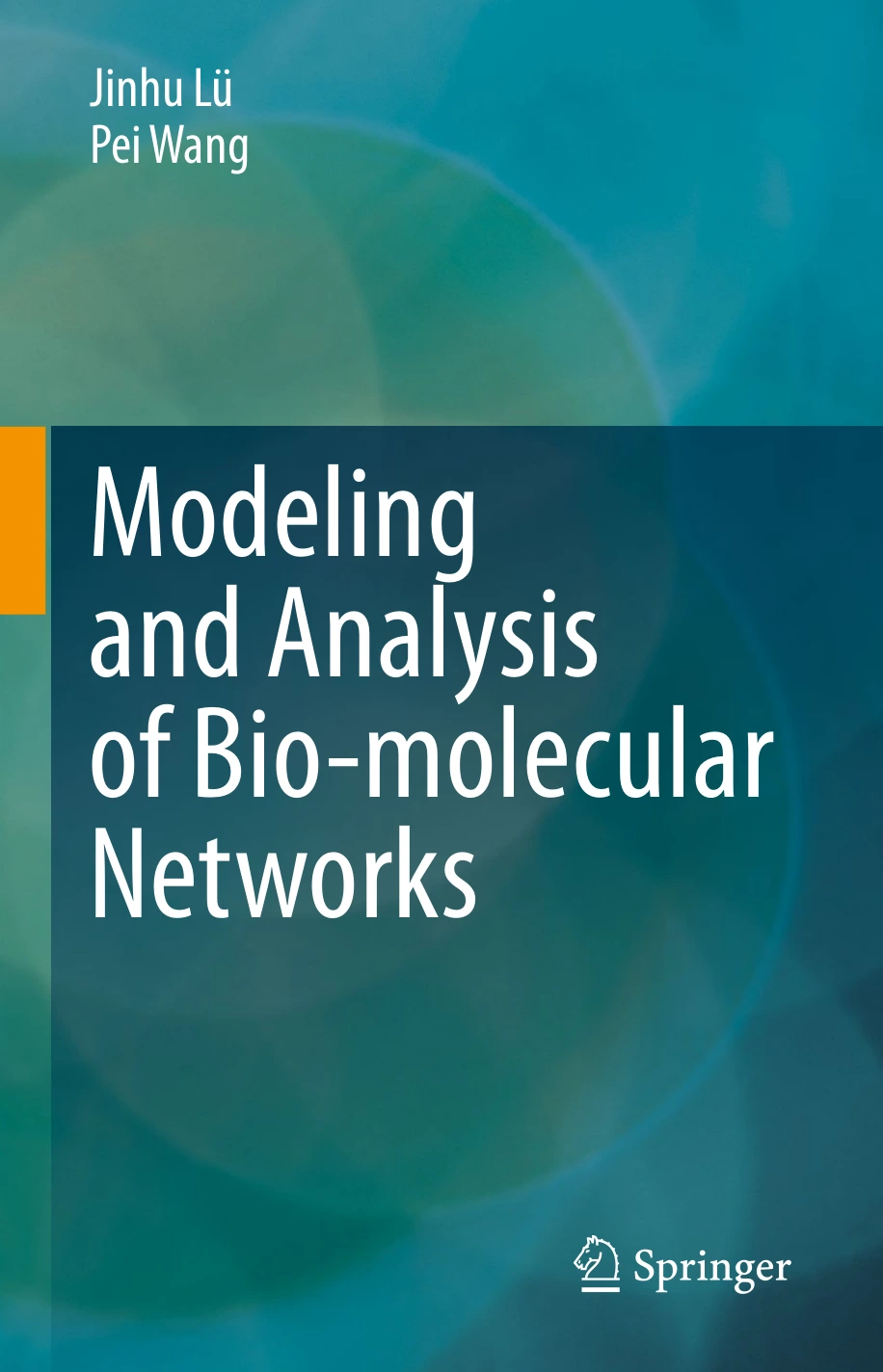
Modeling and Analysis of Bio-molecular Networks
Original price was: $5.00.$2.50Current price is: $2.50.

Jinhu Lü
Product Specs:
- File Type: PDF
- File Size: 21.7 MB
- Book Language: English
- Total Page Count: 475
- Instant Download
Book Overview
Modeling and Analysis of Bio-molecular Networks is a research-oriented textbook that brings mathematical modeling, dynamical analysis, and statistical methods to the study of biological systems. Authors Jinhu Lü and Pei Wang focus on how bio-molecular networks can be represented, reconstructed, and analysed to reveal system-level behaviour in living organisms. The book treats biological networks not as isolated diagrams but as complex systems whose structure and dynamics can be examined with quantitative tools.
From Molecules to Networks
Systems biology seeks a system-level understanding of life by combining biology with mathematical and computational analysis. This book introduces several major classes of bio-molecular networks, including gene regulatory networks, protein–protein interaction networks, metabolic networks, signal transduction networks, and gene co-expression networks. Each type involves different biological entities and interaction patterns, and the authors explain how those differences shape the modeling and analysis process.
What the Book Covers
- Network reconstruction: methods based on online databases, artificial algorithms such as duplication–divergence models, mathematical and statistical inference from molecular data, and topology identification from dynamical systems theory.
- Simple genetic circuits: mathematical modeling and dynamical analysis of network motifs, the recurring circuits that appear more often than expected in randomized networks.
- Coupled and large-scale gene regulatory networks: approaches for moving from small circuits to systems-level descriptions.
- Evolutionary mechanisms: statistical analysis and duplication–divergence modeling of network motifs in undirected protein interaction networks.
- Important nodes and functional genes: methods for identifying key nodes, also known as gene prioritization, and statistical features of functional genes in large-scale human protein–protein interaction networks.
- Omics data analysis: data-driven statistical approaches, including penalized models used for different analytical purposes.
Mathematical and Statistical Foundations
The book assumes a reader who is comfortable with quantitative reasoning. Prerequisites noted by the authors include complex network theory, multivariate statistical analysis, linear algebra, matrix theory, and dynamical systems. The presentation connects these foundations to biological questions, showing how metrics, models, and statistical tests are used to investigate real-world network data. The authors also discuss software tools for network visualization, dynamical analysis, and statistical work, helping readers connect theory with practical computation.
Dynamics of Gene Regulatory Networks
Gene regulatory networks are central to the book. The authors examine how simple genetic circuits behave dynamically, then extend the discussion to coupled and larger regulatory networks. This progression reflects a key challenge in systems biology: whole networks in model organisms are extremely complex, so understanding often begins with smaller motifs and builds toward broader system-level models. The book shows how mathematical modeling can clarify the structural advantages and dynamical roles of these circuits.
Large-Scale Networks and Omics Data
As the scale increases, statistical methods become essential. Later chapters explore large-scale bio-molecular networks, the identification of important nodes, and the statistical properties of functional genes in human protein–protein interaction networks. The final chapter turns to omics data analysis, where high-dimensional biological measurements require careful statistical modeling. The authors survey data-driven approaches and penalized statistical models, connecting methodological choices to the goals of a given analysis.
Who This Book Is For
The intended audience includes undergraduates, graduates, and researchers interested in systems biology, dynamical systems, and complex networks. Readers from bioinformatics, computational biology, applied mathematics, and related fields will find a structured introduction to network-based biological modeling. Because the book moves between biological concepts and mathematical methods, it is most useful to readers who want both perspectives rather than a purely descriptive account of molecular biology.
Why This Subject Matters
Bio-molecular networks help explain how molecules interact to produce the coordinated behaviours of living systems. Reconstructing those networks, analysing their dynamics, and extracting reliable signals from omics data are ongoing challenges with implications for medicine and the life sciences. This book offers a focused, method-oriented view of that work, making it a useful reference for advanced study and research in systems biology and complex network science.
User Reviews
Be the first to review “Modeling and Analysis of Bio-molecular Networks”
You must be logged in to post a review.
Original price was: $5.00.$2.50Current price is: $2.50.




There are no reviews yet.