

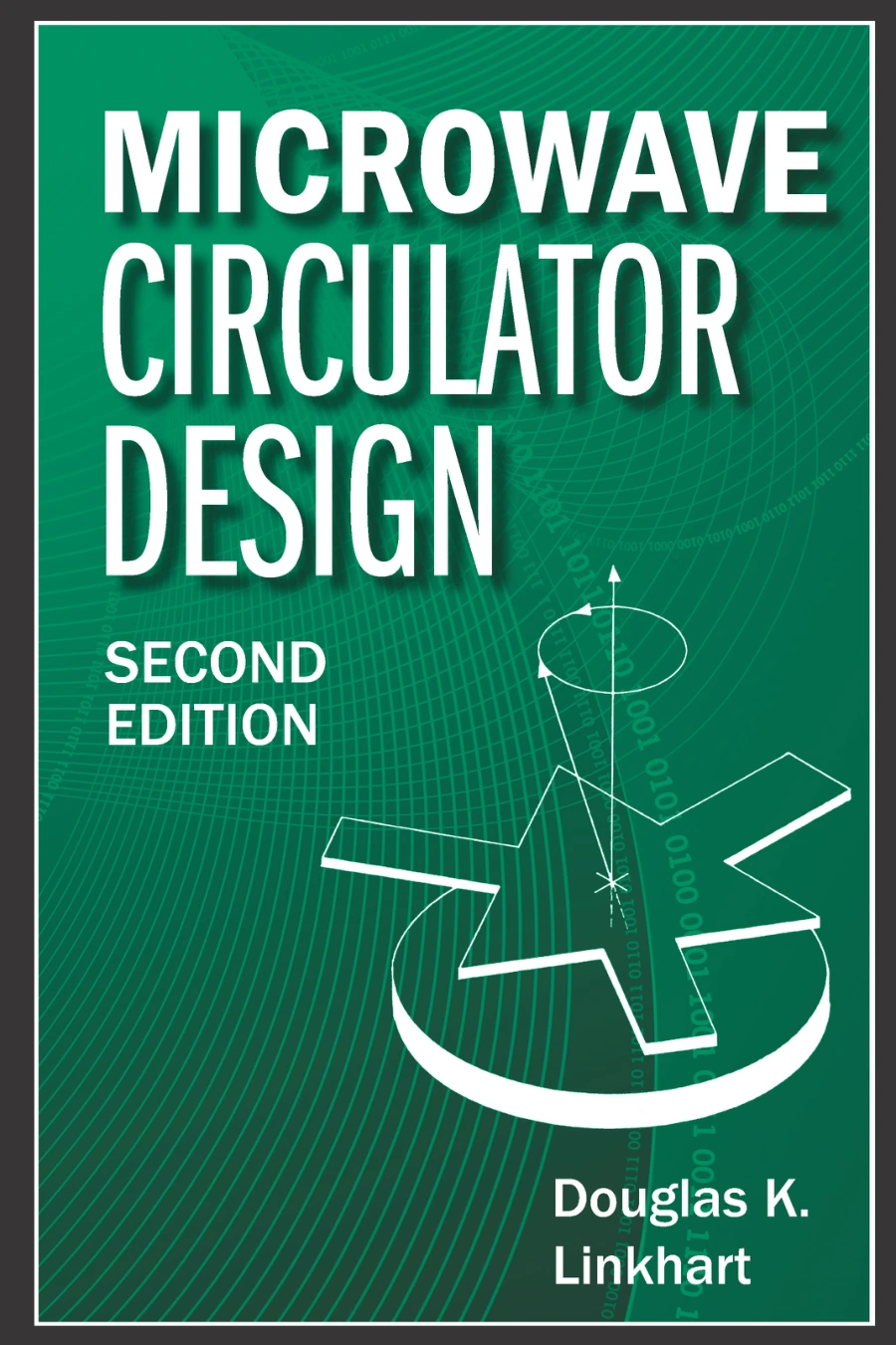
Microwave Circulator Design, Second Edition
Original price was: $5.00.$2.50Current price is: $2.50.

Douglas K. Linkhart
Product Specs:
- File Type: PDF
- File Size: 30.8 MB
- Book Language: English
- Total Page Count: 386
- Instant Download
Microwave Circulator Design in Practice
Microwave circulators are small components with an outsized role in RF systems: they route signals, protect sensitive amplifiers, support duplexing and multiplexing, and help keep transmitters and receivers from interfering with one another. Douglas K. Linkhart’s Microwave Circulator Design, Second Edition approaches these devices as an engineering problem that spans materials science, magnetics, microwave theory, mechanical packaging, and test procedure. Published by Artech House, this edition is a working reference for people who need to understand not only what a circulator does but how design choices affect performance.
From Ferrite Theory to Component Specification
The opening chapters establish the physical basis of ferrimagnetism, ferrimagnetic resonance, and microwave propagation in ferrites. From there, the book moves into circulator specification: the parameters that matter, reflections and segmentation, junction circulators, lumped-constant and differential phase shift designs, switching circulators, Okada circulators, and field-displacement and resonance isolators. The material links device behavior to measurable specifications, which helps readers connect theory with the language of datasheets and design reviews.
Materials, Magnetics, and Electrical Design
Material selection receives detailed treatment, including ferrite classes and manufacturing, test methods, temperature effects, magnet selection, magnetic compensating materials, dielectrics, and metals. The electrical design chapters cover junction circulators, historical papers, above- and below-resonance approximations, network synthesis, center conductor and waveguide junction geometries, and synthesis algorithms for stripline, microstrip, and waveguide junction circulators. Magnetic design and mechanical design chapters address magnet sizing, shielding, temperature compensation, thermal considerations, packaging, tolerances, cavity resonances, transitions, and finishes.
Build, Test, Tune, and Learn by Example
Later chapters focus on assembly and testing, including operating point determination, data collection, RF power testing, intermodulation testing, multipaction testing, magnetic moment measurement, and measurement uncertainty. Tuning is treated as an interaction between magnetic and electrical adjustments, with guidance on magnet charging, calibration, stabilization, and eigenvalue evaluation. The book closes with design examples for above-resonance stripline, below-resonance stripline, waveguide junction, microstrip, differential phase shift, and lumped-constant circulators.
Who This Book Is For
This is a specialized reference for RF and microwave engineers, circulator and isolator designers, component engineers, and advanced students working with ferrite devices. Readers with a foundation in electromagnetics and microwave engineering will find the strongest fit, but the progression from theory to specification to worked examples makes the material useful for both reference and structured study.
User Reviews
Be the first to review “Microwave Circulator Design, Second Edition”
You must be logged in to post a review.
Original price was: $5.00.$2.50Current price is: $2.50.




There are no reviews yet.