

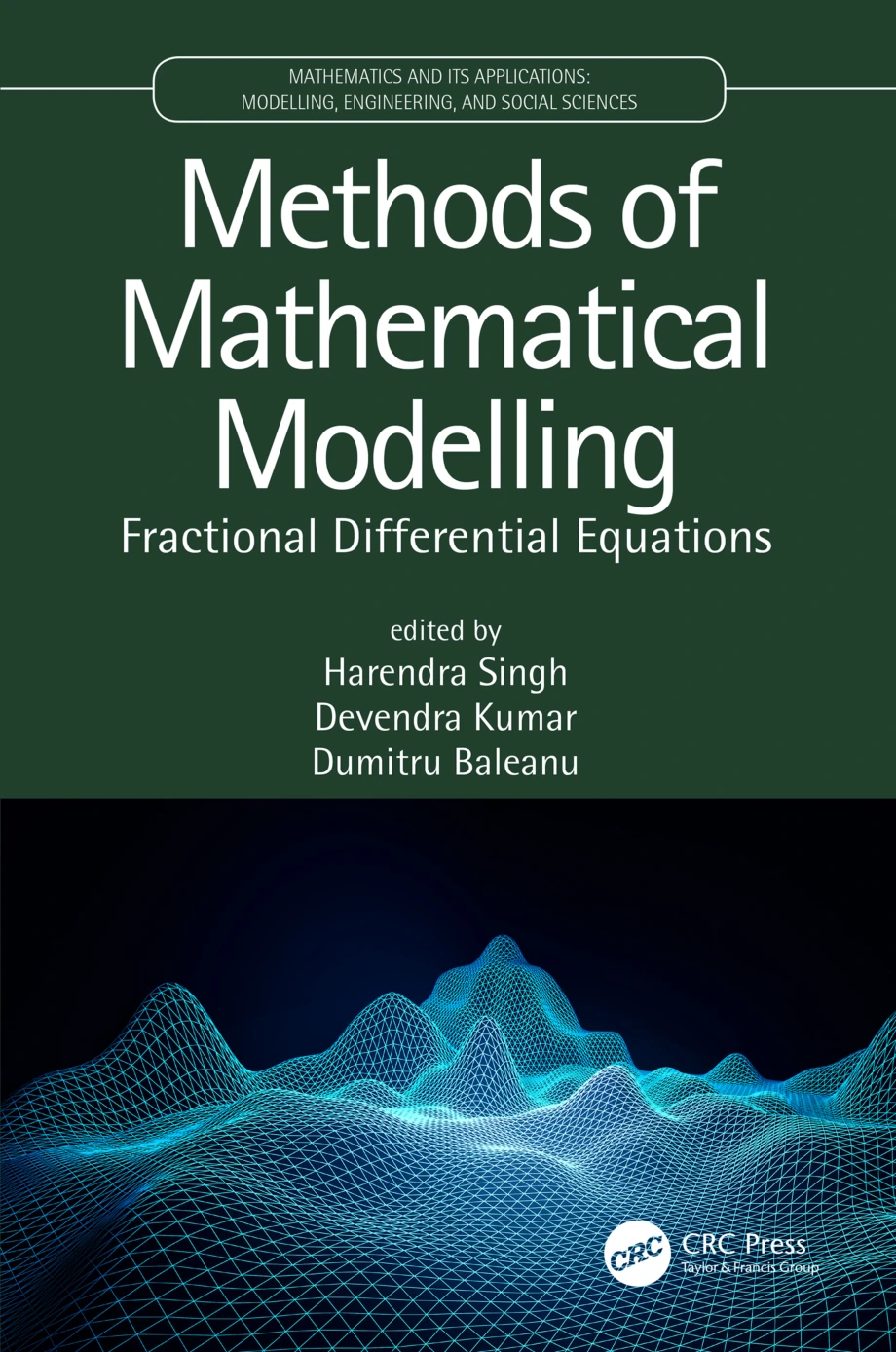
Methods of Mathematical Modelling: Fractional Differential Equations
Original price was: $5.00.$2.50Current price is: $2.50.

Harendra Singh
Product Specs:
- File Type: PDF
- File Size: 11.1 MB
- Book Language: English
- Total Page Count: 255
- Instant Download
A Focused Survey of Fractional Differential Equations
Fractional calculus changes the way differential equations behave. Memory effects, non-local interactions, and anomalous diffusion become part of the model rather than exceptions to it. This edited collection brings together thirteen research chapters that apply fractional differential equations to problems where classical integer-order models often fall short. The editors, Harendra Singh, Devendra Kumar, and Dumitru Baleanu, have assembled contributions that span theoretical analysis, numerical schemes, and applications in chaos, physics, fluid mechanics, and chemistry.
From Chaotic Ecosystems to Nanofluid Flow
The chapters move across a wide scientific landscape. One contribution studies a chaotic tritrophic ecosystem using the Atangana–Baleanu derivative in the Caputo sense. Another examines fractional diffusion with reactive boundary conditions, where particles can adsorb, desorb, or react at a surface. Other chapters address the fractional Lienard equation for oscillating circuits, a Gomez–Atangana–Caputo approximation scheme, fractional optimal control on a spherical region, hybrid nanofluid heat transfer, groundwater moisture models, and chaotic systems described through Caputo, Caputo–Fabrizio, and Atangana–Baleanu operators. Later chapters turn to Zakharov–Kuznetsov equations, chirped solitons in optical metamaterials, and controllability of non-dense delay fractional systems.
Methods That Meet the Problem
What holds the volume together is not a single technique but a willingness to match the method to the model. Readers will encounter spectral formulations, integral-balance methods, q-homotopy analysis, Sumudu transforms, Adomian polynomials, Laplace transforms, and numerical approximation schemes. The collection also compares fractional operators, showing how Caputo, Caputo–Fabrizio, and Atangana–Baleanu derivatives can lead to different behaviours in the same modelling context. For researchers, this comparative approach is one of the book’s practical strengths.
Who Will Use This Volume
The preface identifies graduate students and researchers in mathematical modelling and fractional calculus as the intended audience. The material assumes a working knowledge of differential equations and numerical analysis, so it is best suited to readers who are comfortable with advanced mathematical methods. Applied mathematicians, engineering researchers, and scientists working with anomalous diffusion, control theory, viscoelasticity, signal processing, bioengineering, or fluid mechanics may find relevant chapters, though the book is not an introductory textbook.
Why It Remains Useful
Fractional modelling is still developing, and edited volumes like this one capture a snapshot of active methods and open problems. The chapters are written by different research groups, which means the reader gets multiple perspectives on how fractional derivatives are formulated, solved, and interpreted. For anyone building a research programme around fractional differential equations, the collection offers both specific techniques and a sense of the field’s breadth.
Inside This Digital Edition
This Digital Delights listing provides the full text of Methods of Mathematical Modelling: Fractional Differential Equations. The volume includes a preface, editor and contributor lists, thirteen chapters, and an index. It is a research-oriented reference rather than a casual introduction, and it will be most valuable to readers who already have a foundation in advanced mathematics.
User Reviews
Be the first to review “Methods of Mathematical Modelling: Fractional Differential Equations”
You must be logged in to post a review.
Original price was: $5.00.$2.50Current price is: $2.50.



There are no reviews yet.