

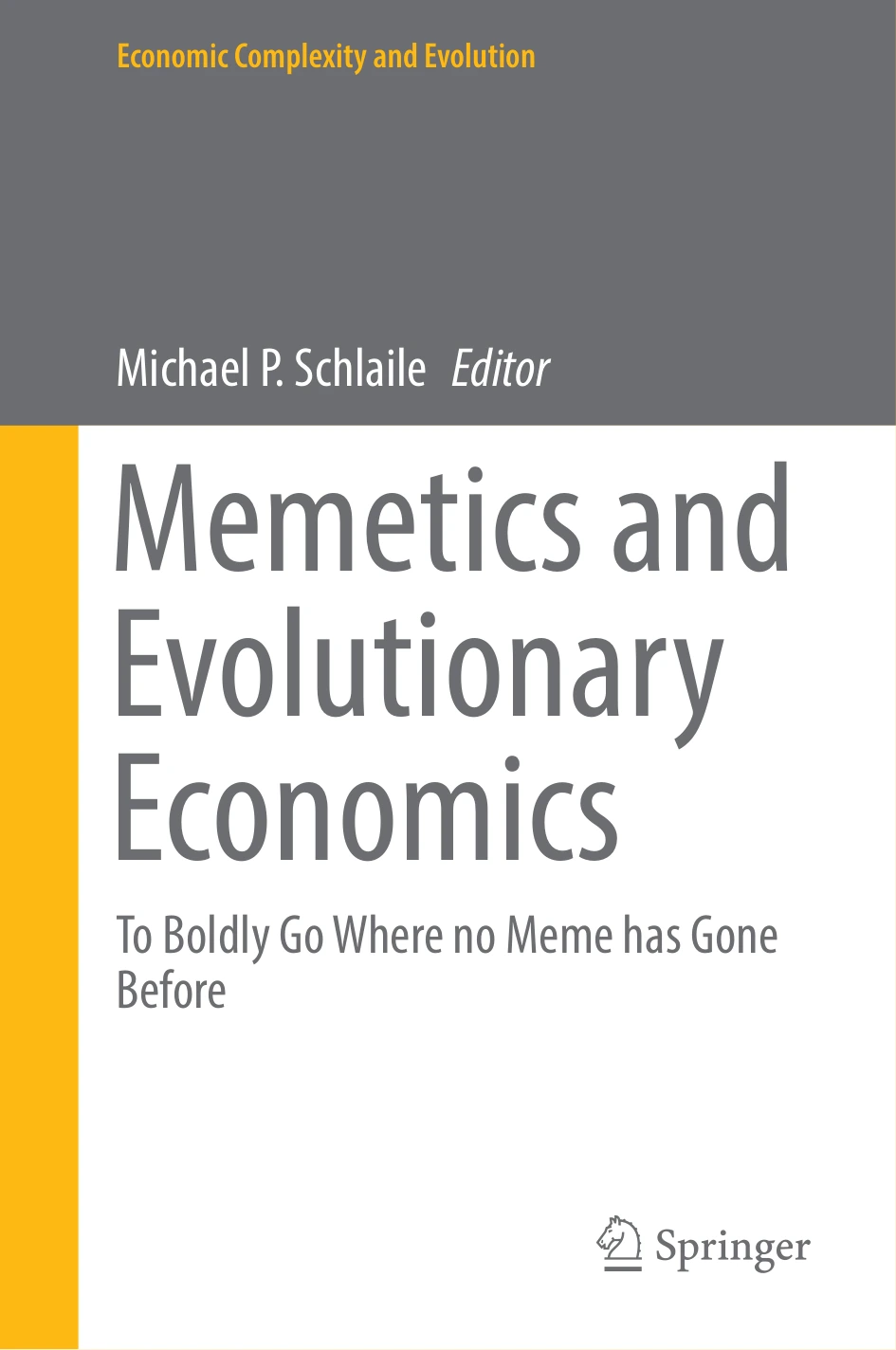
Memetics and Evolutionary Economics: To Boldly Go Where no Meme has Gone Before
Original price was: $5.00.$2.50Current price is: $2.50.

Michael P. Schlaile
Product Specs:
- File Type: PDF
- File Size: 6.1 MB
- Book Language: English
- Total Page Count: 221
- Instant Download
Where Memes Meet Economic Evolution
What if the units of culture—ideas, habits, phrases, rituals—follow evolutionary dynamics that economists cannot afford to ignore? Memetics and Evolutionary Economics takes that question seriously. Edited by Michael P. Schlaile, the volume brings memetics into conversation with evolutionary economics and proposes economemetics as a framework for studying how imitation, replication, creativity, and novelty shape economic and social life.
The book does not treat memes as a gimmick. It asks how cultural replicators might be modelled, how they travel through organizations and networks, and what their diffusion implies for economic theory.
Economemetics as a Research Agenda
At the centre of the book is a simple but ambitious move: if evolutionary economics already borrows from biology, why not also engage with the cultural replicator that Richard Dawkins called the meme? Schlaile and his contributors explore what changes when memetics is taken as a serious analytical partner. The result is an interdisciplinary research programme that touches on innovation, organizational culture, social learning, and the mechanisms by which ideas spread.
Inside the Volume
- Organizational memetics: chapters examine how cultural replication can help capture the complexity of organizational culture.
- Simulation and networks: computational work explores compatibility-based learning in networks of networks.
- Viral diffusion: the ALS Ice Bucket Challenge is analysed from a memetic perspective, showing how a social phenomenon can be studied as a diffusion process.
- Memethics: the book considers the normative implications of memetics, including moral memes and what Dawkins called the changing moral Zeitgeist.
Questions That Drive the Book
Three problems recur. First, can memes be treated as agents, or are concepts such as actants, affordances, and quasi-agents more useful? Second, how should we understand the relationship between replication, remix, creativity, and novelty in economic evolution? Third, what are the ethical stakes of a memetic approach to culture and economics? These questions give the volume its critical edge and make it more than a survey of existing ideas.
How the Book Is Structured
The volume is an edited collection that gathers conceptual chapters and computational studies. It includes a foreword, preface and acknowledgments, and an acknowledgment of previously published work; several chapters first appeared in journals such as the Journal of Business Research, the Journal of Evolutionary Economics, and Cognitive Systems Research. Part of Springer’s Economic Complexity and Evolution series, the book is peer-reviewed and aimed at readers who want to see how memetics might inform economic analysis rather than remain a metaphor.
Who May Find It Valuable
Researchers and graduate students in evolutionary economics, innovation studies, organizational theory, and cultural evolution will find the most direct use for the material. Readers from sociology, social theory, and interdisciplinary complexity studies may also appreciate the book’s attempt to connect memetic theory with economic questions. It is not a lightweight introduction to memes; it is a research-oriented volume that rewards careful reading.
A Bold Interdisciplinary Wager
Memetics and Evolutionary Economics asks readers to take a risk: that a concept often associated with popular culture can be developed into a rigorous tool for understanding economic change. The book’s wager is that cultural evolution and economic evolution are too intertwined to be studied in isolation. For those willing to follow the argument, it offers a distinctive map of where memetics has been, where it might go, and why the journey matters for economics.
User Reviews
Be the first to review “Memetics and Evolutionary Economics: To Boldly Go Where no Meme has Gone Before”
You must be logged in to post a review.
Original price was: $5.00.$2.50Current price is: $2.50.





There are no reviews yet.