

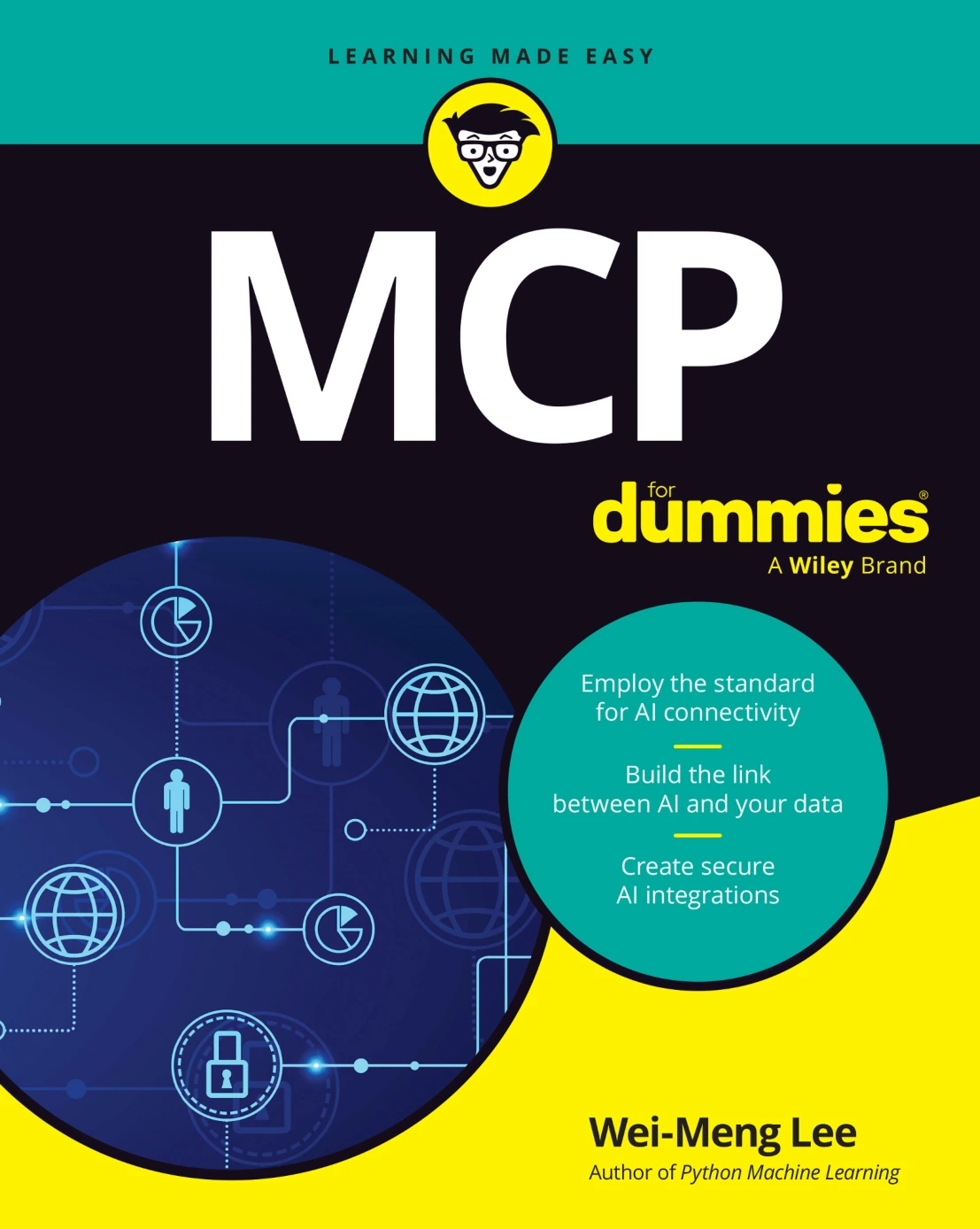
MCP For Dummies
Original price was: $5.00.$2.50Current price is: $2.50.

Wei-Meng Lee
Product Specs:
- File Type: PDF
- File Size: 15.2 MB
- Book Language: English
- Total Page Count: 434
- Instant Download
Plenty of AI projects stall in the same place: the model can reason, but it cannot reach the information it needs. MCP For Dummies is Wei-Meng Lee’s guided tour of the Model Context Protocol — the layer that lets AI clients pull in files, databases, documents, and services through one consistent interface instead of a growing pile of bespoke scripts. The tone is the plainspoken, get-it-working style the For Dummies series is known for, aimed at readers who want results rather than a specification read aloud.
Learn MCP in Small, Buildable Steps 💻
The opening chapters tackle the question most teams eventually ask: why is connecting an assistant to outside data so awkward? From there, the book explains MCP in plain English and separates the protocol into its three core pieces — resources, tools, and prompts — before showing how those pieces combine in real implementations, spanning developer tools and IDE integration through to enterprise knowledge management, data analysis, customer support automation, and personal productivity.
Start with Claude Desktop or Go Straight to the API
Two setup paths are covered: Claude Desktop for readers who want MCP running on a laptop, and API integration for developers wiring MCP into their own applications. The walkthrough covers downloading and installing the client, enabling MCP support, restarting and verifying the setup, and testing with prebuilt servers. A troubleshooting section then unpacks the boot sequence, how a request actually travels, the role of the configuration file, and the practical difference between resources, tools, and prompts.
Your First Project: A Searchable Knowledge Base
The first hands-on build is deliberately useful — connecting an assistant to your own documents. You organize source files, set up a Python environment, convert documents into a consistent format, attach metadata, write an MCP server, add search, wire everything into the client configuration, and refine prompts while reading log files when something misbehaves.
Connect the Data You Already Have
Later sections move to the integrations most workplaces actually depend on:
- SQLite and MySQL databases, including talking to a database in plain English
- Filesystems, CSV files, and PDF documents through the MarkItDown server
- Gmail, covering project creation, enabling the Gmail API, building the credentials file, and configuring the server
- Google Drive cloud storage
Once using other people’s servers feels routine, the book shifts to writing your own: an MCP client over stdio transport, a client using SSE transport, and a client that coordinates several MCP servers at once. A chapter on evaluating server quality and trustworthiness rounds out the discussion with a checklist, the principle of least privilege, red flags to watch for, and a decision framework for building versus buying.
Security, Authentication, and Compliance 🔐
A dedicated chapter examines vulnerabilities, authentication, and encryption, then covers privacy and safe data handling — including keeping secrets out of logs and controlling how long data survives in a cache. Compliance requirements for GDPR, HIPAA, and SOC 2 are explained, and the chapter closes with a security checklist for production deployments.
Agent Behavior, Scale, and Production Realities
The advanced section looks at shaping agent behavior with system prompts, keeping the agent loop under control, and diagnosing the frustrating case where a model simply ignores its instructions. From there it moves to building production-ready solutions, performance, scaling, and reliability, and integrating MCP into systems that already exist. The traditional Part of Tens closes the book with ten essential MCP servers and ten common mistakes, along with practical ways to sidestep them.
Who This Book Suits
Developers, data and platform engineers, and technically minded business readers who want to test an idea before filing a ticket with the engineering team will all find something usable here. Beginners get a working path from installation to a functioning server; experienced practitioners get the security, transport, and production chapters they would otherwise have to piece together from scattered documentation.

Hugging Face in Action
Sold by Wei-Meng Lee Original price was: $5.00.$2.50Current price is: $2.50.






There are no reviews yet.