

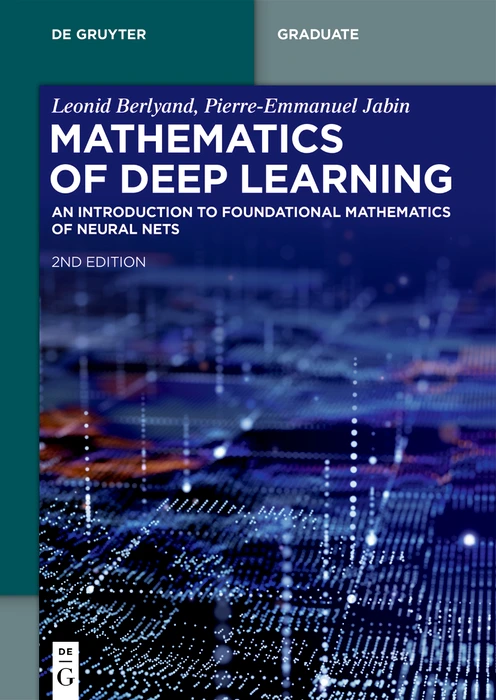
Mathematics of Deep Learning: An Introduction to Foundational Mathematics of Neural Nets, 2nd Revised and Extended Edition
Original price was: $5.00.$2.50Current price is: $2.50.

Leonid Berlyand
Product Specs:
- File Type: PDF
- File Size: 6.0 MB
- Book Language: English
- Total Page Count: 159
- Instant Download
A Rigorous Mathematical Path into Deep Learning
Deep learning is often taught through code, datasets, and architecture diagrams. This book takes a different route. Mathematics of Deep Learning: An Introduction to Foundational Mathematics of Neural Nets treats deep neural networks as mathematical objects and asks what can be defined, proved, and understood with precision. The result is a compact textbook for readers who want the underlying ideas, not just a working implementation.
Written by Leonid Berlyand and Pierre-Emmanuel Jabin, both professors in the Department of Mathematics at Penn State University, the material grew out of a one-semester course for senior undergraduate mathematics majors and first-year graduate students. That origin shapes the book: definitions are stated carefully, theorems are linked to intuition, and each concept is introduced in the simplest setting that still captures the essential mathematics.
What the Book Covers
The opening chapters establish machine learning and classification before moving into the fundamentals of artificial neural networks. From there, the text develops the universal approximation theorem, explains why non-linearity and biases matter, and introduces supervised, unsupervised, and semi-supervised learning. Regression and support vector machines appear as stepping stones toward deeper material, including kernel methods and convex separation.
Later chapters turn to training and architecture. Gradient descent, stochastic gradient descent, batch size, and epochs are discussed with mathematical care. Backpropagation is derived through the chain rule and computational complexity, leading to a detailed treatment of convolutional neural networks: convolution, padding, pooling, equivariance, and invariance.
Why the Mathematical View Matters
Many questions about deep learning have received empirical answers: architectures work, training converges, and certain layers capture useful features. This book does not dismiss those results. Instead, it offers a complementary perspective, showing how those questions can be framed in the language of analysis, linear algebra, and optimization. The aim is not to replace practical machine learning but to give mathematically trained readers a foundation for asking deeper questions.
How the Material Is Organized
Each chapter centers on a key concept. Some chapters can be covered in a single lecture, while others contain enough material for several sessions. Rigorous definitions and statements are supplemented by heuristic explanations and figures, and exercises at the end of major chapters invite active engagement. An appendix reviews the chain rule, and a bibliography and index support further study.
Who This Book Is For
This text is intended for senior undergraduates in mathematics, first-year graduate students, and researchers who want a foundational understanding of neural networks. It will be most useful to readers who are comfortable with mathematical reasoning and want to see deep learning explained in that language. The 2nd revised and extended edition builds on the authors’ teaching experience and reflects the continuing development of the subject.
User Reviews
Be the first to review “Mathematics of Deep Learning: An Introduction to Foundational Mathematics of Neural Nets, 2nd Revised and Extended Edition”
You must be logged in to post a review.
Original price was: $5.00.$2.50Current price is: $2.50.





There are no reviews yet.