

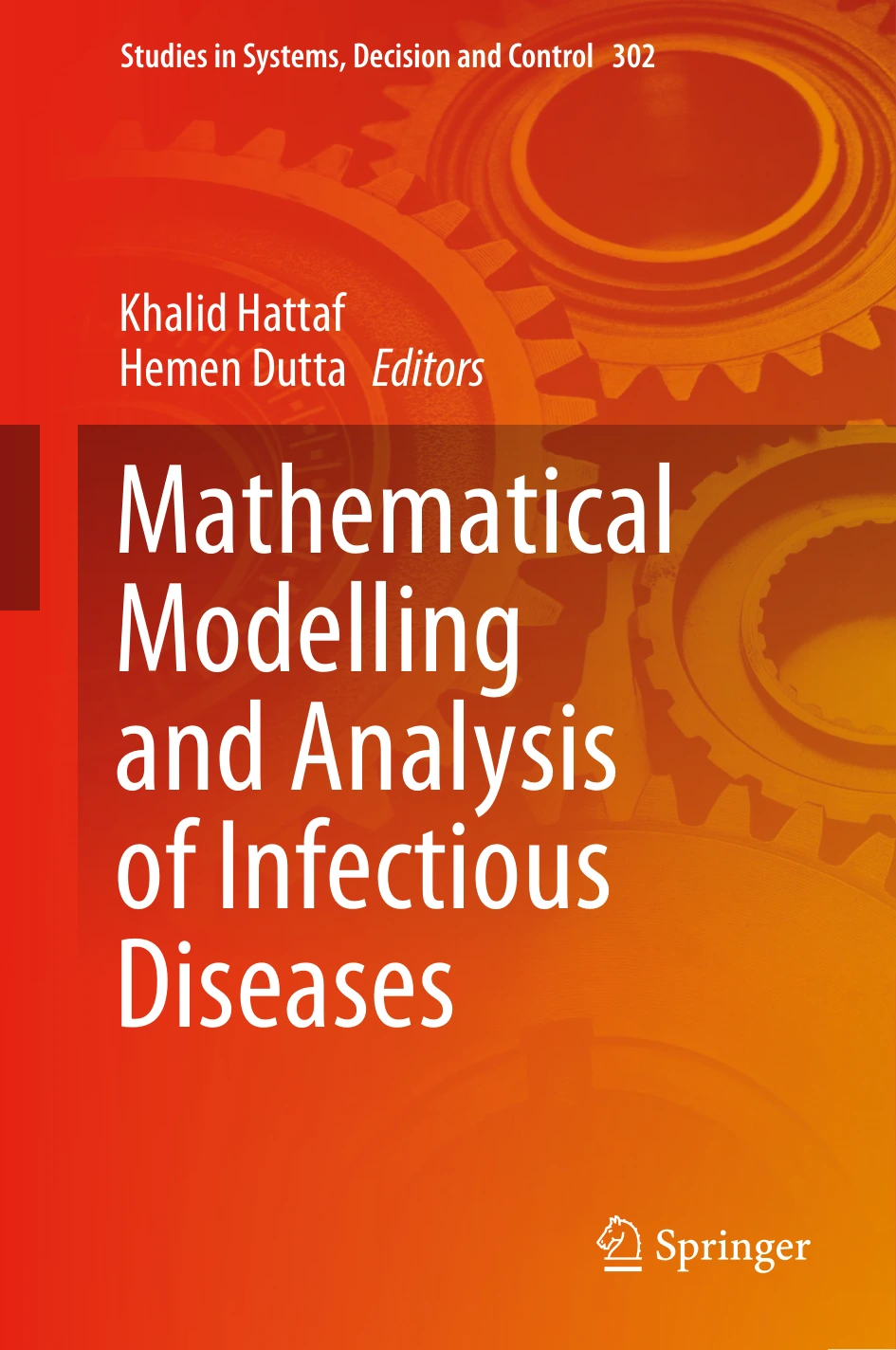
Mathematical Modelling and Analysis of Infectious Diseases
Original price was: $5.00.$2.50Current price is: $2.50.

Khalid Hattaf
Product Specs:
- File Type: PDF
- File Size: 11.6 MB
- Book Language: English
- Total Page Count: 348
- Instant Download
Mathematical Models for a World of Infectious Threats
Infectious diseases remain among the most complex challenges in public health. Mathematical modelling gives researchers a structured way to describe transmission, forecast outbreaks, compare interventions, and explore how diseases might evolve. Mathematical Modelling and Analysis of Infectious Diseases gathers twelve focused chapters that reflect the breadth of modern work in this field.
Published as volume 302 in Springer’s Studies in Systems, Decision and Control series, this edited collection brings together theoretical advances, analytical results, and numerical studies. It is not a single textbook with one voice; instead, it offers a range of perspectives from contributors working on different diseases, mathematical frameworks, and public-health questions.
What the Volume Explores
Across its twelve chapters, the book examines both foundational modelling questions and applications to specific infections. Topics include:
- Stochastic models of pathogen evolution, where transmission and virulence are treated as random variables
- Spatial SIR epidemic models and how the shape of a spatial domain can influence the basic reproduction number
- Nonlinear incidence and treatment rates in disease control strategies
- Delay virus dynamics models with mitotic transmission and cure rates
- Fractional-order hepatitis B models and positivity-preserving numerical schemes
- SICA models for HIV transmission, including deterministic, fractional, and stochastic formulations
- TB-HIV/AIDS co-infection models using fractional derivatives without singular kernels
- A multiparametric risk index for dengue transmission
- Time delay and diffusion effects on wild Aedes aegypti mosquito populations
- Hepatitis B virus dynamics with capsids and immune response
- Ebola virus disease models with post-death transmission and environmental contamination
- Sufficient optimality conditions for delayed optimal control problems
Methods and Analytical Approaches
The chapters draw on a wide mathematical toolkit: ordinary and partial differential equations, delay differential equations, fractional calculus, Lyapunov stability theory, next-generation operators, and optimal control. Several contributions combine rigorous analysis with numerical simulation, allowing readers to see how theoretical thresholds and stability conditions translate into practical disease dynamics. The inclusion of stochastic and fractional models reflects ongoing efforts to capture complexities that classical deterministic systems may miss.
From Theory to Public Health Insight
Although the mathematics is central, the motivation is public health. Models of HIV, hepatitis B, dengue, Ebola, and mosquito populations are developed with an eye toward transmission patterns, treatment strategies, and control measures. The volume does not promise easy answers; rather, it demonstrates how modelling can clarify the conditions under which interventions might succeed or fail. Readers interested in the interplay between mathematical structure and real-world disease behaviour will find plenty of material for deeper study.
Who May Find This Book Useful
The preface identifies researchers, students, educators, scientists, professionals, and practitioners as the primary audience. Graduate students in applied mathematics, epidemiology, or mathematical biology will encounter advanced methods and open problems. Established researchers can use the collection to survey recent developments across multiple disease systems. Public-health professionals with a mathematical background may find the modelling frameworks helpful for interpreting transmission dynamics and control strategies. Because the chapters assume familiarity with differential equations and mathematical analysis, the book is best suited to readers with some quantitative training.
About the Editors
Khalid Hattaf is affiliated with the Centre Régional des Métiers de l’Éducation et de la Formation (CRMEF) in Casablanca, Morocco. Hemen Dutta is in the Department of Mathematics at Gauhati University, India. Their editorial work brings together contributions from an international group of researchers.
Why This Collection Matters
Infectious diseases do not respect borders, and the mathematical tools used to study them continue to evolve. This volume captures a moment in that evolution, offering a compact yet varied reference for readers who want to understand how contemporary modelling approaches address transmission, immunity, treatment, and control. For those building their knowledge of mathematical epidemiology, it is a substantive addition to the literature.
User Reviews
Be the first to review “Mathematical Modelling and Analysis of Infectious Diseases”
You must be logged in to post a review.
Original price was: $5.00.$2.50Current price is: $2.50.






There are no reviews yet.