

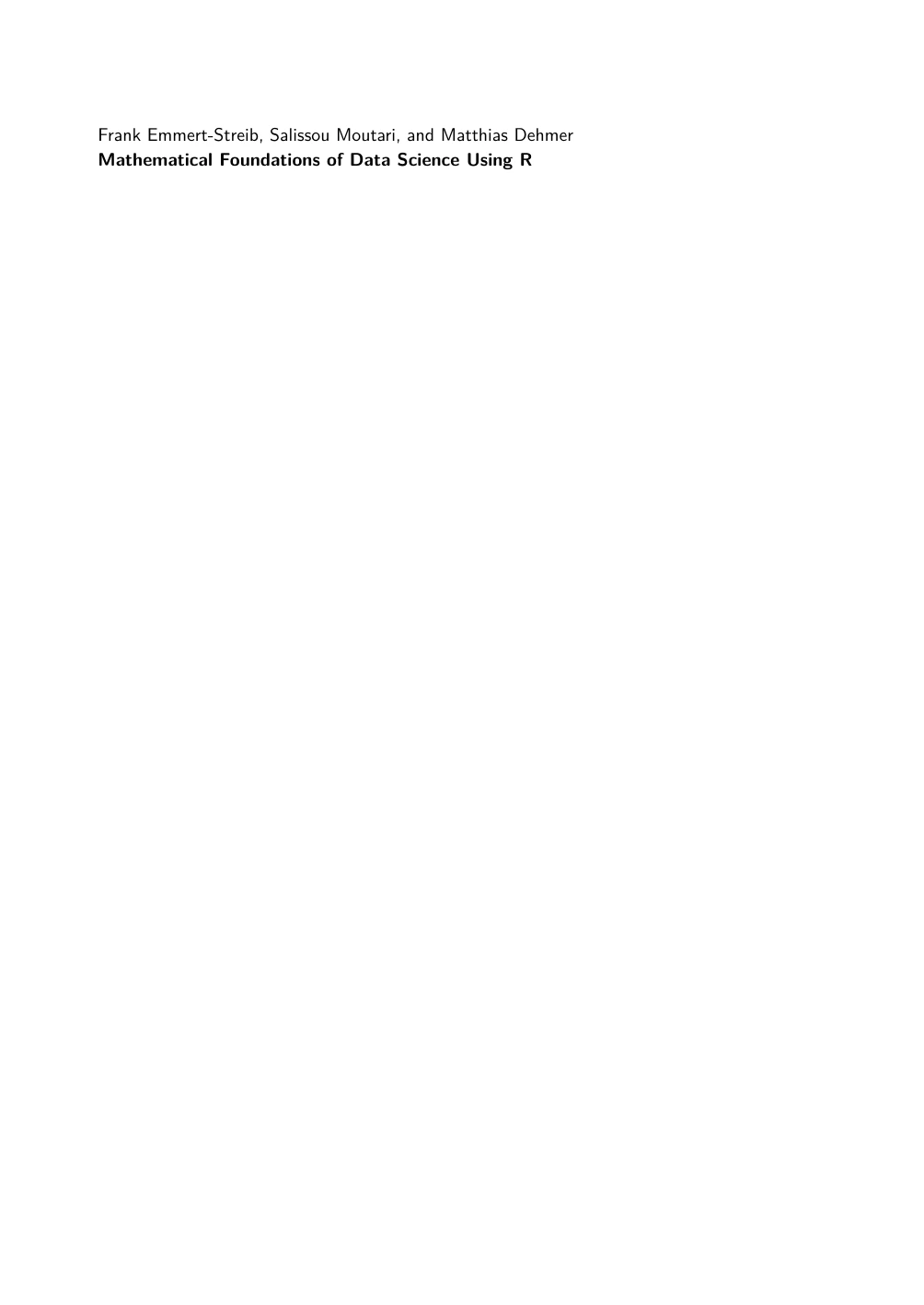
Mathematical Foundations of Data Science Using R
Original price was: $5.00.$2.50Current price is: $2.50.

Frank Emmert-Streib
Product Specs:
- File Type: PDF
- File Size: 42.3 MB
- Book Language: English
- Total Page Count: 424
- Instant Download
Mathematics, R, and the Practice of Data Science
Data science sits at the intersection of computation, statistics, and mathematical reasoning. Mathematical Foundations of Data Science Using R, Second Edition, is built for readers who want more than a surface-level familiarity with the methods they use. Written by Frank Emmert-Streib, Salissou Moutari, and Matthias Dehmer, this De Gruyter STEM textbook connects selected mathematical topics with the practical, algorithmic side of working in R.
The book grew out of the authors’ teaching and supervision experience. Their aim is not to cover every corner of analysis or probability theory, but to present the mathematical ideas that appear repeatedly in a data scientist’s toolkit—and then show how those ideas become concrete through R code.
Three Parts, One Integrated Path
The second edition is organized into three main parts, allowing readers to move from programming fundamentals to visualization and then into the mathematics that supports data science methods.
Part I: Introduction to R
Early chapters cover programming paradigms, installing R and packages, core data structures, functions, string handling, reading and writing data, and building R packages. This section gives readers a working command of the language before the mathematical material deepens.
Part II: Graphics in R
The second part focuses on graphics, from basic plotting functions to advanced work with ggplot2 and network visualization. Visualizing data is treated as part of understanding it, not as a final decorative step.
Part III: Mathematical Basics of Data Science
The final part introduces selected mathematical foundations used across data science, statistics, and machine learning. Theoretical basics are paired with practical examples, so readers can practice concepts side by side with their implementation.
Who This Book Is For
The authors intended the text for undergraduate and graduate students in data science, especially those majoring in computer science, statistics, applied mathematics, information technology, or engineering. It can also suit researchers and practitioners who want to strengthen the mathematical reasoning behind their R workflows.
Because the book combines theory with code, it works best for readers willing to move between mathematical notation and an R session. The result is a text that supports both coursework and self-directed study.
Why the R Connection Matters
R is not just a demonstration tool here. It is the environment where mathematical methods become executable. By pairing selected mathematical topics with R implementations, the book helps readers see how abstract concepts translate into analysis, plotting, and reproducible code.
For learners who have felt that data science methods remain slightly out of reach without the underlying mathematics, this second edition offers a structured route through the foundations—and a practical language for putting them to work.
User Reviews
Be the first to review “Mathematical Foundations of Data Science Using R”
You must be logged in to post a review.
Original price was: $5.00.$2.50Current price is: $2.50.



There are no reviews yet.