
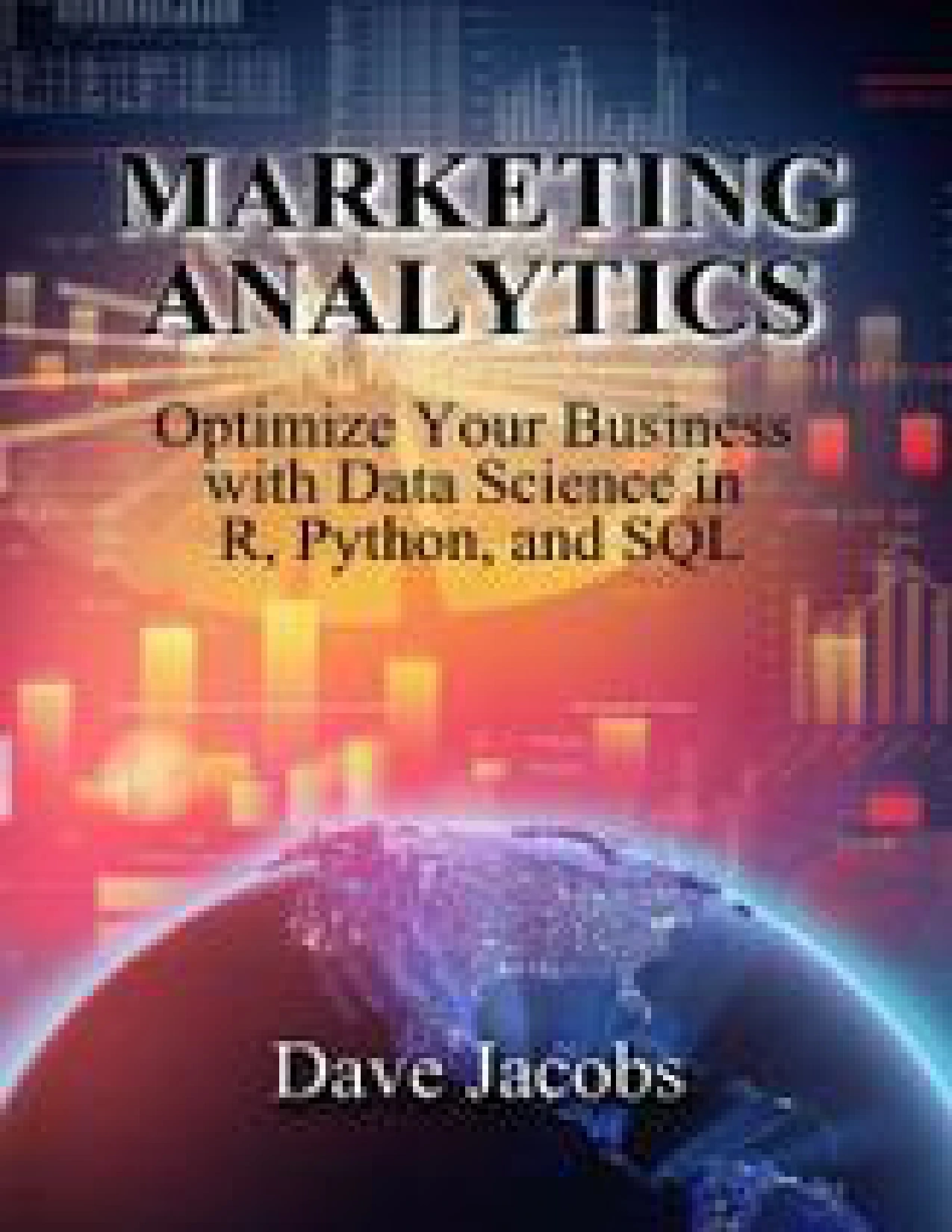
Marketing Analytics: Optimize Your Business with Data Science in R, Python, and SQL
Original price was: $5.00.$2.50Current price is: $2.50.

Dave Jacobs
Product Specs:
- File Type: PDF
- File Size: 14.5 MB
- Book Language: English
- Total Page Count: 164
- Instant Download
Where Marketing Questions Meet Practical Data Skills 📊
Marketing analytics is often taught either as abstract statistics or as software tutorials with little business context. This book takes a different route. Dave Jacobs introduces the methods and the tools together, using examples drawn from real business situations and showing how SQL, R, and Python fit into a working analytics workflow. The result is a guide for readers who want to understand not just how to run a model, but why a marketer or analyst would use it.
Build a Foundation in SQL, R, and Python 💻
The opening chapters cover the essentials of each language and the environments used throughout the book. Readers are guided through installing MySQL, R, and Python, then move into creating databases and tables, learning language basics, importing and exporting data, and preparing for analysis. The book treats the three languages as complementary rather than competing: SQL for querying and managing relational data, R for statistical modeling and visualization, and Python for flexible analysis, including text analytics with NLTK.
From Data Exploration to Predictive Models
Once the foundations are in place, the book moves through a sequence of core analytics tasks. It covers exploring and manipulating data, joining tables, creating and transforming variables, subsetting and sampling, and graphing results. Later chapters introduce linear regression, time series analysis, clustering with k-means, variable identification, segmentation with pivot tables, logistic regression, decision trees, multinomial logistic regression, uplift models, and text analytics. Each method is presented with attention to its marketing purpose, so readers can see how techniques connect to decisions about customers, campaigns, channels, and offers.
Marketing Methods with a Business Purpose
The preface frames the book around outcomes that matter to marketers and business analysts. Readers will encounter approaches for:
- Segmenting customers with pivot tables and statistical measures of significance
- Building predictive models to identify customers or prospects likely to take action
- Determining optimal channel, offer, and message
- Identifying customers most likely to be influenced by marketing
- Creating databases and setting up test and control groups
- Measuring campaign effectiveness and visualizing results
- Forecasting sales and other KPIs
- Understanding customer sentiment through text analytics
Who Will Get the Most from This Book
This guide is aimed at readers who are new to marketing analytics, as well as those who know the methodologies but have not yet worked with SQL, R, or Python. It starts from zero knowledge of the three languages and builds toward a solid grasp of each. Because the examples use accessible tools, readers do not need expensive statistical software to follow along; the book notes that Excel is relatively inexpensive and that R, Python, and SQL are free to use.
A Practical Alternative to Academic Examples
Many technical books rely on examples that are too academic or complex to translate easily into daily business work. This one deliberately uses scenarios faced by real businesses, making the methods easier to connect to actual marketing problems. Companion datasets are referenced to help readers follow the examples more closely. The tone is instructional and grounded, with the aim of helping readers see the meaning inside a mass of data and use that understanding to improve marketing decisions.
User Reviews
Be the first to review “Marketing Analytics: Optimize Your Business with Data Science in R, Python, and SQL”
You must be logged in to post a review.
Original price was: $5.00.$2.50Current price is: $2.50.
There are no reviews yet.