

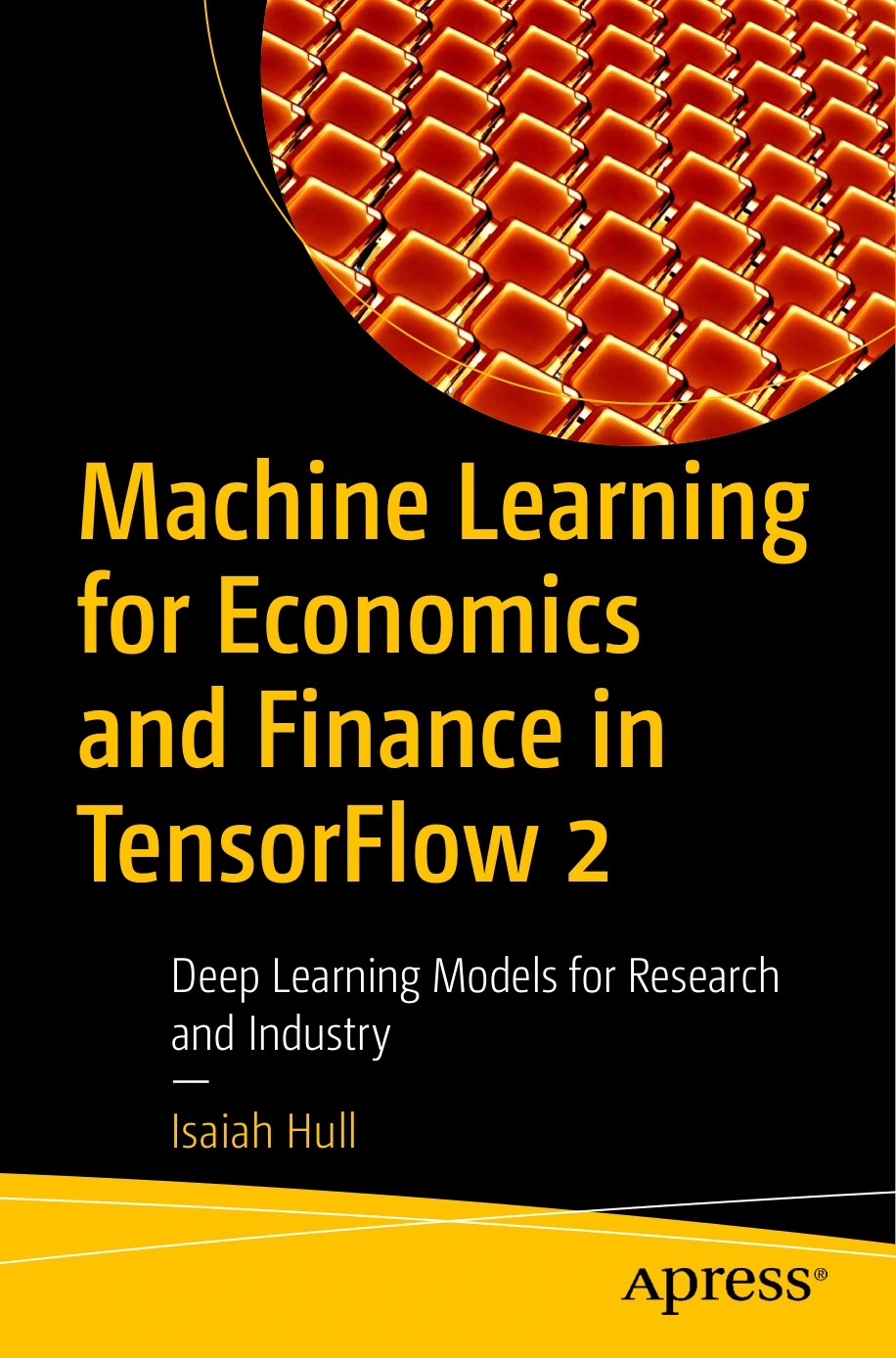
Machine Learning for Economics and Finance in TensorFlow 2: Deep Learning Models for Research and Industry
Original price was: $13.99.$7.00Current price is: $7.00.

Isaiah Hull
Product Specs:
- File Type: PDF
- File Size: 5.7 MB
- Book Language: English
- Total Page Count: 374
- Instant Download
Economic and financial data can pose questions that sit between established econometric methods and newer machine-learning approaches. In Machine Learning for Economics and Finance in TensorFlow 2, Isaiah Hull brings those fields together through examples that connect model-building with problems in economics and finance.
The book starts with TensorFlow fundamentals, then develops a broad tour of machine-learning methods and their empirical applications. Its emphasis is not simply on naming algorithms: readers encounter techniques in the context of questions such as prediction, text analysis, forecasting, and solving theoretical models.
Connect machine learning with economic questions
An early section considers how machine learning relates to economics and traditional econometric practice. From there, the book introduces regression and tree-based methods, giving readers a foundation for understanding how models can be trained, assessed, and applied to economic and financial data.
Explore varied data and model families
The subject matter expands across several kinds of data and analytical approaches. Chapters address image classification, text data and natural language processing, time series, dimensionality reduction, and generative models. Coverage includes neural networks, recurrent models, principal component analysis, autoencoders, variational autoencoders, and generative adversarial networks.
This range makes the book useful for readers interested in how machine learning methods can be selected and framed around different empirical tasks—not just in one algorithm or data type.
Put TensorFlow 2 to work
TensorFlow 2 provides the practical setting for the book’s examples. The opening material introduces tensors, mathematical foundations, and working with data; later chapters use the framework to develop models for applied and theoretical problems. The final section turns to economic models, including examples such as the cake-eating problem and the neoclassical business cycle model.
Who may find it useful?
This book is aimed at students, data scientists working in economics and finance, economists in public or private-sector roles, and academic social scientists. Readers with an interest in computational economics, applied machine learning, or using TensorFlow to explore economic problems will find its cross-disciplinary focus especially relevant.
For readers who want to understand how modern machine-learning tools meet the questions economists and finance researchers actually investigate, this is a focused, example-led introduction.
User Reviews
Be the first to review “Machine Learning for Economics and Finance in TensorFlow 2: Deep Learning Models for Research and Industry”
You must be logged in to post a review.
Original price was: $13.99.$7.00Current price is: $7.00.


There are no reviews yet.