

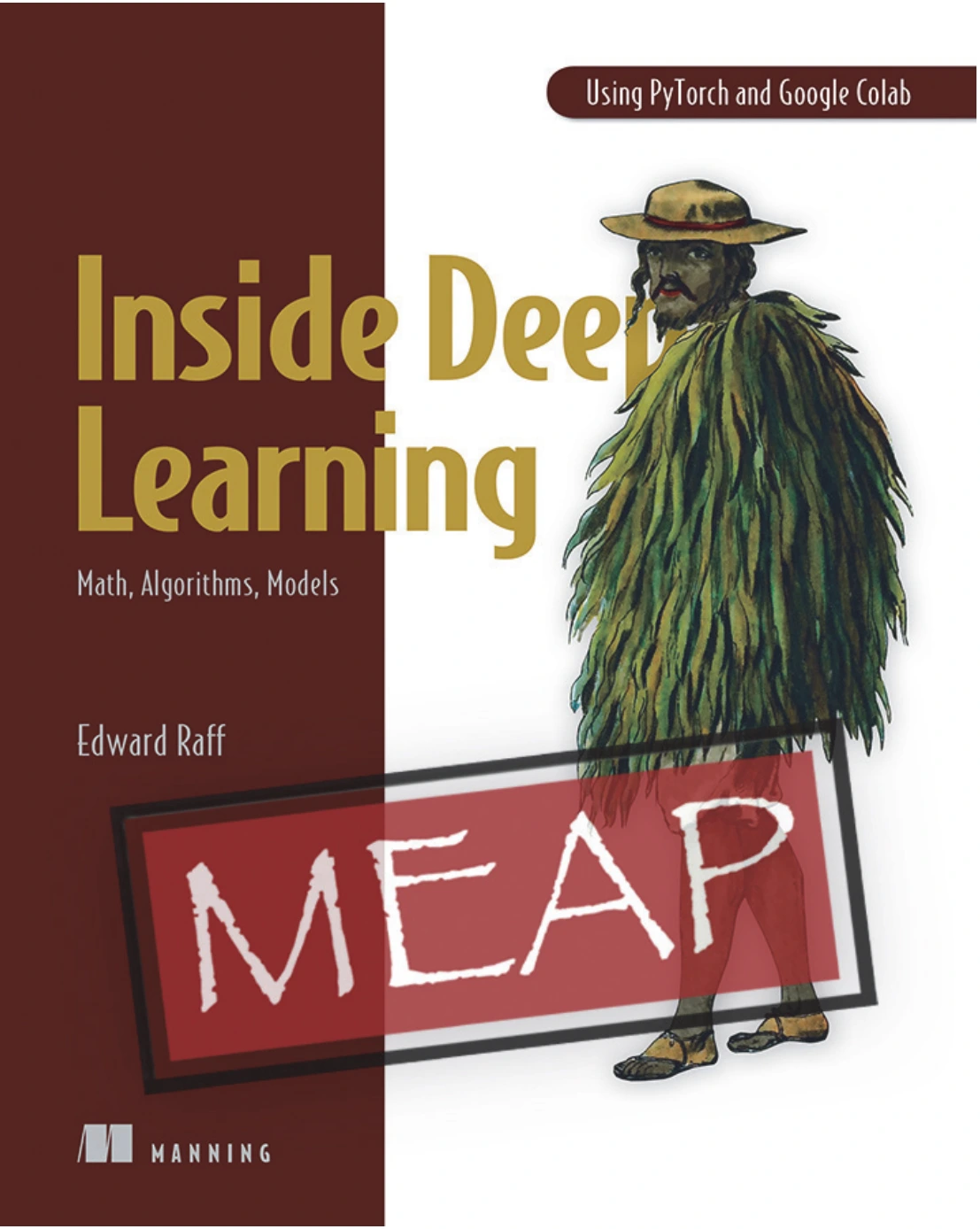
Inside Deep Learning: Math, Algorithms, Models
Original price was: $600.00.$300.00Current price is: $300.00.

Edward Raff
Product Specs:
- File Type: PDF
- File Size: 4.8 MB
- Book Language: English
- Total Page Count: 100
- Instant Download
Deep learning is easier to reason about when its models are more than black boxes. In Inside Deep Learning: Math, Algorithms, Models, Edward Raff presents neural networks as collections of building blocks—techniques readers can understand, implement, and combine for different kinds of problems. This Version 1 MEAP manuscript pairs practical PyTorch programming with explanations of the mathematics and intuition behind the methods.
Start with the mechanics of learning
The opening chapter introduces PyTorch, tensors, GPU acceleration, automatic differentiation, optimization, and the Dataset interface. These foundations show how data and model parameters are represented, and how a network adjusts itself during training.
Build from foundational networks
The manuscript’s first part moves through fully connected, convolutional, and recurrent neural networks before turning to modern training techniques and common design building blocks. Together, these topics establish a working vocabulary for understanding how neural-network architectures are assembled and trained.
Explore more advanced approaches
The second part extends that foundation to autoencoding, object detection, generative adversarial networks, attention, alternatives to recurrent networks, and transfer learning. The emphasis is not simply on naming methods: the book’s stated approach is to connect implementation with an understanding of what the components do and where they may be useful.
Code and mathematical intuition, side by side
Rather than treating deep learning as a collection of snippets to copy, Raff aims to explain the ideas behind the code. The manuscript presents mathematical relationships and builds intuition around them, without setting out to provide full derivations or proofs. That balance can help readers make more informed choices when adapting models to new tasks.
Who this manuscript is for
This material is intended for readers with a firm programming background and some machine-learning experience. Familiarity with basic calculus, linear algebra, and statistics will help with the explanations. Python programmers looking to understand the structure and reasoning behind PyTorch-based deep learning methods will find the subject matter especially relevant.
For readers who want to understand not only how neural networks are built, but how their parts fit together, this early-access manuscript offers a guided route from foundational methods toward more advanced model designs.
User Reviews
Be the first to review “Inside Deep Learning: Math, Algorithms, Models”
You must be logged in to post a review.
How Large Language Models Work
Sold by Edward Raff Original price was: $600.00.$300.00Current price is: $300.00.






There are no reviews yet.