

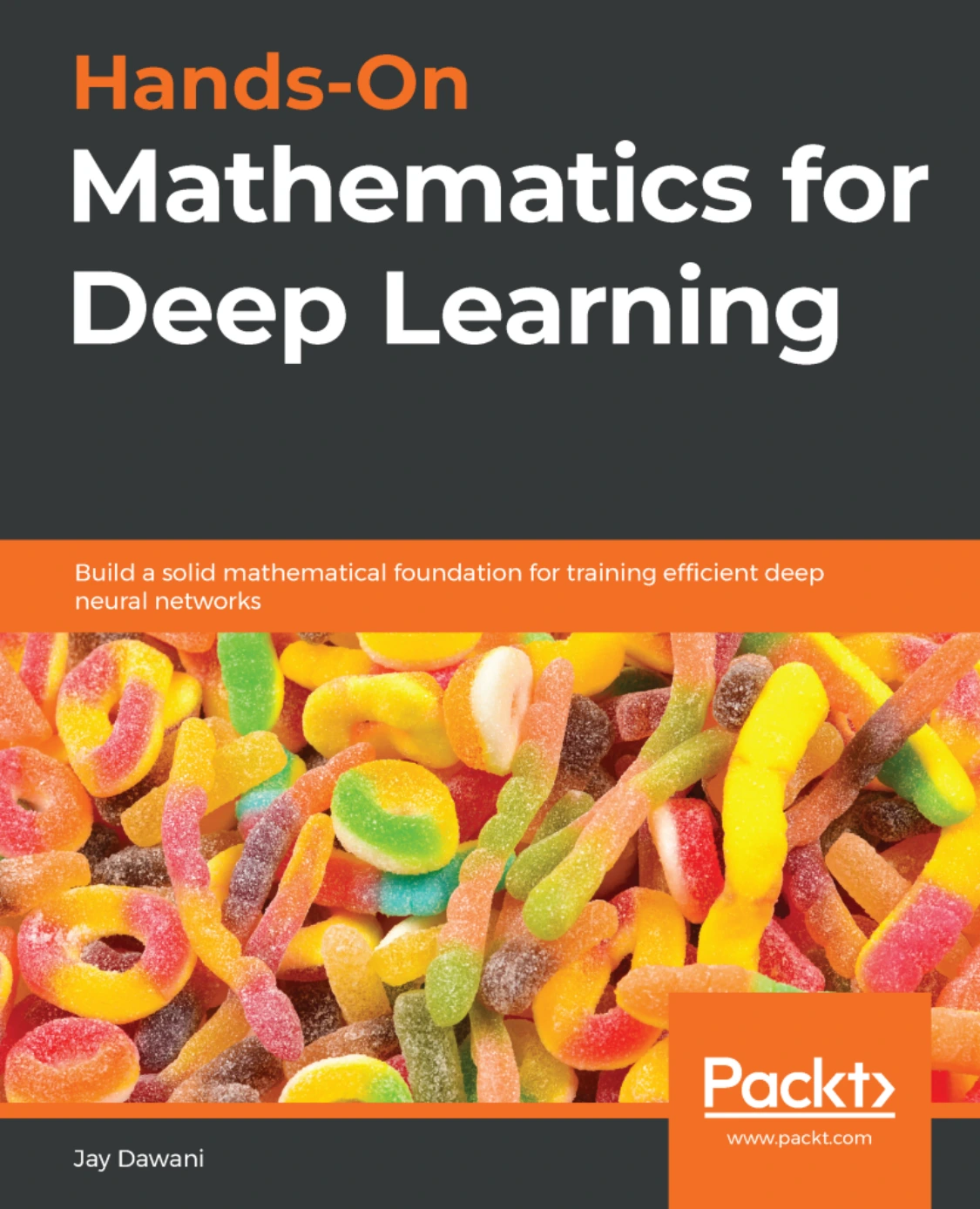
Hands-On Mathematics for Deep Learning: Build a solid mathematical foundation for training efficient deep neural networks
Original price was: $27.89.$13.95Current price is: $13.95.

Jay Dawani
Product Specs:
- File Type: PDF
- File Size: 50.7 MB
- Book Language: English
- Total Page Count: 347
- Instant Download
Deep learning models can feel opaque when the mathematics behind them is out of reach. Hands-On Mathematics for Deep Learning brings those foundations into view, linking core mathematical ideas to the neural networks and learning methods built on them.
Jay Dawani begins with the mathematical toolkit—linear algebra, calculus, probability and statistics, optimization, and graph theory—then turns to neural-network models and their mechanics. The emphasis is not only on naming the pieces, but on understanding how they contribute to training and working with deep learning systems.
Build the mathematical foundation
The opening section moves from vectors, matrices, and matrix decompositions through derivatives, integrals, probability distributions, statistical estimation, and optimization. Graph theory rounds out this groundwork. Together, these topics give readers a way to make sense of the mathematical operations that appear throughout machine learning.
See how neural networks work
The next section introduces linear neural networks and feedforward networks, including perceptrons, multilayer perceptrons, activation functions, loss functions, parameter initialization, and backpropagation. Later topics, as described by Packt, extend to regularization and deep learning architectures such as convolutional neural networks, recurrent neural networks, and generative adversarial networks. ([](
From equations to learning methods
Optimization is a recurring thread: the contents include least squares, Newton and quasi-Newton methods, gradient descent, stochastic gradient descent, momentum, and adaptive methods. Seeing these ideas alongside neural-network training helps clarify how mathematical choices connect to model behavior.
A useful fit for technically curious readers
This book is intended for data scientists and machine-learning developers who want to understand the math beneath deep learning algorithms. Packt says basic machine-learning knowledge is required; a stronger mathematical background may help, but is not essential. If you want to move beyond treating neural-network methods as black boxes, Dawani’s structured progression offers a practical place to strengthen that understanding.
User Reviews
Be the first to review “Hands-On Mathematics for Deep Learning: Build a solid mathematical foundation for training efficient deep neural networks”
You must be logged in to post a review.
Original price was: $27.89.$13.95Current price is: $13.95.
There are no reviews yet.