

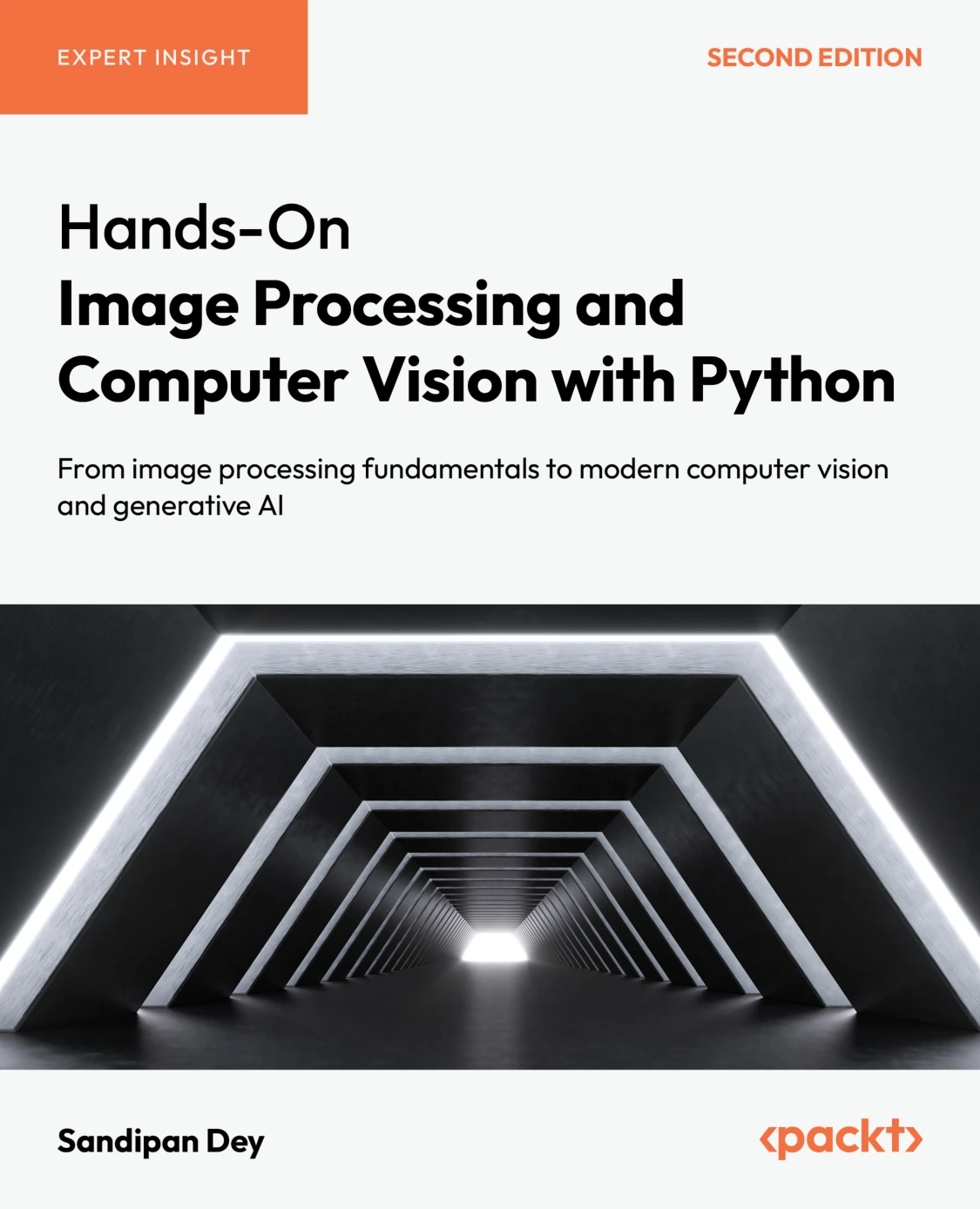
Hands-On Image Processing and Computer Vision with Python: From image processing fundamentals to modern computer vision and generative AI (Second Edition)
Original price was: $35.99.$18.00Current price is: $18.00.

Sandipan Dey
Product Specs:
- File Type: PDF
- File Size: 64.8 MB
- Book Language: English
- Total Page Count: 770
- Instant Download
Images can be cropped, filtered, restored, segmented, classified, and interpreted—and each step calls for a different set of ideas and tools. In this second edition, Sandipan Dey builds a practical route from the fundamentals of digital image processing to contemporary computer vision and generative AI, with Python examples grounding the discussion.
The book’s progression makes it useful both as a learning path and as a broad technical reference: it starts with pixels, color spaces, image formats, and everyday manipulations, then moves into computer vision workflows and newer deep-learning methods. 🖼️
Start with the image itself
Early chapters introduce how digital images are represented and handled in Python. Readers work with image input and output, data types, color spaces, and libraries including PIL, Matplotlib, scikit-image, OpenCV, and Imageio. Practical operations such as cropping, resizing, color adjustment, geometric transformations, and noise manipulation help connect basic concepts to visible results.
Build toward computer vision
From those foundations, the book broadens into image enhancement and restoration, filtering, segmentation, feature extraction, classification, and object detection. The emphasis on implementation gives readers a way to see how individual methods fit into larger image-processing and vision tasks, rather than treating every technique as an isolated formula.
Explore modern learning methods
Later chapters introduce neural-network approaches, including CNNs and Vision Transformers, alongside GANs, diffusion models, foundation models, and vision-language systems. Topics such as image-to-image translation and image generation extend the book’s scope from analyzing visual data to creating or transforming it.
Python tools across the workflow
Examples draw on a range of familiar scientific and machine-learning libraries, including NumPy, OpenCV, SciPy, scikit-image, scikit-learn, TensorFlow, Keras, and PyTorch. That breadth helps readers relate core image-processing ideas to the ecosystems used for modern computer vision work. 💻
Who may find it useful
This book may suit Python programmers, students, data practitioners, and computer-vision learners who want a substantial, example-led treatment spanning classical image processing and newer AI techniques. Its broad coverage also makes it a useful reference for readers choosing a direction for further study or project work.
For readers ready to work from pixels and transformations through to modern visual AI, this second edition brings a wide field of techniques together in one Python-focused volume.
User Reviews
Be the first to review “Hands-On Image Processing and Computer Vision with Python: From image processing fundamentals to modern computer vision and generative AI (Second Edition)”
You must be logged in to post a review.
Original price was: $35.99.$18.00Current price is: $18.00.

There are no reviews yet.