

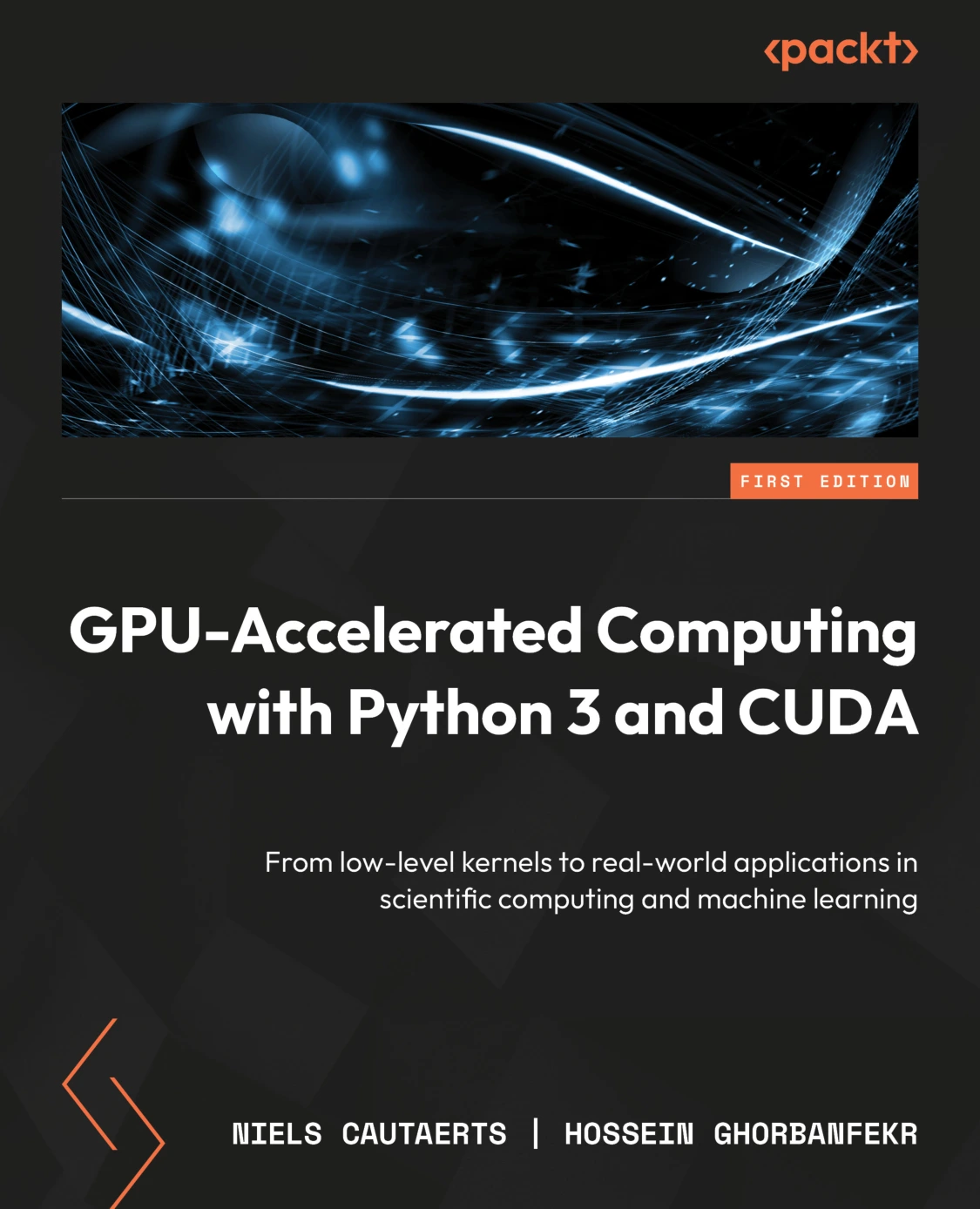
GPU-Accelerated Computing with Python 3 and CUDA: From Low-Level Kernels to Real-World Applications in Scientific Computing and Machine Learning
Original price was: $35.99.$18.00Current price is: $18.00.

Niels Cautaerts
Product Specs:
- File Type: PDF
- File Size: 114.9 MB
- Book Language: English
- Total Page Count: 534
- Instant Download
Python can make numerical work approachable; GPU acceleration can make computationally demanding workloads practical. This book bridges the two, guiding readers from CUDA fundamentals and custom Python kernels toward performance-aware scientific and machine-learning applications. Its focus is not simply getting code onto a GPU, but understanding when parallelism helps, how to measure it, and where bottlenecks can undermine the gains.
Start with the GPU programming model
The book opens with general-purpose GPU computing, CUDA, and the realities of parallel execution. Profiling examples and performance estimates help frame an essential question: does a particular problem actually benefit from GPU acceleration?
Write, debug, and tune CUDA kernels in Python
With those foundations in place, readers work through CUDA kernels using Python tools, including Numba-CUDA. The material addresses execution, thread coordination, race conditions, debugging, and profiling—practical details that matter when moving from a working kernel to code whose behavior and performance are understood.
Follow performance beyond the kernel
GPU speed depends on more than computation alone. The book examines memory access, transfers between host and device, asynchronous execution, and profiling with tools such as NVIDIA Nsight. This broader view helps readers investigate where time is spent rather than assuming the GPU is automatically the answer.
Connect low-level control to higher-level tools
Later material expands into Python libraries and approaches for numerical computing, data work, machine learning, and multi-GPU processing. Examples span scientific simulations, image processing, PDE solvers, and transformer models, showing how GPU programming concepts connect to varied workloads.
Who will find it useful?
Python developers, data scientists, engineers, and researchers working with scientific or numerical code will find a path from core concepts to applied GPU techniques. Familiarity with scientific Python and basic computing fundamentals is a helpful starting point; the book offers both low-level kernel insight and broader library-based methods.
For readers who want to understand what their Python workloads are doing on NVIDIA GPUs—and make informed choices about accelerating them—this is a focused, hands-on guide.
User Reviews
Be the first to review “GPU-Accelerated Computing with Python 3 and CUDA: From Low-Level Kernels to Real-World Applications in Scientific Computing and Machine Learning”
You must be logged in to post a review.
Original price was: $35.99.$18.00Current price is: $18.00.
There are no reviews yet.