

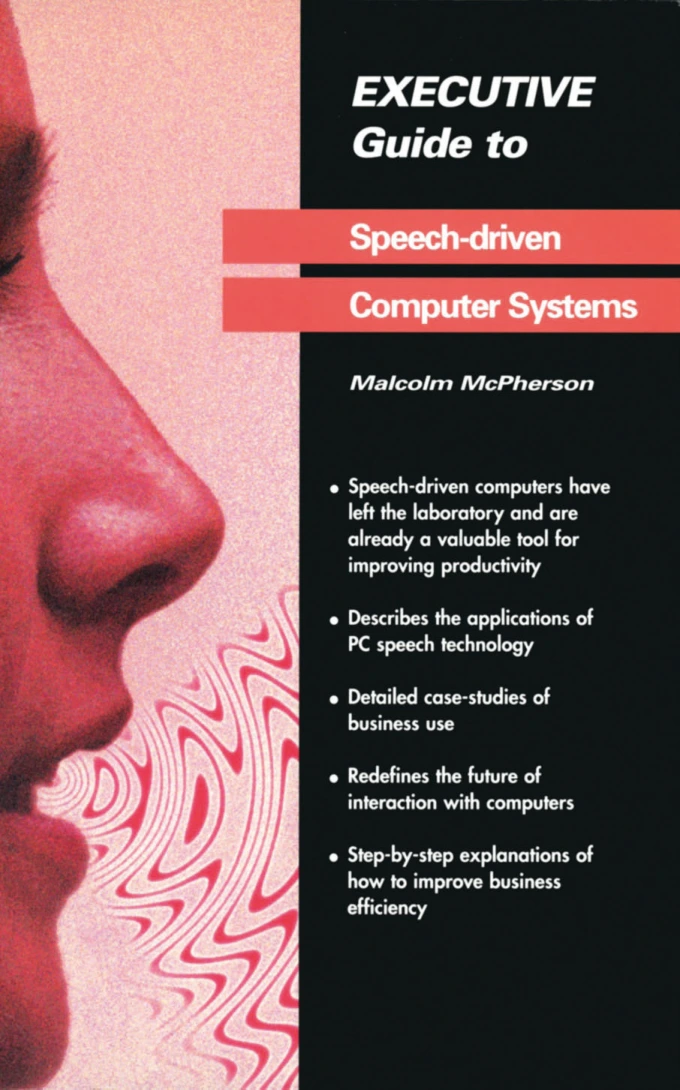
Executive Guide to Speech-Driven Computer Systems
Original price was: $5.00.$2.50Current price is: $2.50.

Malcolm McPherson
Product Specs:
- File Type: PDF
- File Size: 12.2 MB
- Book Language: English
- Total Page Count: 123
- Instant Download
Before voice interfaces became familiar, businesses were already asking a consequential question: what would change if people could work with computers by speaking? In this historically grounded executive guide, Malcolm McPherson examines the speech-recognition systems and workplace possibilities being discussed in the mid-1990s—with an emphasis on practical business decisions, not abstract theory.
The result is both an introduction to speech-driven computing and a snapshot of an important moment in information technology. Its product examples and predictions belong to their period; its central concern—how a new interface might reshape office work—gives the book its lasting historical interest.
How speech recognition works
McPherson explains core distinctions that help readers make sense of speech systems: continuous and discontinuous speech, speaker-dependent and speaker-independent recognition, small and large vocabularies, and different styles of spoken input. These comparisons give executives a vocabulary for understanding what systems could—and could not—do in the book’s era.
From demonstrations to office use
Examples of speech packages and workplace case studies bring the discussion down to earth. The book considers applications in settings such as interior design, legal work, banking, and office administration, showing how the suitability of a system depends on the task and the user rather than on the technology alone.
The technology behind the promise
Later sections survey products then on the market and research questions facing speech-recognition developers. Topics include microphones, sound cards, database searching, template matching, neural networks, and artificial intelligence. The guide connects these technical subjects to the business decisions executives were being asked to consider.
Workplaces, access, and change
The final chapters look at environmental and medical aspects of speech recognition, workplace reorganization, and the technology’s possible effects on executive work. An appendix gathers practical questions for business leaders, including why speech technology matters and what steps an organization might take next.
A mid-1990s view of a changing interface
This book is best approached as a period account, not as a current buying guide to speech software. Readers interested in the history of speech recognition, business computing, human-computer interaction, or earlier expectations about voice-operated offices will find a clear, executive-oriented record of the technology’s ambitions and concerns at the time.
User Reviews
Be the first to review “Executive Guide to Speech-Driven Computer Systems”
You must be logged in to post a review.
Original price was: $5.00.$2.50Current price is: $2.50.






There are no reviews yet.