

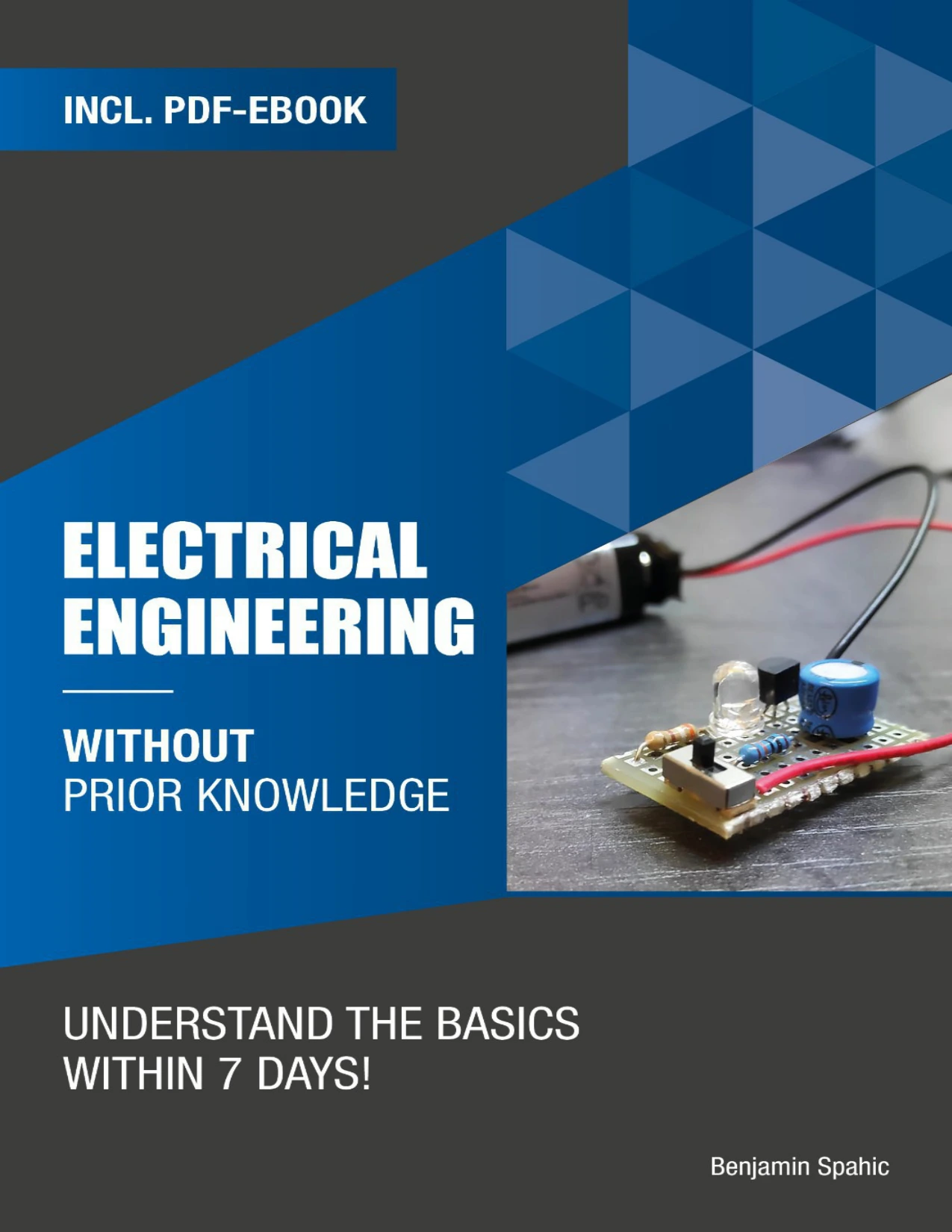
Electrical engineering without prior knowledge: Understand the basics within 7 days
Original price was: $5.00.$2.50Current price is: $2.50.

Benjamin Spahic
Product Specs:
- File Type: PDF
- File Size: 8.2 MB
- Book Language: English
- Total Page Count: 132
- Instant Download
Electrical engineering can feel like a tangle of unfamiliar symbols and quantities until the basics begin to connect. Benjamin Spahic’s introductory guide starts with the math and physics readers need, then follows those ideas into fields, circuits, and the components found in everyday electronics.
The progression is practical: understand what voltage and current mean, learn to read and reason about circuit arrangements, and see how components such as resistors, diodes, transistors, capacitors, and coils behave. Examples and calculations keep the discussion grounded in application rather than theory alone.
Start with the foundations
The opening chapters revisit exponential functions, powers, logarithms, SI units, energy, and power. This groundwork is intended to help readers follow the electrical concepts that come next, especially if mathematics or physics lessons are a distant memory.
From electric fields to working circuits
Spahic introduces atoms and electrical conduction before explaining electric and magnetic fields, potential, voltage, and current. Circuit symbols and arrow conventions help make diagrams easier to interpret, while Kirchhoff’s laws provide a framework for understanding what happens at circuit nodes and around loops.
Meet the components behind the diagrams
Resistor combinations and voltage and current dividers lead into semiconductor basics, including the diode and PN junction, bipolar and field-effect transistors, capacitors, and coils. Seeing these ideas in sequence helps readers connect component behavior with the larger circuit around it.
A practical example to bring it together
The closing application examines an LED switch-on delay, including the circuit and the calculation of its time delay. It offers a concrete setting for applying concepts introduced earlier in the book.
Who may find this introduction useful?
This guide is written for technically interested beginners rather than readers seeking an advanced treatment. Students exploring engineering, career changers, and programmers curious about hardware may appreciate its accessible route through electrical fundamentals.
For readers ready to make sense of voltage, current, and the building blocks of circuits, this book offers a structured place to begin.
User Reviews
Be the first to review “Electrical engineering without prior knowledge: Understand the basics within 7 days”
You must be logged in to post a review.
Original price was: $5.00.$2.50Current price is: $2.50.






There are no reviews yet.