

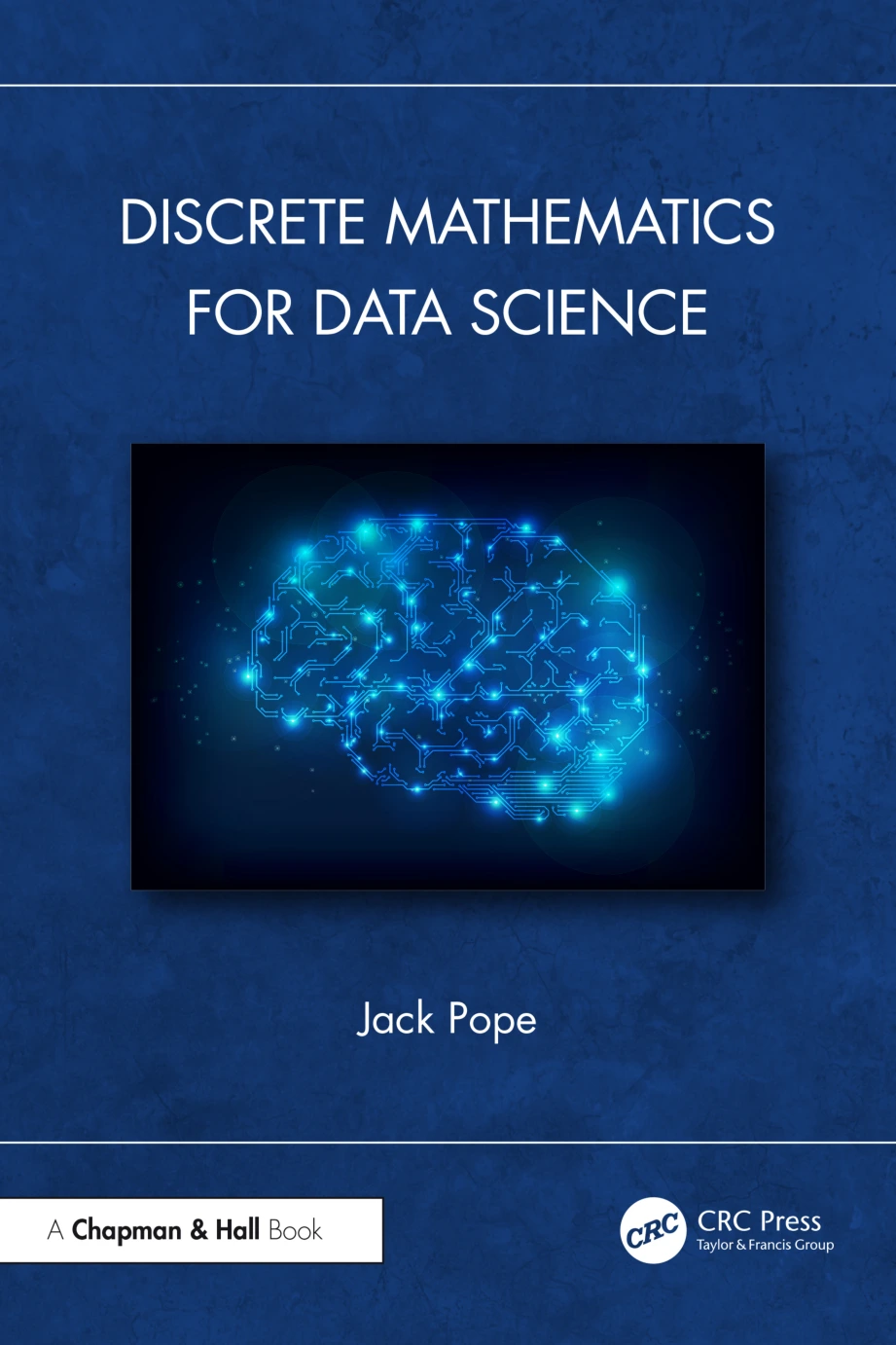
Discrete Mathematics for Data Science
Original price was: $83.44.$41.72Current price is: $41.72.

Jack Pope
Product Specs:
- File Type: PDF
- File Size: 25.4 MB
- Book Language: English
- Total Page Count: 404
- Instant Download
Data science depends on more than collecting and analyzing information: it also relies on the mathematical structures and computational ideas that make data workable. In Discrete Mathematics for Data Science, Jack Pope builds an undergraduate introduction around that connection, moving from problem-solving fundamentals toward the logic, algorithms, and data organization used in computational analysis.
Start with how problems are framed
The opening section treats problem-solving as a skill to practice, introducing pseudocode and ways to systematize problems. From there, the book develops the building blocks behind digital computation: data and abstraction, number systems and conversion, binary arithmetic, and logic. This progression helps place mathematical ideas alongside the computer representations and operations they inform.
Follow the ideas into computational logic
Propositional logic, sets, relations, proof, and computability lead into functions, repetition, recursion, lambda calculus, and algorithm complexity. Together, these subjects give readers a framework for understanding how precise definitions and reasoning connect with procedures and programs.
See how data is organized and analyzed
Later sections turn to data organization and structures, then to analytical topics including permutations and combinations, probability and statistics, multivariate analysis, resampling, information theory, and data dimensions. The broad scope makes the book a bridge between discrete mathematical structures and the kinds of questions that arise in data science.
A textbook shaped for practice
Examples and exercises accompany the material, and the book identifies source code and solutions as supplementary resources. Its stated audience includes undergraduate students in data science and computer science; the accessible approach may also suit readers from neighboring fields who want to understand the mathematical foundations behind computational work.
For students who want the mathematics to feel connected to data and computation—not like a separate set of abstractions—Pope’s text offers a structured route through the concepts and their applications.
User Reviews
Be the first to review “Discrete Mathematics for Data Science”
You must be logged in to post a review.
Original price was: $83.44.$41.72Current price is: $41.72.


There are no reviews yet.