

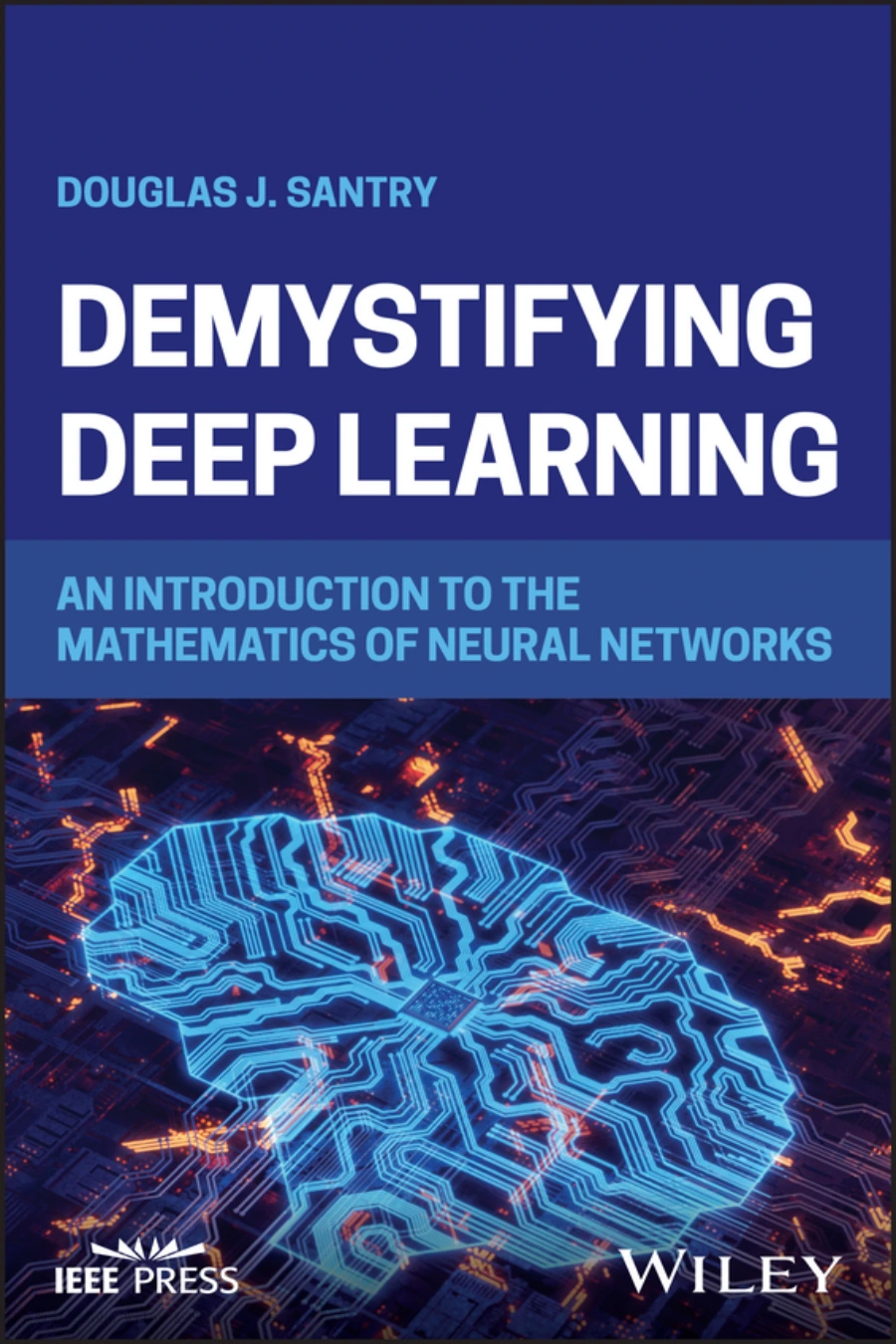
Demystifying Deep Learning: An Introduction to the Mathematics of Neural Networks
Original price was: $104.00.$52.00Current price is: $52.00.

Douglas J. Santry
Product Specs:
- File Type: PDF
- File Size: 5.5 MB
- Book Language: English
- Total Page Count: 259
- Instant Download
Deep learning becomes easier to reason about when its mathematics is connected to the steps a neural network actually performs. Douglas J. Santry’s Demystifying Deep Learning builds that connection, moving from the foundations of artificial neural networks to the algorithms used to train them and the software principles behind their implementation.
Rather than treating neural networks as a black box, the book follows their workings: how a model represents data, how error is measured, and how that error guides changes to the network’s weights. The result is a technically focused introduction for readers who want to understand the machinery behind modern deep learning.
From neurons to working models
The early chapters establish the vocabulary and mathematics of deep learning, including feed-forward networks, activation functions, matrix notation, and classification. Santry then develops the training process through regression, backpropagation, loss functions, and classifier training. These foundations help readers see how individual calculations fit into the larger learning algorithm.
Training is more than one algorithm
Once the basic training loop is in view, the book compares approaches to updating network weights. Topics include stochastic gradient descent, momentum methods, AdaGrad, RMSProp, ADAM, and Levenberg–Marquardt optimization. The discussion gives readers a framework for understanding why training strategies differ and how optimization connects to the behavior of a model.
Convolutions, generalization, and implementation
Dedicated chapters explore convolutional neural networks, including filters, pooling, feature maps, and training. The book also examines generalization error, the bias–variance trade-off, regularization, and batch and layer normalization. Its treatment extends beyond model theory to the design of deep-learning training libraries, with attention to matrices, memory access, and computational structure.
Where neural networks lead next
The closing chapter surveys generative adversarial networks, reinforcement learning, natural language processing, attention, transformers, and neural Turing machines. Chapter-end projects provide opportunities to engage with the material, while an appendix reviews linear algebra, calculus, matrices, and probability.
A mathematical route into deep learning
This book is a strong fit for technically minded readers who want more than a high-level overview of artificial intelligence. Engineers, computing professionals, and advanced undergraduate students can use its structured progression to build a clearer understanding of neural-network mathematics, training methods, and implementation.
User Reviews
Be the first to review “Demystifying Deep Learning: An Introduction to the Mathematics of Neural Networks”
You must be logged in to post a review.
Original price was: $104.00.$52.00Current price is: $52.00.






There are no reviews yet.