

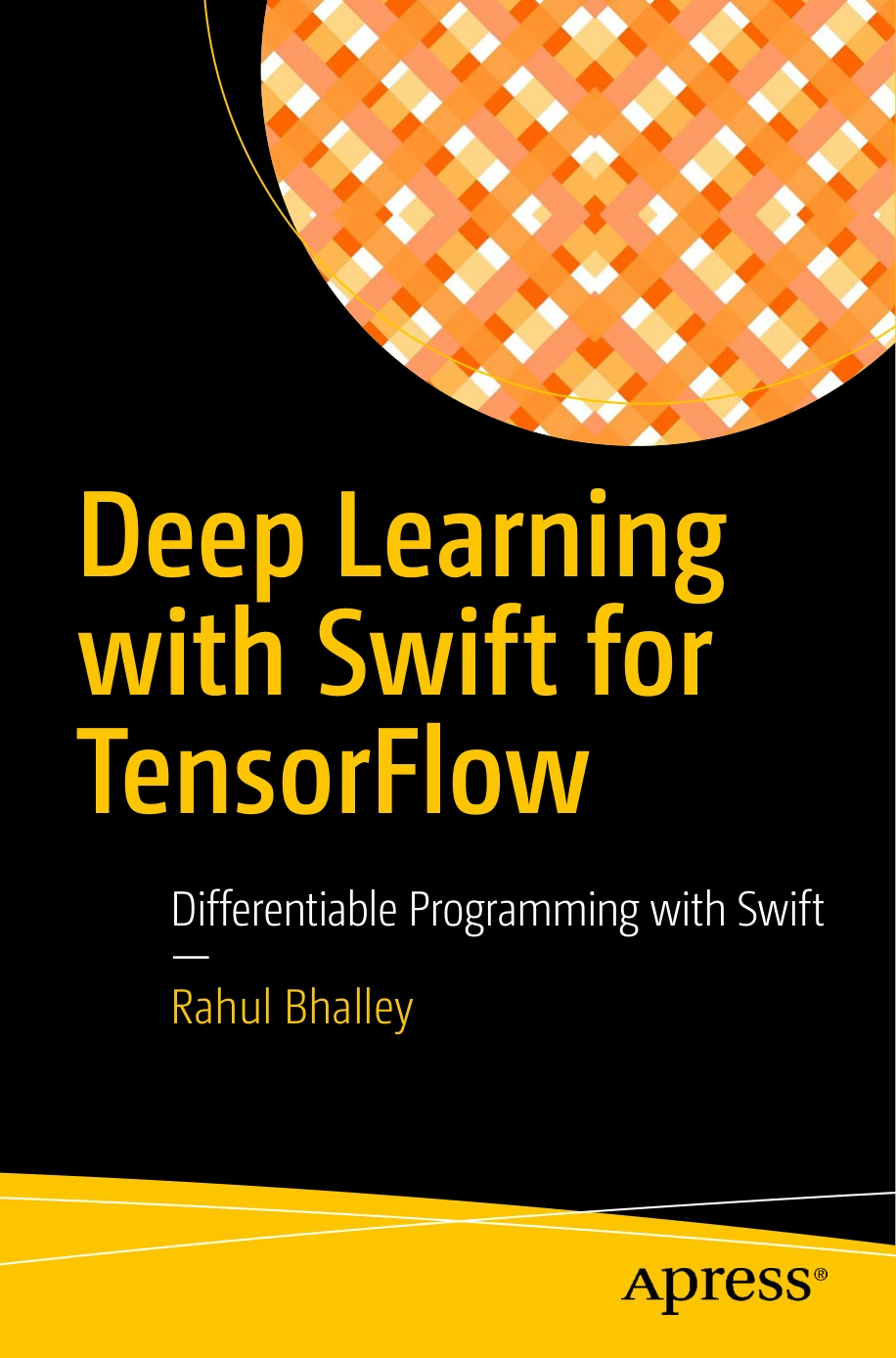
Deep Learning with Swift for TensorFlow: Differentiable Programming with Swift
Original price was: $49.99.$25.00Current price is: $25.00.

Rahul Bhalley
Product Specs:
- File Type: PDF
- File Size: 3.8 MB
- Book Language: English
- Total Page Count: 295
- Instant Download
Deep learning becomes easier to approach when its mathematics, programming tools, and model-building ideas are considered together. In Deep Learning with Swift for TensorFlow, Rahul Bhalley builds that connection step by step, beginning with core machine-learning concepts before moving into differentiable programming, TensorFlow, neural networks, and computer vision.
The book’s distinctive angle is its focus on Swift for TensorFlow: readers encounter both the Swift language and the ideas behind programming machine-learning algorithms, rather than treating deep learning only as a collection of ready-made models.
Start with the ideas behind machine learning
The opening chapter introduces learning paradigms, maximum likelihood estimation, algorithm design, and the bias–variance trade-off. A substantial mathematics chapter follows, covering matrices and vectors, probability, and differential calculus. Together, these foundations give readers context for the optimization and neural-network concepts that come later.
Explore differentiable programming in Swift
The book then turns to differentiable programming, including algorithmic differentiation, its accumulation modes and implementation approaches, and Swift language features such as functions, closures, and operators. Python interoperability also appears in this section, providing another point of connection for readers working across machine-learning tools.
From TensorFlow fundamentals to neural networks
Chapters on TensorFlow basics and neural networks move into training and testing, model optimization, gradient-based optimization, network structures, activation functions, and loss functions. This progression connects the underlying principles with the components used to build and train models.
Computer vision rounds out the subject
The final main chapter examines convolutional neural networks, including convolution layers, dimensions, local connectivity, parameter sharing, translation equivariance, and shortcut connections. It brings the book’s earlier discussions of learning and networks into a focused computer-vision context.
Who may find this book useful
Its broad progression makes the book relevant to newcomers building foundations in machine learning, Swift programmers curious about deep learning, and experienced practitioners interested in differentiable programming. Readers should note that the subject is specifically Swift for TensorFlow, the framework context in which this book was written.
User Reviews
Be the first to review “Deep Learning with Swift for TensorFlow: Differentiable Programming with Swift”
You must be logged in to post a review.
Original price was: $49.99.$25.00Current price is: $25.00.
There are no reviews yet.