

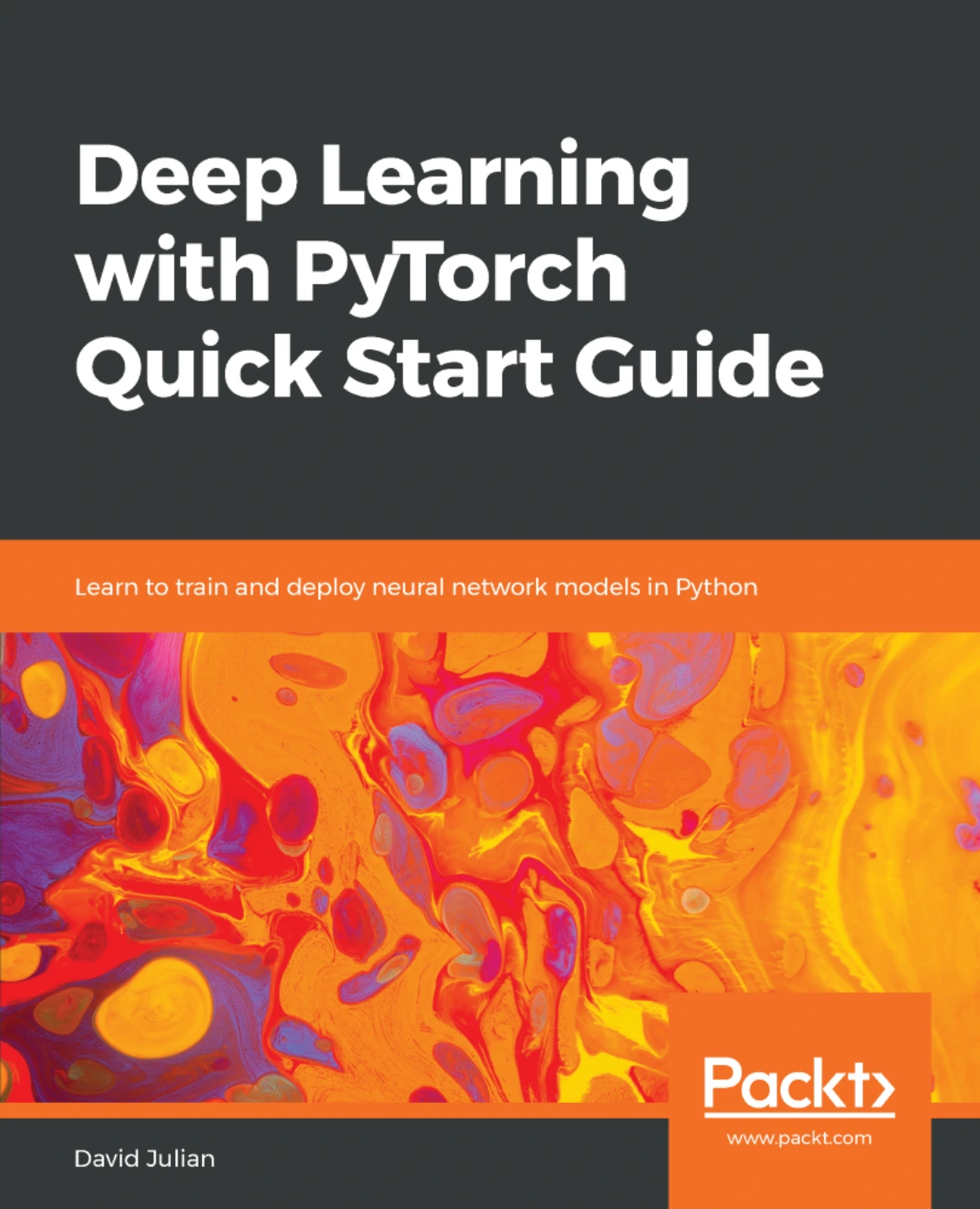
Deep Learning with PyTorch Quick Start Guide
Original price was: $9.99.$5.00Current price is: $5.00.

David Julian
Product Specs:
- File Type: PDF
- File Size: 6.4 MB
- Book Language: English
- Total Page Count: 150
- Instant Download
Deep learning becomes easier to approach when the code and the ideas develop side by side. In Deep Learning with PyTorch Quick Start Guide, David Julian takes readers from PyTorch’s basic operations to working neural-network architectures, with practical examples grounded in Python.
The progression is purposeful: first get comfortable with tensors, datasets, and the mechanics of the library; then build an understanding of the models and training methods that make deep learning work. The result is a hands-on introduction for readers ready to move beyond machine-learning basics and experiment with neural networks.
Start with PyTorch’s building blocks 💻
The opening chapters cover installation, tensor operations, NumPy conversion, indexing and reshaping, and ways to load and prepare data. That foundation makes later model examples easier to follow: readers can see how data moves through the workflow instead of treating training as a black box.
Connect the mathematics to model training
Julian introduces supervised and unsupervised learning, classification, linear algebra, linear and logistic models, gradient descent, and artificial neural networks. The book then connects those ideas to PyTorch’s computational graphs, automatic differentiation, and activation functions—concepts that help explain how model parameters are updated during learning.
Explore image and sequence models
Separate chapters examine convolutional networks, including kernels, pooling, multilayer architectures, and batch normalization, followed by recurrent networks, LSTMs, and a language-model example using a gated recurrent unit. This range gives readers a view of architectures suited to different kinds of data, from images to sequences.
Make more of the PyTorch toolkit
The later material turns to GPUs, multiprocessing and distributed environments, optimizer algorithms, learning-rate schedulers, parameter groups, and pretrained models. These topics broaden the introduction beyond model definitions to the tools used to train and improve models.
Who will find this useful?
This PyTorch deep learning guide is written for readers with working Python knowledge, some machine-learning familiarity, and a grounding in relevant mathematics such as linear algebra and differential calculus. Developers and learners who prefer to understand concepts by trying them in code will find a clear, chapter-by-chapter path through the subject.
For a practical introduction to neural networks in Python, this book brings the essential concepts and PyTorch workflows into one focused learning experience.
User Reviews
Be the first to review “Deep Learning with PyTorch Quick Start Guide”
You must be logged in to post a review.
Original price was: $9.99.$5.00Current price is: $5.00.



There are no reviews yet.