

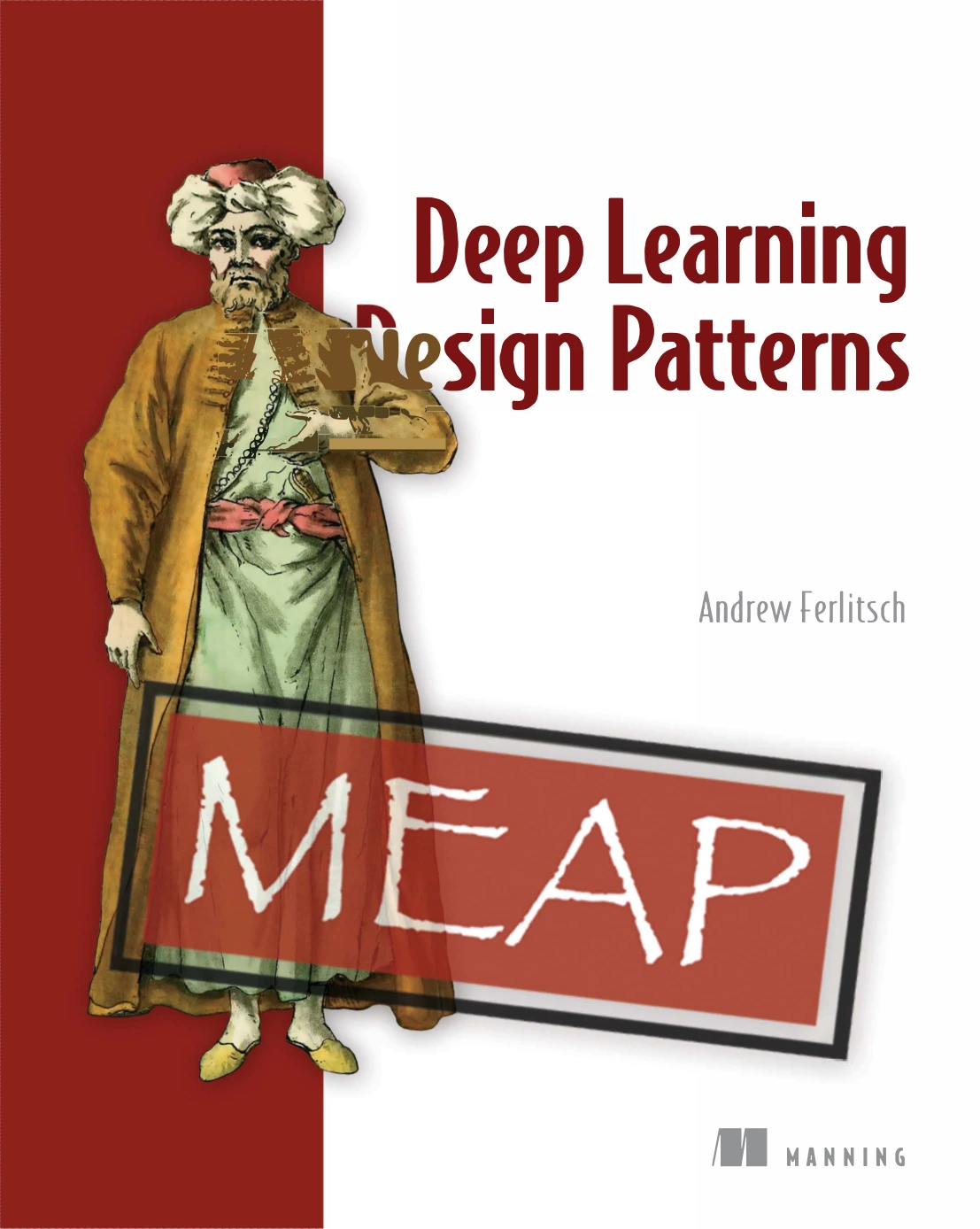
Deep Learning Design Patterns: Version 3 (MEAP Edition)
Original price was: $5.00.$2.50Current price is: $2.50.

Andrew Ferlitsch
Product Specs:
- File Type: PDF
- File Size: 10.6 MB
- Book Language: English
- Total Page Count: 244
- Instant Download
Taking a deep-learning model from an experiment to a production system involves more than choosing a network architecture. This Version 3 MEAP manuscript approaches that challenge through reusable design patterns, arranging its material around the responsibilities and developing expertise of data scientists and machine-learning engineers.
Computer vision is the main setting for its examples, but the book also discusses how its ideas can be adapted to natural-language processing, structured data, and signal processing. It is an early-access manuscript, so this listing identifies the MEAP version rather than presenting it as the later finished edition.
Patterns for models built to work together
The opening chapters introduce production AI and the design choices behind convolutional neural networks, including alternative connectivity patterns and mobile models. Later topics broaden the scope to autoencoders, transfer learning, hyperparameter tuning, and the pipelines used to prepare data and train models.
A recurring idea is to treat models as composable parts of a larger system. The manuscript develops that perspective through subjects including model fusion, model amalgamation, multi-task models, architecture search, knowledge distillation, and self-supervised learning.
A progression from foundations to advanced methods
The contents are divided into three experience-oriented parts: junior, mid-level, and advanced data scientist. That structure gives readers a map through the material, from production-AI concepts and established model patterns to automation and more advanced approaches to combining or training models.
Python and TensorFlow in a practical context
Examples use Python and TensorFlow 2.x with the Keras model API. The author describes the code samples as working examples, while noting that some may appear as components of larger code. The manuscript also describes related code samples and chapter learning materials, making the book part of a broader teaching approach rather than a discussion of architectures alone.
Who may find this manuscript useful
Ferlitsch addresses software engineers, machine-learning engineers, and data scientists at different career stages. Readers beginning with the junior-level material should have basic Python knowledge and some prior exposure to machine learning; foundational concepts are introduced in the book, while a separate primer is identified for novices.
For readers interested in how deep-learning techniques fit into production workflows, this MEAP offers a structured look at the patterns, pipelines, and model-composition ideas behind that work.
User Reviews
Be the first to review “Deep Learning Design Patterns: Version 3 (MEAP Edition)”
You must be logged in to post a review.
Original price was: $5.00.$2.50Current price is: $2.50.




There are no reviews yet.