

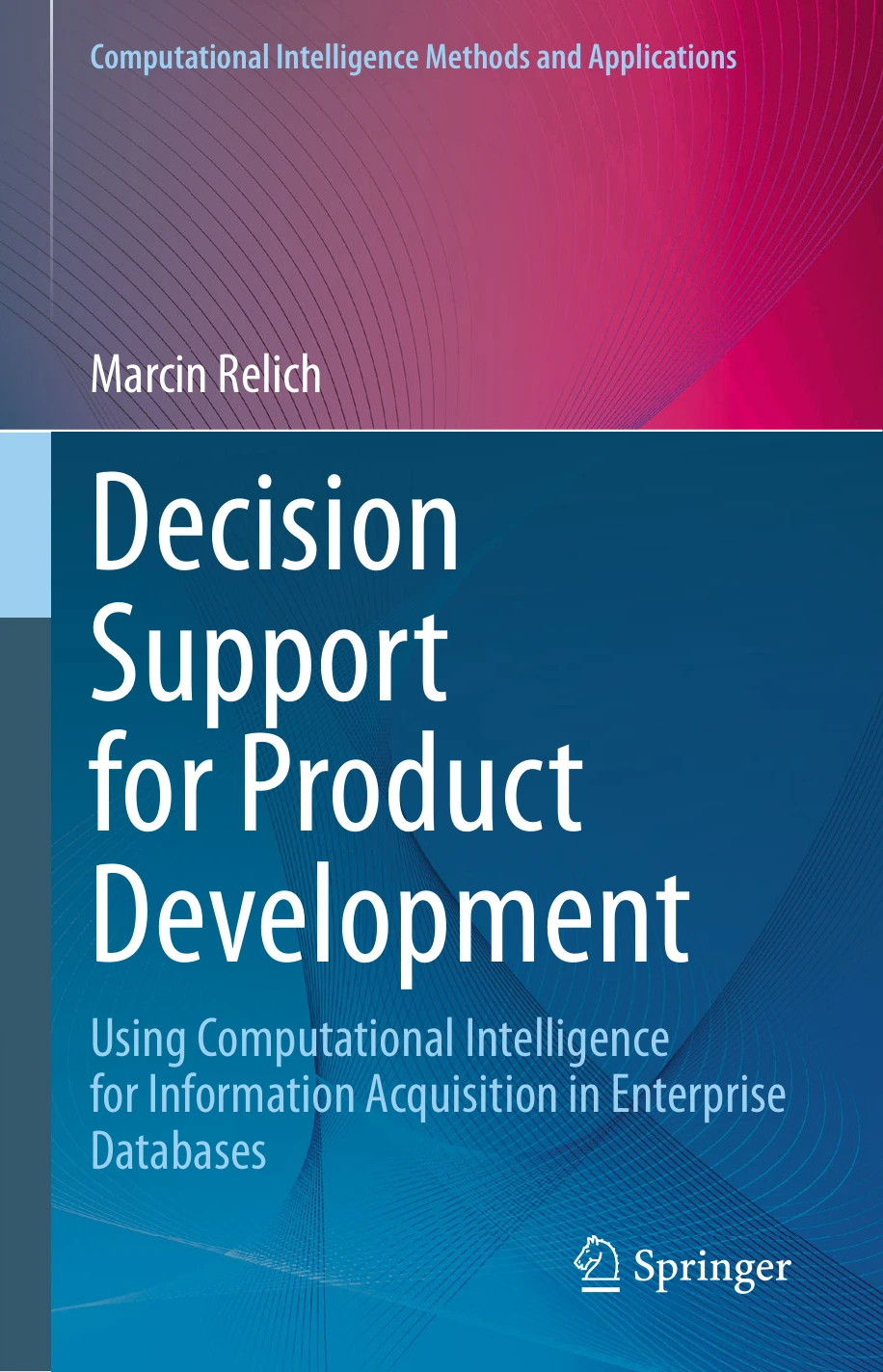
Decision Support for Product Development: Using Computational Intelligence for Information Acquisition in Enterprise Databases
Original price was: $13.99.$7.00Current price is: $7.00.

Marcin Relich
Product Specs:
- File Type: PDF
- File Size: 5.1 MB
- Book Language: English
- Total Page Count: 124
- Instant Download
Choosing which new products to develop is not simply a matter of ranking promising ideas. Each project competes for resources, depends on uncertain assumptions, and may affect the rest of a company’s development portfolio. In Decision Support for Product Development, Marcin Relich sets out a data-informed framework for examining those connected decisions with computational intelligence and constraint-based modeling.
The book focuses on how information held in enterprise databases can help decision-makers evaluate product potential, explore project portfolios, and investigate what conditions might make a desired outcome attainable.
Model the decision, not just the calculation
Relich presents new product development as a system of variables and constraints involving the product, the enterprise, and its business environment. Formulating that model declaratively allows different questions to be addressed within the same framework, rather than relying on a separate fixed procedure for each problem.
The approach covers both forward analysis—estimating outcomes from specified inputs—and inverse analysis, which searches for input conditions that could produce a target result. That distinction matters when a project falls short: the question can shift from “What result should we expect?” to “What would need to change?”
From company data to useful estimates
One central theme is acquiring information from previous project data. The book discusses identifying relevant variables and relationships, then applying artificial neural networks and neuro-fuzzy structures to support estimation when datasets are multidimensional or some judgments are imprecise. It also compares neural-network estimates with multiple regression.
Constraint programming is used to help search for admissible solutions while accounting for dependencies and resource limits—an important consideration when many combinations of project choices are possible.
Portfolio choices and resource allocation
The framework is applied to several related management problems: evaluating a new product’s potential, selecting a portfolio of development projects, scheduling projects, and allocating resources among them. The discussion also considers how a decision support system can help analyze the economic effects of alternative managerial choices.
For readers working across data and product strategy
This research-focused monograph will interest computer and management scientists, students, and practitioners concerned with product innovation, enterprise data, computational intelligence, or decision-support systems. Its particular value lies in bringing modeling, prediction, simulation, and portfolio decisions into one account of new product development.
User Reviews
Be the first to review “Decision Support for Product Development: Using Computational Intelligence for Information Acquisition in Enterprise Databases”
You must be logged in to post a review.
Original price was: $13.99.$7.00Current price is: $7.00.






There are no reviews yet.