

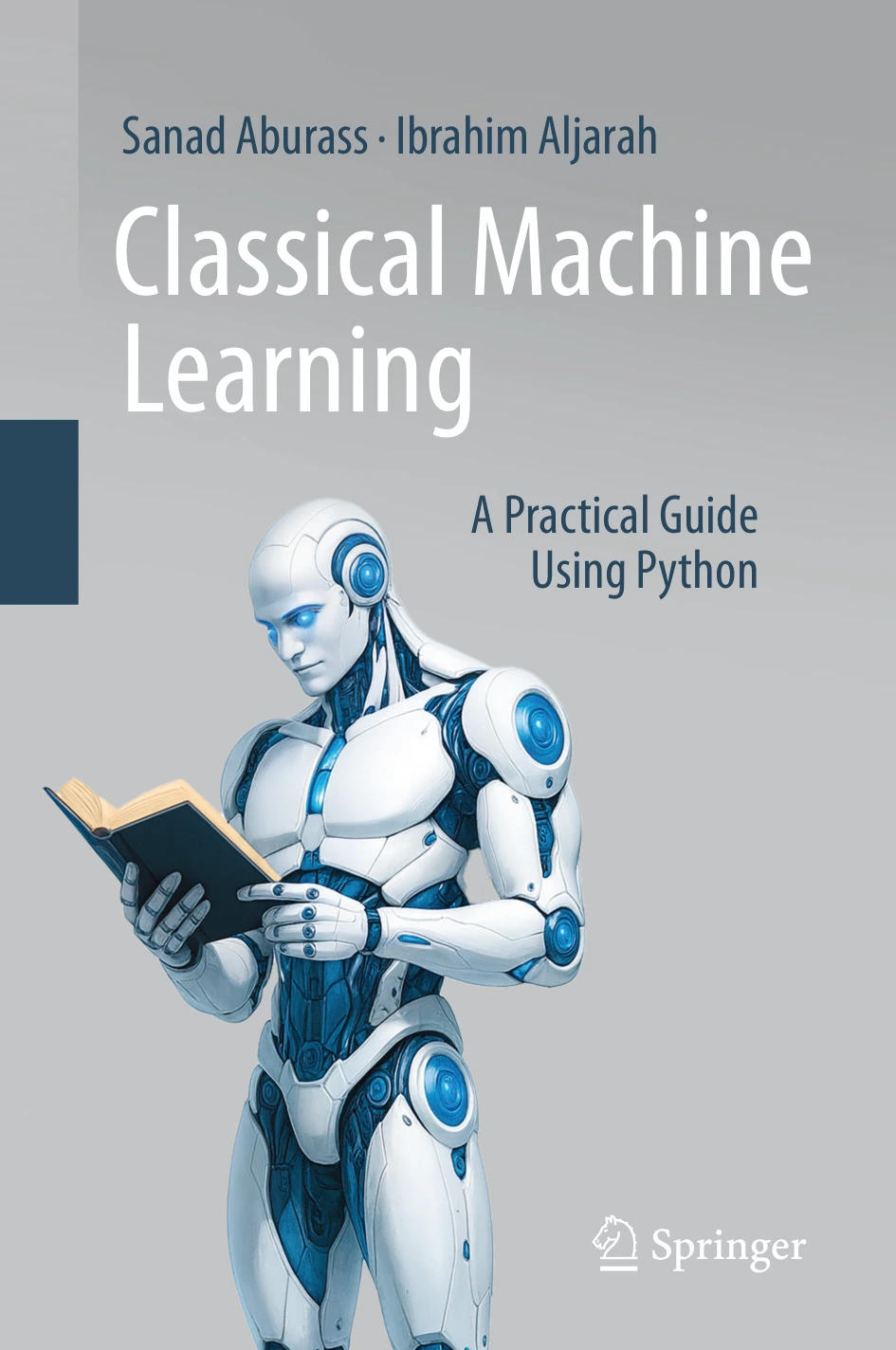
Classical Machine Learning: A Practical Guide Using Python
Original price was: $64.99.$32.49Current price is: $32.49.

Sanad Aburass
Product Specs:
- File Type: PDF
- File Size: 12.4 MB
- Book Language: English
- Total Page Count: 324
- Instant Download
Understanding machine learning means more than knowing which model to call. Classical Machine Learning: A Practical Guide Using Python connects foundational algorithms with the ideas, mathematics, and code behind them, helping readers build a clearer picture of how models learn from data.
Sanad Aburass and Ibrahim Aljarah take a practical, step-by-step approach, beginning with data representation and preparation before turning to prediction, classification, pattern discovery, and neural-network methods. The book is designed for readers ready to work with both the underlying concepts and Python implementations.
Start with the data
The opening material explores data preprocessing and feature engineering, including how features are represented across different data types. That foundation sets up the later discussions of learning algorithms: the quality and form of the information supplied to a model matter to the patterns it can identify.
From regression to ensembles
Readers encounter linear and logistic regression, Naïve Bayes, decision trees, and random forests. The discussion then broadens to ensemble learning, including AdaBoost and gradient boosting. Together, these topics introduce approaches for predicting values, assigning categories, and combining models.
Find structure beyond labeled data
The unsupervised-learning material covers K-Means and DBSCAN clustering alongside principal component analysis (PCA). These methods offer different ways to investigate unlabeled data, discover groupings, and reduce dimensionality.
Build toward neural networks 💻
Later chapters introduce artificial neural networks, convolutional operations, convolutional neural networks, recurrent neural networks, and transfer learning. The book also presents Cubixel representation as an emerging idea in image processing. The progression connects classical machine-learning foundations with neural-network and computer-vision concepts.
Theory paired with Python
Mathematical explanations sit alongside practical implementations using commonly used Python libraries such as NumPy, pandas, scikit-learn, and TensorFlow. Readers should have working knowledge of linear algebra and calculus, as well as some familiarity with Python, to follow the material comfortably.
For students, researchers, and practitioners seeking a structured introduction to established machine-learning methods, this guide brings algorithms, mathematical ideas, and hands-on coding into one learning path.
User Reviews
Be the first to review “Classical Machine Learning: A Practical Guide Using Python”
You must be logged in to post a review.
Original price was: $64.99.$32.49Current price is: $32.49.

There are no reviews yet.